
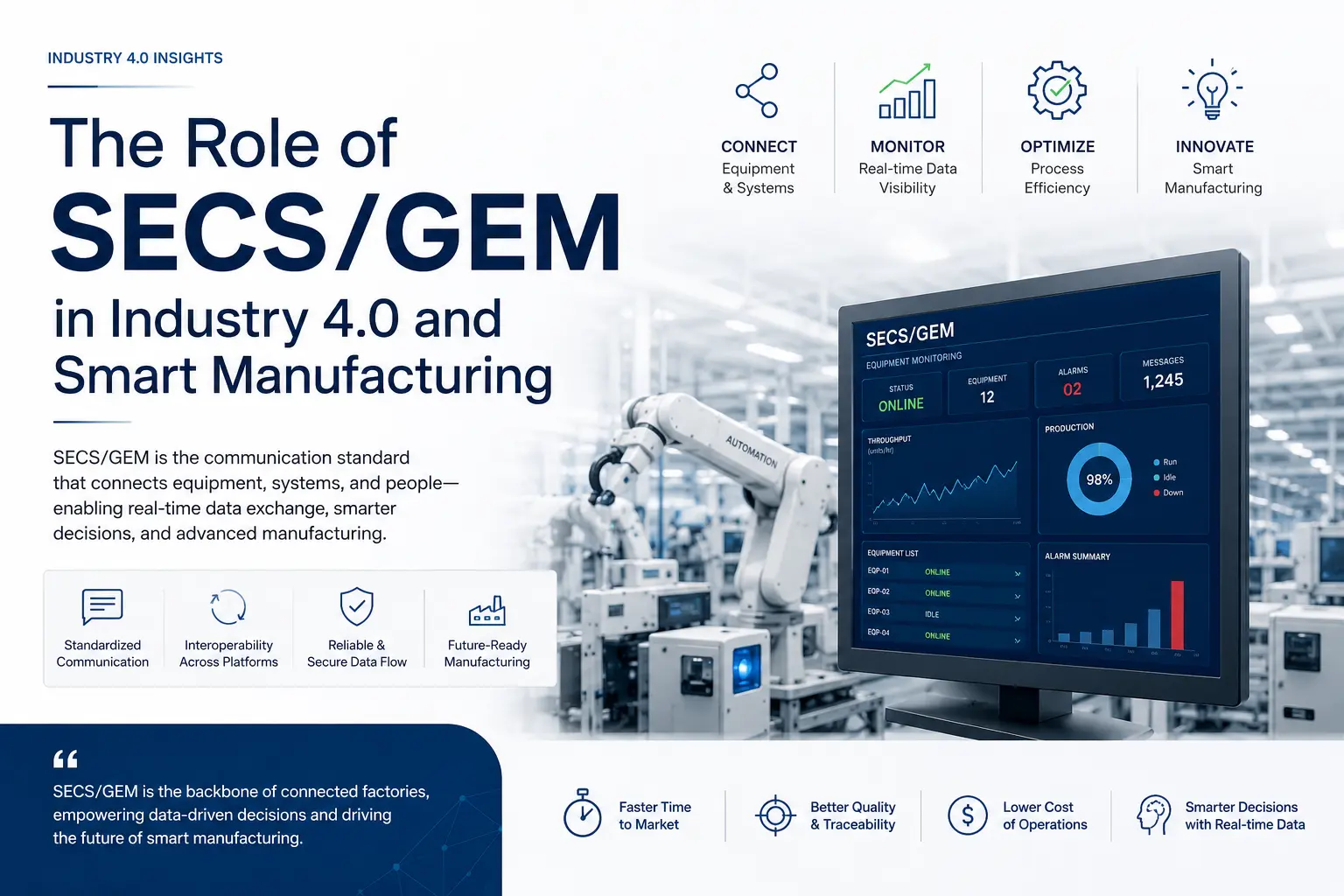
The semiconductor industry is moving toward smarter and more automated factories. Modern semiconductor fabs use advanced equipment, MES platforms, automation systems, sensors, and data analytics to improve production. However, all these systems need to communicate with each other to work effectively.
This is where SECS/GEM in Industry 4.0 becomes important. SECS/GEM helps semiconductor equipment communicate with factory systems such as MES, CIM, monitoring platforms, and data analytics applications.
In simple terms, SECS/GEM acts as a communication link between semiconductor equipment and factory software. It helps manufacturers collect equipment data, monitor machines, automate processes, and build a more connected manufacturing environment.
A simple Industry 4.0 equipment communication flow looks like this:
Semiconductor Equipment → SECS/GEM → MES/CIM → Data → Analytics/AI → Smart Manufacturing
What Is SECS/GEM?
SECS/GEM is a communication standard widely used in semiconductor manufacturing. It allows semiconductor equipment to communicate with host systems used to manage and monitor factory operations.
During manufacturing, equipment generates information such as machine status, alarms, process values, events, and production information. SECS/GEM provides a standard way to exchange this information between the equipment and host system.
What Can SECS/GEM Support?
SECS/GEM can be used for activities such as:
- Equipment status monitoring
- Equipment data collection
- Alarm reporting
- Event notification
- Remote commands
- Process monitoring
- Recipe-related communication
- Production tracking
- Equipment automation
- MES integration
SECS/GEM can also support two-way communication. This means a host system can receive information from equipment and send supported commands back to the equipment.
Why SECS/GEM Matters for Industry 4.0
Industry 4.0 focuses on connected machines, automation, real-time data, and intelligent decision-making. A smart factory needs equipment to communicate with software systems so that information can move quickly between the factory floor and higher-level applications.
SECS/GEM helps provide this connection in semiconductor manufacturing. Instead of keeping equipment information isolated, manufacturers can make supported equipment data available to factory systems.
This can help reduce manual monitoring and improve visibility into equipment and production activities.
SECS/GEM and Semiconductor Equipment Automation
Semiconductor equipment generates a large amount of information during production. Engineers may need to know whether equipment is running, idle, waiting, processing, or experiencing an alarm.
Manually collecting this information from every machine can take time. It can also make it difficult to monitor a large number of machines at the same time.
SECS/GEM automation helps automate the exchange of equipment information with host systems.
For example, when an equipment event occurs, the machine can send the event information to the host. The host application can then use this information for monitoring, reporting, production tracking, or other automated activities.
Common Equipment Information
SECS/GEM communication may be used to exchange information such as:
- Equipment status
- Alarm conditions
- Process parameters
- Equipment events
- Production information
- Recipe information
- Remote commands
- Equipment data values
This helps manufacturing teams get better visibility into equipment performance without depending entirely on manual checks.
SECS/GEM and MES Integration
MES, or Manufacturing Execution System, is an important part of semiconductor factory operations. It helps manage production activities, track lots and materials, monitor manufacturing processes, and maintain production information.
For MES to work effectively, it needs information from the equipment on the factory floor.
SECS/GEM can provide a communication path between semiconductor equipment and MES or CIM systems. Equipment can send supported events and data to the host, while the host can send supported commands back to the equipment.
Simple MES Integration Flow
Equipment → SECS/GEM → MES/CIM → Production Management
For example, when equipment completes a process, it can report the related event to the host system. The MES can use that information to update production status and maintain manufacturing records.
This reduces manual data entry and helps create a more connected production environment.
Equipment Data Collection and Real-Time Monitoring
Data is a major part of smart manufacturing. Semiconductor equipment generates valuable information that can help engineers understand machine performance and production conditions.
SECS/GEM can help collect supported equipment data and make it available to factory applications. This information can then be used for real-time monitoring, reporting, and analysis.
For example, engineers can monitor equipment status and alarms from a central application instead of checking every machine individually.
Data Collected From Equipment Can Support
- Equipment performance monitoring
- Alarm monitoring
- Process trend analysis
- Downtime analysis
- Production reporting
- Equipment utilization analysis
- Maintenance planning
- Data analytics
When equipment information is available in real time, manufacturing teams can respond more quickly to abnormal conditions.
How SECS/GEM Supports AI and Predictive Analytics
Artificial intelligence and machine learning are becoming important in smart manufacturing. However, AI systems need reliable equipment data before they can provide useful insights.
SECS/GEM can help make equipment information available to data collection and analytics platforms. Once this data is collected and processed, it can be used for different AI and machine learning applications.
A simple process looks like this:
Equipment Data → Data Collection → Data Processing → AI/ML → Insight → Action
For example, equipment parameters may gradually change from their normal operating range. An analytics system can identify this change and alert engineers so they can investigate the equipment.
SECS/GEM does not perform AI itself. Instead, it helps provide the equipment connectivity and data needed by AI and analytics applications.
Possible Applications
- Predictive maintenance
- Equipment health monitoring
- Anomaly detection
- Fault detection
- Process trend analysis
- Equipment performance analysis
- Root-cause investigation
- Production optimization
Practical Example: Equipment Alarm Monitoring
Consider a semiconductor machine that detects an abnormal condition during production.
Without automated communication, an operator or engineer may need to notice the alarm directly on the machine and then report it to the appropriate team.
With SECS/GEM communication, the equipment can send the supported alarm information to the host system automatically.
The host system can display the alarm, record the event, and trigger the appropriate manufacturing workflow. The information can also be stored for later analysis.
The basic process is:
Equipment Detects Alarm → SECS/GEM Sends Event → Host System Receives Data → Team Takes Action
This is a simple example of how equipment connectivity can improve factory visibility and response time.
SECS/GEM as a Foundation for Smart Manufacturing
Smart manufacturing does not depend on one technology. It requires equipment, communication, factory software, data systems, and analytics to work together.
SECS/GEM plays an important role in this environment by helping semiconductor equipment communicate with host systems.
The equipment generates information. SECS/GEM provides the communication path. MES and CIM systems use the information for manufacturing activities. Data platforms store and process the information, while analytics and AI applications can use it to identify trends and potential problems.
This creates a connected flow:
Equipment → SECS/GEM → MES/CIM → Data → Analytics/AI → Manufacturing Decisions
This connected approach can help semiconductor manufacturers improve automation, equipment visibility, data availability, and production management.
Conclusion
The semiconductor industry is moving toward smarter, more connected, and more automated factories. To achieve this, manufacturing equipment needs to communicate reliably with factory systems.
SECS/GEM in Industry 4.0 provides an important communication foundation for this connection. It helps semiconductor equipment exchange information with MES, CIM, monitoring, data collection, and analytics systems.
SECS/GEM can support equipment automation, real-time monitoring, MES integration, equipment data collection, and predictive analytics. It can also help manufacturers modernize legacy equipment and connect older machines with modern factory systems.
For semiconductor manufacturers, equipment OEMs, MES/CIM teams, and automation engineers, SECS/GEM can be an important building block for smart manufacturing.
As semiconductor factories continue to adopt Industry 4.0 technologies, reliable equipment communication will remain essential for building connected, automated, and data-driven manufacturing operations.


