
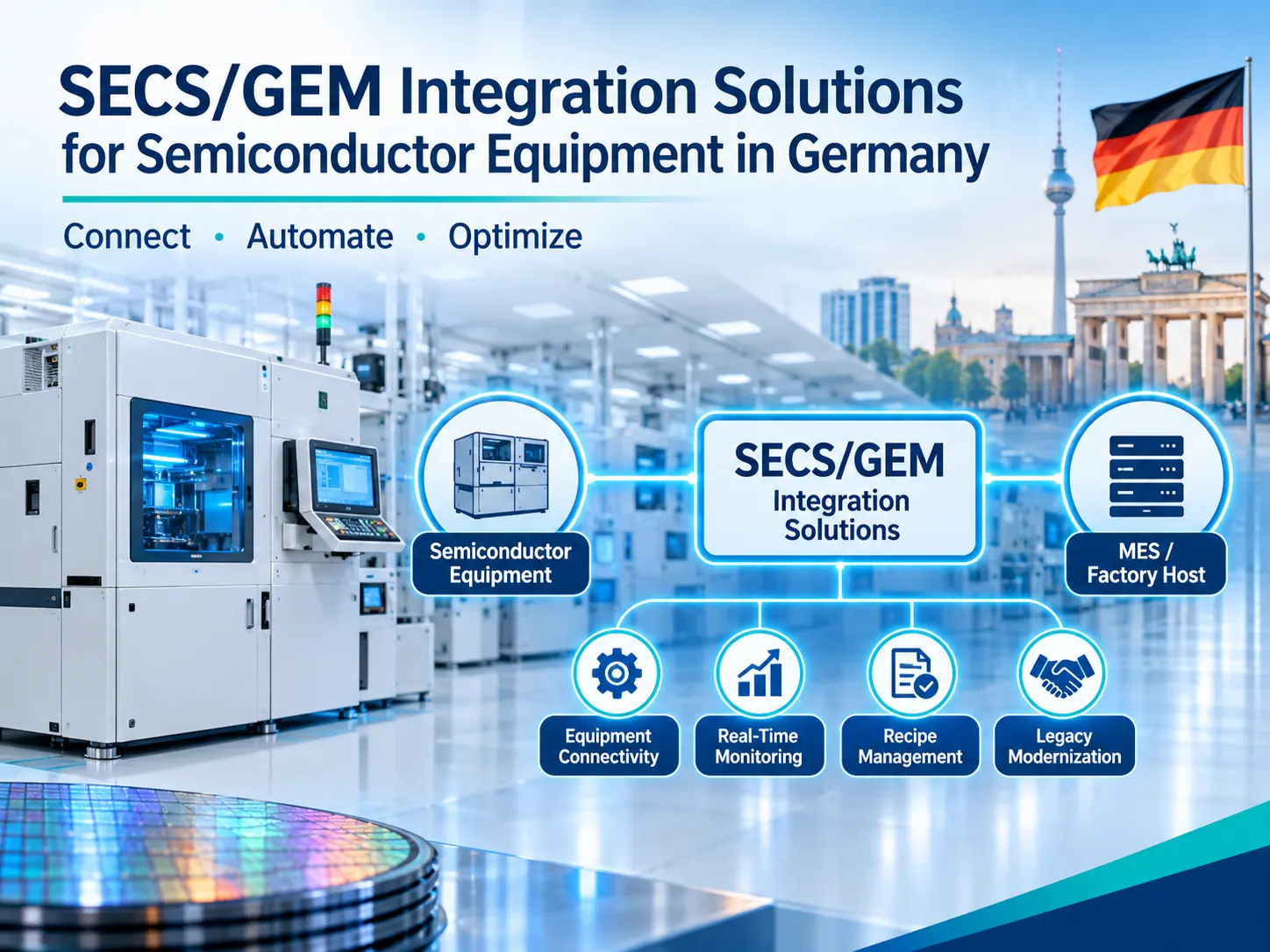
Germany is one of Europe’s key centers for semiconductor equipment engineering and manufacturing. Equipment makers and fabs face the same demand: tools must share data with factory systems reliably and in a standard way. Equipment connectivity, factory automation and MES integration are now core requirements.
SECS/GEM integration solutions in Germany give OEMs and fabs a common language for that exchange. SECS/GEM is the SEMI-standardized way for equipment to communicate with a host system. One MES can then monitor, control and collect data from tools built by many different vendors.
What Is SECS/GEM Integration in Semiconductor Manufacturing?
SECS/GEM integration adds a standards-based communication layer to a piece of equipment so a host or MES can talk to it. Four SEMI standards work together in this SECS/GEM communication protocol:
- SECS-I (SEMI E4): Defines message transfer over a serial (RS-232) connection. It is common on older tools.
- SECS-II (SEMI E5): Defines the message formats and data structures. Think of it as the shared vocabulary.
- HSMS (SEMI E37): Carries SECS-II messages over TCP/IP Ethernet. It is the modern replacement for serial links.
- GEM (SEMI E30): Defines how equipment should behave. It covers state models, event reporting, alarms, remote commands and recipe handling.
In short, SECS-II is the language, HSMS or SECS-I is the road it travels on, and GEM is the rulebook for what the equipment says and does.
Why German Semiconductor Manufacturers Need SECS/GEM Integration
Most factories run equipment from many international vendors, in a range of ages and software generations. Without a common standard, every tool becomes a custom integration project.
Common challenges include:
- Different vendors use different data formats and interfaces.
- Legacy machines may have no host interface at all.
- Manual monitoring and paper-based logging slow response times.
- Production visibility is limited when tool data stays on the machine.
- MES connectivity is hard to scale across mixed equipment.
| Equipment Integration Challenge | Impact on Production | SECS/GEM Approach |
|---|---|---|
| Multi-vendor equipment | Inconsistent data and custom communication interfaces | Standardized SECS/GEM communication across compatible equipment |
| Legacy machines without a host interface | Manual operation and limited data collection | SECS/GEM interface retrofit or bridging layer |
| Manual monitoring | Delayed detection of alarms and equipment state changes | Automated event reporting and alarm notifications |
| Limited production visibility | Gaps in traceability and process data | Standardized data collection and equipment status reporting |
| MES integration effort | Longer integration timelines for individual tools | Reusable, standards-based host communication |
Key Applications of SECS/GEM Integration Solutions
Semiconductor Equipment-to-MES Integration
SECS/GEM lets the MES track equipment state, receive process events and send commands. This is the basis for automated lot tracking and for a connected, traceable production line. For teams planning host-side work, MES integration and migration support is a related area.
Remote Equipment Monitoring and Control
GEM defines remote commands and status reporting. Engineers can see whether a tool is idle, running or in alarm without walking to the machine. Authorized hosts can also start or stop processing remotely.
Recipe Management and Process Data Collection
Hosts can upload, download and verify recipes through the interface. They can also subscribe to process data through collection events and reports. This supports consistent recipe use and better traceability.
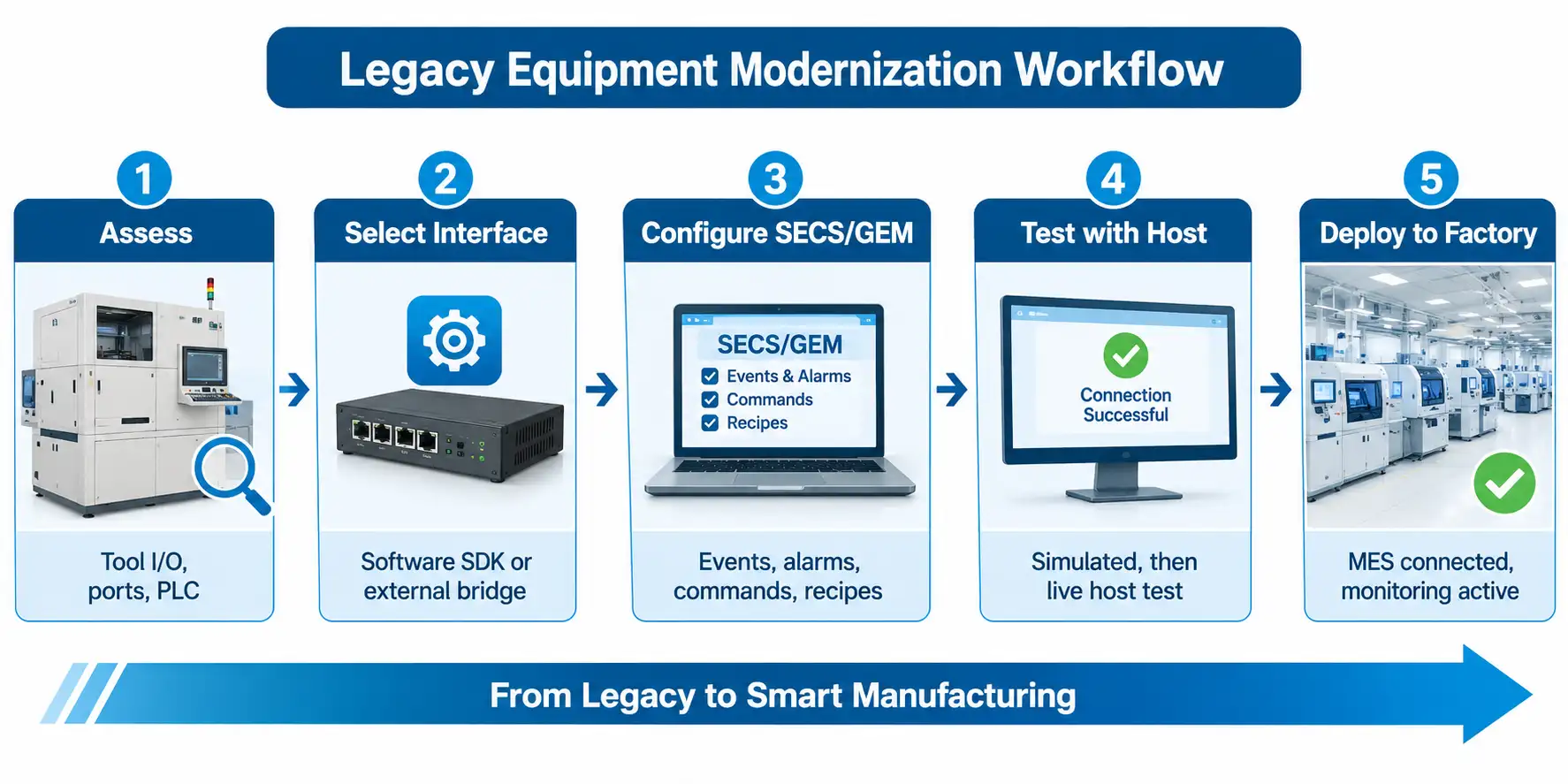
Legacy Semiconductor Equipment Modernization
Many valuable tools were built before SECS/GEM was widely required. Adding an interface can extend their useful life and bring them into a connected factory without replacing the hardware.
How Does SECS/GEM Integration Work?
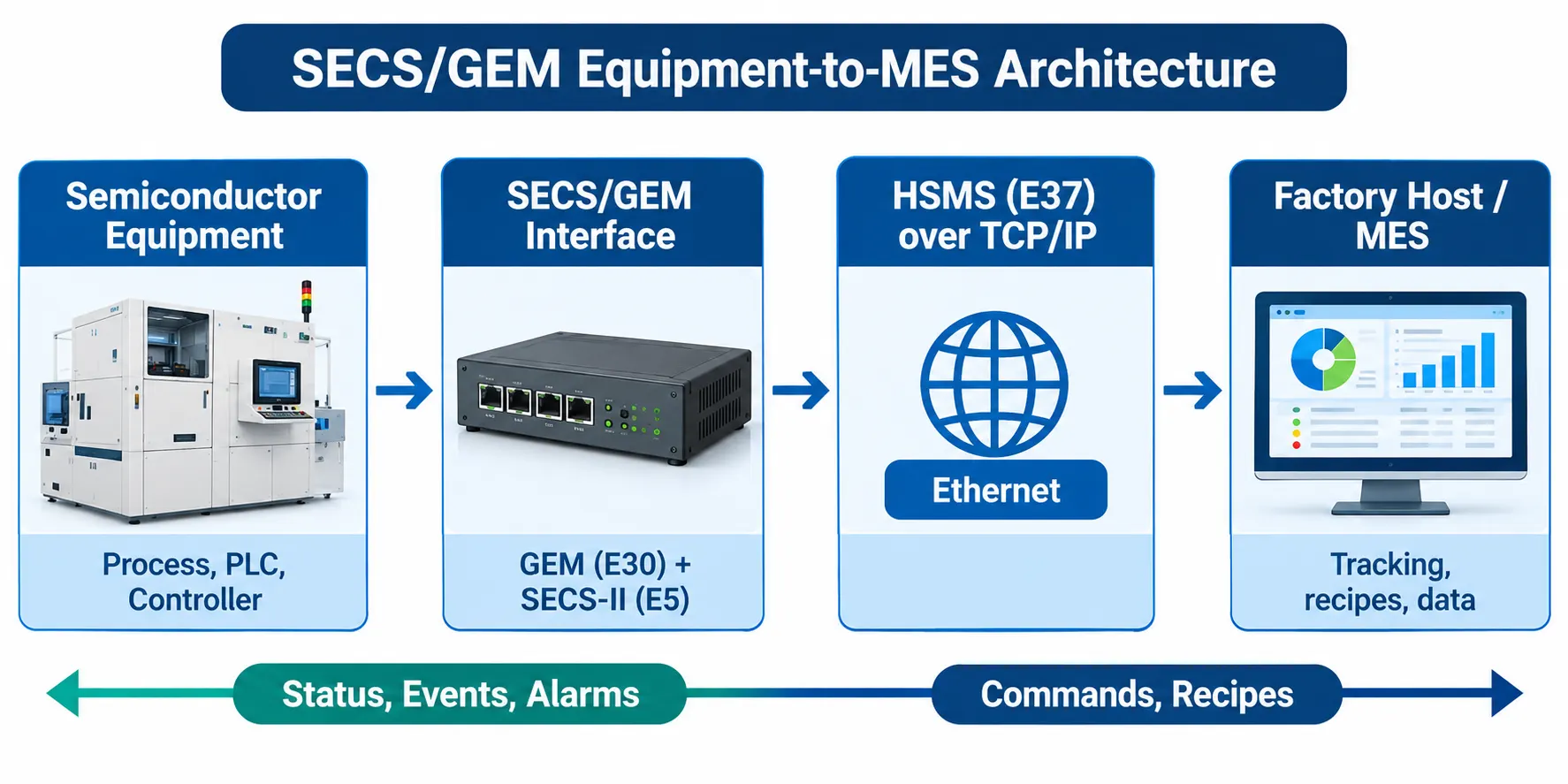
The architecture has four layers. The equipment holds its process and control logic. The SECS/GEM interface turns that equipment data into standard messages. HSMS carries those messages over the TCP/IP network. The factory host or MES receives them and responds.
SECS/GEM vs GEM300: Understanding the Difference
GEM300 extends the basic GEM standard for 300 mm automated fabs. It adds standards for carrier handling, substrate tracking and job control.
| Area | SECS/GEM (E30) | GEM300 |
|---|---|---|
| Communication | Uses SECS-II messages over HSMS or SECS-I | Uses the same communication foundation with additional SEMI standards |
| Equipment Control | Supports state models, remote commands and alarms | Adds Process Job and Control Job management |
| Carrier Management | Not included in the basic GEM standard | Supports carrier handling and load port management |
| Substrate Tracking | Not included in the basic GEM standard | Supports substrate location and movement tracking |
| Advanced Automation | Provides basic host connectivity and equipment control | Enables advanced, host-driven material and process automation |
How to Choose SECS/GEM Integration Solutions in Germany
Consider these points when evaluating a solution:
- Standards compliance: Does it follow E4, E5, E37 and E30, and GEM300 where needed?
- Equipment compatibility: Does it fit your controllers, PLCs and software environment?
- HSMS support: Is Ethernet-based communication supported for modern hosts?
- MES connectivity: Can it work with your MES and host-side requirements?
- Scalability: Can you reuse the approach across many tools?
- Testing: Can you validate against a simulated host before going live?
- Technical support: Is expert help available during integration and after deployment?
How eInnoSys Supports Semiconductor Equipment Integration
eInnoSys provides factory automation and equipment software for semiconductor fabs, OSATs and equipment OEMs. Its offerings relevant to this topic:
- EIGEMBox: A plug-and-play SECS/GEM box for legacy equipment, for equipment connectivity and modernization.
- EIGEMEquipment / SECS/GEM SDK: A SECS/GEM SDK for equipment software, for development and integration.
- GEM300 Solutions: A GEM300 SDK for advanced equipment automation.
- EIGEMSim: A SECS/GEM simulator for communication simulation and testing.
- EIGEMLink: A product for equipment connectivity and protocol integration.
Conclusion
Connected equipment is the foundation of modern semiconductor production. Standardized communication through SECS/GEM, HSMS and GEM300 reduces integration effort and supports MES connectivity. For legacy tools, an added interface can extend equipment life. Choosing the right SECS/GEM integration solutions in Germany means checking standards compliance, compatibility, testing and long-term support.


