
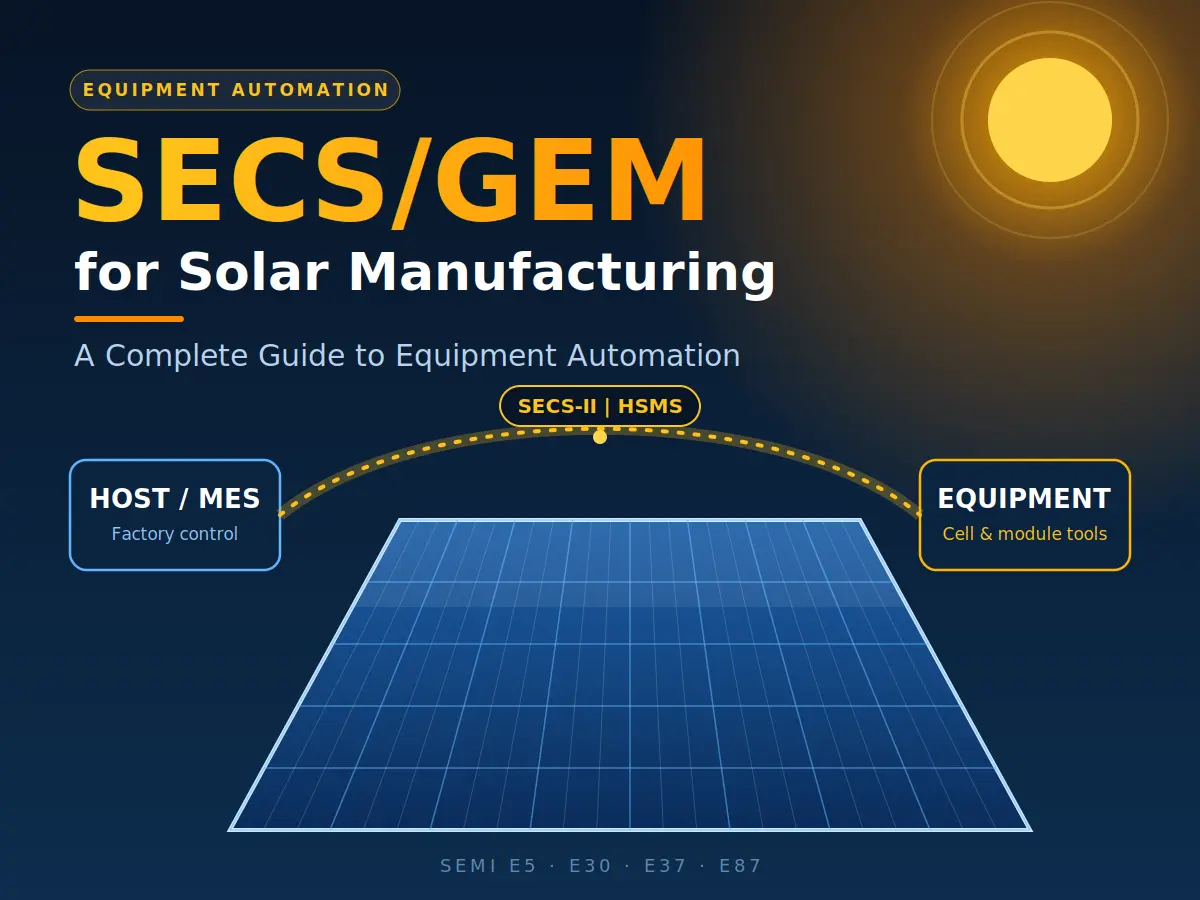
Solar cell and module factories are scaling fast, and the equipment on their floors is more complex than ever. Screen printers, diffusion furnaces, PECVD tools, laminators, and testers each run on their own controller and their own communication style. Without a common language, connecting them to a factory system becomes a slow, expensive custom project.
This is where SECS GEM solar manufacturing comes in. SECS/GEM is a proven set of standards that lets equipment and factory software exchange data in a consistent way. Semiconductor fabs have relied on it for decades, and photovoltaic (PV) manufacturers are now adopting it to build a truly smart solar PV system.
This guide explains what SECS/GEM is, why it matters for solar, and how to implement it.
What Is SECS/GEM?
SECS/GEM is a pair of SEMI standards that define how equipment talks to a host, usually a Manufacturing Execution System (MES).
- SECS-I (SEMI E4) and HSMS (SEMI E37) define how messages travel over a serial or Ethernet connection.
- SECS-II (SEMI E5) defines the structure and meaning of those messages.
- GEM (SEMI E30) defines standard equipment behavior, such as how a tool reports its state, sends alarms, and accepts commands.
Together, they give every machine the same “vocabulary.” A host system can ask any compliant tool for its status without needing a custom driver for each brand.
Why SECS/GEM Matters for Solar PV Factories
Solar manufacturing runs on thin margins and high volumes. A small yield loss or an hour of unplanned downtime adds up quickly. SECS GEM for photovoltaic manufacturing helps in four practical ways.
- Standardized communication. Equipment from different vendors speaks one protocol, which removes the need for dozens of proprietary interfaces.
- Real-time monitoring. Process values, equipment states, and alarms stream to the host as they happen. Engineers see problems in seconds instead of at the end of a shift.
- Full traceability. Every wafer, cell, and module can be linked to the recipe, tool, and process parameters used to make it. This is essential for quality audits, warranty claims, and root-cause analysis.
- Remote control and automation. The host can start and stop processes, download recipes, and enforce approved settings. This reduces operator error and keeps production consistent.
Core SECS/GEM Capabilities Explained
The GEM standard groups its features into a few key capabilities that every solar automation engineer should know.
- Equipment state model: Tells the host whether a tool is idle, processing, or in a fault condition.
- Collection events: Notify the host when something happens, such as a lot starting or a process step finishing.
- Status variables and data collection: Let the host read or subscribe to real-time process values like temperature, pressure, or belt speed.
- Alarm management: Sends clear alerts when limits are exceeded so teams can respond quickly.
- Remote commands: Allow the MES to start, stop, pause, or abort a process.
- Recipe management: Lets recipes be uploaded, downloaded, and verified from a central location.
- Spooling: Stores messages if the connection drops, so no data is lost.
These features form the backbone of reliable solar equipment connectivity.
The Challenge: Legacy and Mixed Equipment
Most solar plants run a mix of new and older machines. Many older tools have no SECS/GEM support at all. Others use vendor-specific protocols that do not match the MES. Replacing every machine is rarely realistic.
The good news is that you do not have to. There are two common routes to solve this:
- Build SECS/GEM into new equipment using an embedded software library.
- Retrofit existing equipment using an external gateway or interface layer.
The right choice depends on whether you are an equipment OEM or a factory operator.
How eInnoSys Solutions Support Solar Equipment Integration
eInnoSys offers a complete toolset for solar equipment integration, from software libraries to hardware gateways and testing tools. Here is how each product fits in.
For Equipment OEMs:-
- EIGEMEquipment is a SECS/GEM software solution that OEMs embed directly into their tool controllers. It is a strong fit for standard PV equipment that needs fast, compliant connectivity.
- EIGEM300Equipment adds GEM300 capabilities for advanced, highly automated tools, including job management and carrier handling. It is useful for OEMs building next-generation, high-throughput lines.
- EIGEM84 supports SEMI E84, the standard for automated material handoff between equipment and transport systems. It helps connect tools with automated material handling.
For Factories with Legacy Tools:-
- EIGEMBox is a plug-and-play hardware gateway that adds SECS/GEM to equipment that lacks it. It is a clear example of how smart gateways connect solar tools to the MES without rewriting machine software.
- EIGEMHMI provides a user interface for configuring and monitoring the SECS/GEM connection, making setup and daily operation easier for technicians.
For MES and IT Teams
- EIGEMLink acts as the host-side connection, helping MES and IT teams communicate with many machines through one consistent interface. This is the kind of solar equipment communication software that simplifies large, multi-vendor lines.
For Testing and Validation
EIGEMSim is a simulator that mimics either the equipment or the host. Teams can test their interfaces long before the real machines arrive, which shortens commissioning time and reduces risk.
You can explore how these tools apply to your production line on the Solar PV Industry page.
Step-by-Step: Implementing SECS/GEM in a Solar Plant
A structured approach keeps projects on time and on budget.
| Step | Action | |
|---|---|---|
| Audit Your Equipment | List every tool, controller type, and current communication method. | |
| Define Your Data Needs | Identify the events, alarms, and process values required by MES and analytics teams. | |
| Choose the Integration Path | Use embedded software for new equipment and gateways for legacy equipment. | |
| Simulate First | Test message flows and scenarios with a simulator before connecting live equipment. | |
| Connect and Validate | Integrate equipment in stages and validate each tool against your requirements. | |
| Monitor and Improve | Use equipment data to reduce downtime, improve yield, and optimize recipes. |
Benefits You Can Expect
Plants that adopt SECS/GEM commonly report:
- Faster onboarding of new equipment
- Lower integration costs over time
- Better yield through tighter process control
- Reduced downtime thanks to real-time alarms
- Stronger traceability for audits and customers
- A solid foundation for Industry 4.0 and analytics
Together, these gains turn scattered machines into a connected, data-driven smart solar PV system.
Conclusion
SECS GEM solar manufacturing gives PV producers a reliable path to standardized communication, real-time visibility, and full traceability. Whether you are an OEM building new tools or a plant manager modernizing an existing line, SECS/GEM turns isolated machines into a connected, automated factory.
eInnoSys brings the software, gateways, and testing tools needed to make that happen, from embedded libraries to plug-and-play hardware. To see how eInnoSys can support your solar equipment automation goals, visit eInnoSys and talk to the team today.


