
Why Hardware Interlocks Still Matter
Picture this: a transport robot is positioning a cassette of 25 wafers worth hundreds of thousands of dollars. At that exact moment, the process equipment needs to know the cassette is securely in place before gripping it. A software message taking 100 milliseconds to arrive isn’t fast enough— you need hardware-level signals responding in microseconds. That’s where SEMI E23 comes in.
The SEMI E23 Standard defines the parallel I/O interface for cassette transfer between equipment. While SECS handles high-level material movement commands such as “transfer cassette from port 1 to loadlock,” the Cassette Transfer Parallel I/O Interface manages the split-second mechanical handoff. These safety-critical signals prevent equipment collisions and protect wafers during the physical transfer process.
Important Note: While SEMI E23 currently has an Inactive Status, it remains valid for use. Many legacy systems and equipment still rely on this interface specification, and understanding it is essential for maintaining existing installations and supporting older equipment architectures.
Understanding the Interface Architecture
The SEMI E23 Specification defines two distinct interface types, each suited to different equipment configurations and safety requirements. This dual approach gives equipment manufacturers flexibility while maintaining standardized interoperability.

Wire-Connected Interface
- Direct electrical connections between equipment
- Fastest response time (microseconds)
- Used for equipment in close proximity
- Hardwired safety interlocks
- Lower installation complexity
- Common in tool-to-stocker connections

Photo-Coupled Interface
- Optical isolation between systems
- Electrical noise immunity
- Prevents ground loop problems
- Enhanced safety through isolation
- Preferred for process-to-transport links
- Better long-term reliability
The Signal Exchange Process
When two pieces of equipment need to transfer a wafer cassette, they execute a carefully choreographed sequence of parallel I/O signals. This isn’t just about moving material—it’s about ensuring both systems agree on the state of the transfer at every millisecond. The parallel I/O interface semiconductor equipment uses multiple signal lines to coordinate the mechanical operation safely.
SECS/GEM SDK and Development Tools
Typical Cassette Transfer Signal Sequence

1. Transport Equipment Approach
   TR_READY : HIGH   (Transport in position)
   LD_READY : LOW    (Load port not ready)

2. Load Port Preparation
   LD_READY : HIGH   (Load port ready to receive)
   LD_BUSY  : LOW    (Load port available)

3. Transfer Authorization
   TR_REQUEST : HIGH (Request to transfer)
   LD_TR_ACK  : HIGH (Load port acknowledges)

4. Physical Transfer
   TR_BUSY : HIGH    (Transfer in progress)
   LD_BUSY : HIGH    (Load port busy)

5. Completion
   TR_COMPLETE : HIGH (Transport finished)
   LD_COMPLETE : HIGH (Load port confirms receipt)

6. Release
   All signals return to LOW state
   Equipment ready for next operation
Real-World Context
The beauty of the SEMI E23 cassette interface is that these signals work independently of the SECS communication layer. Even if your network connection drops, the hardware interlocks prevent unsafe operations. The cassette won’t be released until both pieces of equipment explicitly signal they’re ready through dedicated I/O lines.
SECS/GEM Integration Products
Fabs & Assembly/Test/Packaging Products
- SECS/GEM addition & enhancement on legacy equipment – EIGEMBox & EIGEM-HMI
- E84 & E87 addition on legacy equipment – EIGEMBox
- AI/ML-based health monitoring & predictive maintenance – XPump
- Factory host – EIStationController
- Recipe Management System – EIRMS
- AI/ML based Smart FDC with Predictive Analytics – SeerSight
- Analog Gauge Monitoring – EIGaugeMonitor
- Equipment Simulator – EIGEMSim
- Factory host SDK – EIGEMHost & EIGEM300Host
- Chemical Management – EIBarcodeGuardian
- Spare Parts & Vendor Management – EICMMS
OEMs (Original Equipment Manufacturer) Products
Integration with SECS Communication
The cassette transfer interface semiconductor defined by SEMI E23 complements rather than replaces SECS messaging. Here’s how they work together: Your MES system sends a high-level SECS command like “Load cassette from input port.” The equipment acknowledges via SECS, but the actual mechanical transfer uses the parallel I/O interface for real-time coordination. Once complete, the equipment reports success back through SECS. This layered approach gives you both high-level control and low-level safety.
This separation of concerns is crucial. SECS operates over network protocols that can experience latency, packet loss, or delays. The parallel I/O communication in semiconductor fabs defined by SEMI E23 provides deterministic, hardware-level control that’s immune to network issues. You get the best of both worlds—sophisticated factory automation through SECS, and reliable physical control through parallel I/O.

Photo-Coupling: The Safety Advantage
The photo-coupled interface deserves special attention. When the SEMI E23 semiconductor standard specifies photo-coupling between process equipment and transport equipment, it’s addressing real reliability concerns. Photo-couplers use LED and photodetector pairs to transfer signals optically, providing complete electrical isolation between the two systems.
Why does this matter? Process equipment might operate at different ground potentials than transport equipment. Without isolation, ground loops can cause noise, signal errors, or even equipment damage. Photo-coupling eliminates these problems while maintaining fast signal response. It’s especially important in cleanroom environments where multiple pieces of equipment from different manufacturers need to work together reliably.

Legacy Systems and Modern Alternatives
While SEMI E23 has Inactive Status, it remains relevant for several reasons. First, countless pieces of existing equipment use this interface and continue to operate reliably. Second, the principles of hardware interlocks and parallel I/O remain valid even as newer standards emerge. Third, understanding SEMI E23 helps when interfacing legacy equipment with modern systems—you often need gateway devices that translate between old and new protocols.
Modern equipment increasingly uses network-based protocols or integrated standards like SEMI E84 for FOUP transfer. However, the core concept of hardware-level interlocks for safe material handling remains unchanged. The lessons learned from SEMI equipment interface standards like E23 inform these newer specifications, ensuring backward compatibility and design continuity.

Maintenance and Troubleshooting
When working with wafer cassette transfer standard implementations, signal integrity is everything. Common issues include loose wire connections causing intermittent signals, failed photo-couplers from aging components, timing mismatches between equipment, and ground potential differences in wire-connected systems. Understanding the SEMI E23 specification helps diagnose these problems systematically by checking each signal’s state and timing against the expected sequence.
Proper testing equipment—oscilloscopes for timing analysis, multimeters for continuity checks, and signal generators for interface verification—becomes essential. The SEMI automation standards framework provides clear test procedures and acceptance criteria, making it possible to validate interface operation objectively.
Need Help with Legacy Equipment Interfaces?
Einnosys specializes in equipment automation hardware and SEMI standards implementation. Whether you’re maintaining SEMI E23 cassette transfer systems, upgrading to modern interfaces, or integrating legacy equipment with new factory automation, we provide the expertise to keep your material handling running reliably.
Related Products and Services
Alarm Management System
EIAMS is a powerful Alarm Management System for Semiconductors from einnosys that automatically tracks, analyzes, and....
EI Manual Wetbench Automation
Prevent wrong chemical dipping and incorrect etch time — without replacing your existing wet bench.Non-invasive Semiconductor Wet Bench…
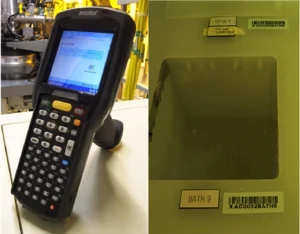
EIBarcodeGuardian
EIBarcodeGuardian by eInnoSys is a smart Chemical Barcode Verification & Chemical Handling Safety System designed to prevent wrong…
EIGaugeMonitor
Eliminate Manual Gauge Reading & Visual Inspection Errors Smart. Automated. Reliable.EIGaugeMonitor is an advanced analog gauge monitoring system…

EIGEM300Equipment
GEM300 SDK & Integration Services is a plug-and-play, SEMI standards compliant, SECS/GEM software that can be integrated quickly…
EIGEM300Host
EIGEM300Host is SEMI standards-compliant, plug-n-play SECS/GEM SDK that can be integrated into any host application at the FAB…

Schedule a Free Technical Consultation
Connect with our experts to discuss your OEM and FAB/ATP requirements and explore the right solution for your operations.
FAQs About SECS/GEM SDK & Integration in Malaysia
What is SEMI E23?
SEMI E23 is a semiconductor equipment interface standard that defines a parallel I/O hardware interface used for safe and reliable cassette transfer between process equipment and transport systems. It focuses on microsecond-level signal exchange during physical handoff.
Why does SEMI E23 use hardware-level signals instead of software messages?
Mechanical cassette transfer requires deterministic, ultra-fast responses. Software or network-based messages can experience latency or packet loss, while SEMI E23 hardware signals respond in microseconds, ensuring safe material handling and collision prevention.
Is SEMI E23 still valid even though it has Inactive Status?
Yes. Although SEMI E23 is marked as Inactive, it remains valid and widely used in legacy semiconductor equipment. Many fabs still rely on it, and understanding the standard is essential for maintaining and integrating older tools.
What happens if the network or SECS communication fails during transfer?
Even if SECS communication fails, SEMI E23 hardware interlocks continue to function independently. The cassette transfer will not proceed unless both sides explicitly signal readiness, preventing unsafe operations.