
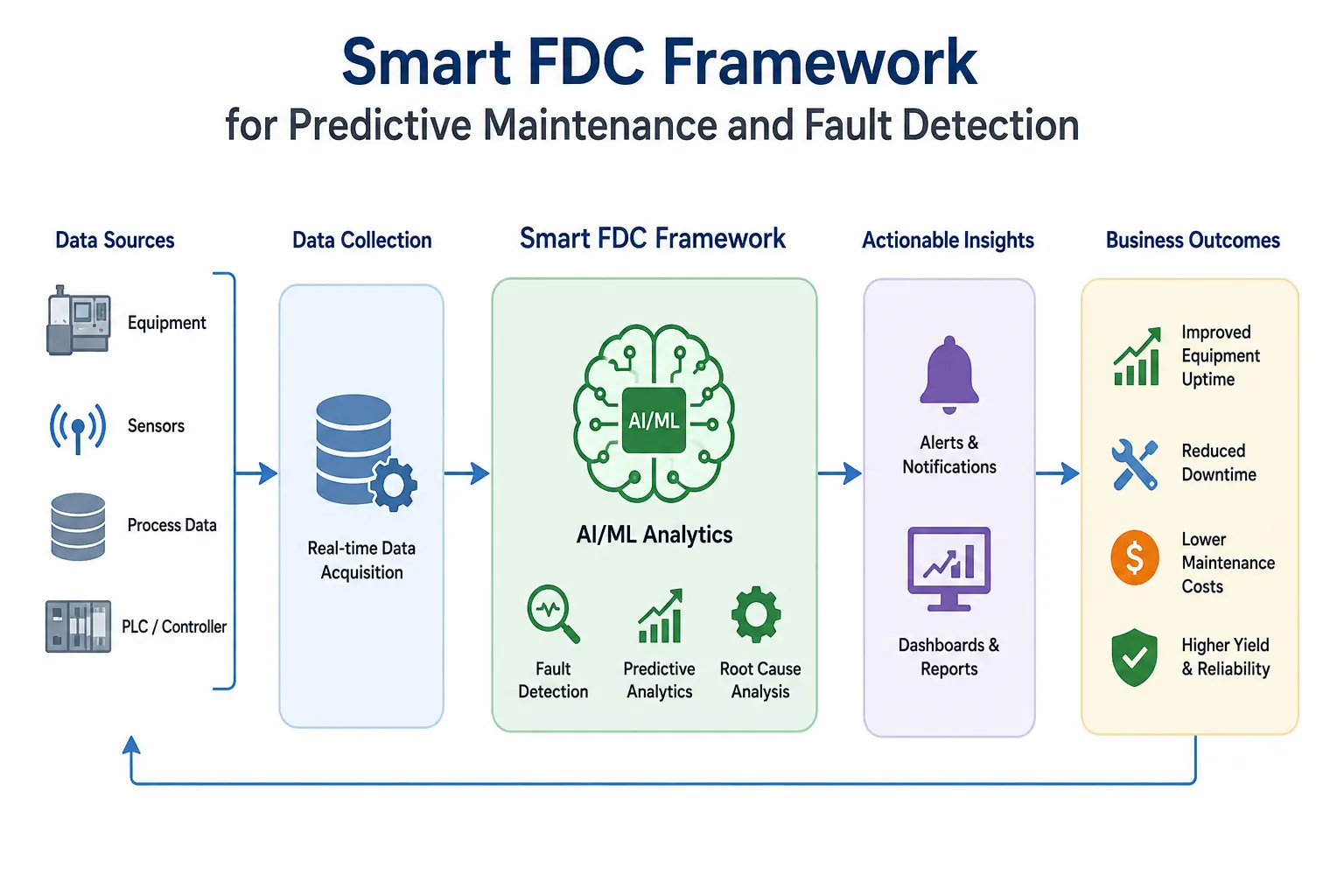
Semiconductor fabs run on tight margins. A single unplanned tool outage can cost hours of lost throughput, scrapped wafers, and missed delivery windows. This is why more manufacturing and equipment engineers are moving beyond traditional Fault Detection and Classification (FDC) toward a Smart FDC Framework — one that combines real-time equipment data with AI and machine learning to catch problems before they become downtime.
In this article, we’ll break down what a Smart FDC Framework actually is, why legacy FDC systems are struggling to keep up, and how AI-driven predictive analytics — like the approach used in SeerSight AI Predictive Analytics — is changing fault detection, equipment health monitoring, and yield management across the fab.
What Is Smart FDC?
Smart FDC is the next evolution of Fault Detection and Classification. Traditional FDC systems monitor process parameters against fixed control limits and flag a fault only after a value crosses a threshold. That reactive model catches obvious problems, but it often misses the subtle, slow-building drift that precedes most equipment failures.
A Smart FDC Framework, by contrast, layers AI and machine learning on top of the same sensor and equipment data. Instead of relying on static limits alone, it learns what “normal” actually looks like for each tool, chamber, or process step, and it flags deviations long before they would trip a conventional alarm. The result is a system that doesn’t just detect faults — it anticipates them.
This shift matters because modern fabs generate far more data than engineers can reasonably review manually. Smart FDC turns that flood of data into something usable: fewer false alarms, earlier warnings, and clearer root-cause context when something does go wrong.
Why Traditional FDC Is No Longer Enough
Conventional FDC was designed for a simpler manufacturing environment. It works reasonably well for single-variable, threshold-based monitoring, but it has real limitations in today’s high-mix, high-complexity fabs:
- Static limits miss gradual drift. A sensor reading can creep slowly out of spec over weeks without ever crossing a fixed threshold.
- High false-alarm rates create alert fatigue. Engineers start ignoring alarms when too many turn out to be noise.
- Limited context for root cause. A threshold breach tells you that something went wrong, not why.
- No predictive capability. Traditional FDC reacts to faults; it can’t forecast a failure days or weeks out.
These gaps are exactly what a Smart FDC Software approach is built to close, by adding intelligence that continuously learns from equipment behavior rather than checking it against a fixed rulebook.
How AI/ML Enhances Fault Detection
Bringing AI Predictive Analytics into the FDC pipeline changes the fundamental logic of fault detection. Instead of asking “did this value cross a line,” the system asks “does this pattern of behavior look like the early stage of a known failure mode.”
Anomaly Detection
Machine learning models trained on historical equipment data can spot subtle multivariate anomalies that would never trip a single-parameter alarm. This is especially valuable in chambers and tools where dozens of parameters interact simultaneously.
Predictive Alerts
Once a model recognizes an emerging pattern associated with past failures, it can generate a predictive alert — often days or weeks ahead of an actual breakdown. That lead time is what separates AI Predictive Maintenance from simple reactive monitoring.
Root Cause Analysis
AI models can also correlate a fault signature against historical events, maintenance logs, and process context, helping engineers narrow down root cause faster instead of starting an investigation from scratch.
Continuous Learning Models
Unlike static control limits, machine learning models can be retrained as new data comes in, so the system keeps adapting to process changes, new recipes, and equipment aging over time.
Smart FDC Framework Architecture
A production-grade Smart FDC Framework is typically built in layers, each responsible for a specific part of the fault detection and predictive maintenance workflow.
Data Collection Layer
Everything starts with reliable equipment connectivity. Data is pulled directly from tools and sensors using industry-standard protocols such as SECS/GEM, OPC UA, MQTT, and Modbus, giving the system a consistent, real-time stream of process and equipment health data.
AI/ML Analytics Engine
This layer applies statistical models and machine learning algorithms to the incoming data, establishing behavioral baselines and continuously scoring new data against them.
Anomaly Detection and Predictive Alerts
Deviations from the learned baseline are flagged, scored for severity, and — when they match patterns linked to past failures — escalated into predictive alerts before a hard fault occurs.
MES & Equipment Integration
For Smart FDC to be actionable, it can’t operate in isolation. Integration with MES and factory automation systems means alerts, equipment status, and maintenance recommendations flow directly into the systems engineers already use.
Benefits of Smart FDC
Manufacturing teams that move to a Smart FDC Framework typically see improvements across several operational metrics:
- Higher yield through earlier detection of process drift before it affects wafers
- Improved OEE by reducing unplanned downtime and shortening diagnostic time
- Better throughput as fewer tools sit idle waiting on manual troubleshooting
- Lower maintenance costs by shifting from calendar-based to condition-based maintenance
- Reduced false alarms, which keeps engineers responsive to real alerts instead of desensitized to noise
- Stronger equipment health visibility across the fab, not just at the tool level
Semiconductor Use Cases
Smart FDC and AI Predictive Maintenance are already being applied across several areas of semiconductor manufacturing:
- Etch and deposition chambers, where subtle parameter drift can affect film uniformity long before a hard fault triggers
- CMP and cleaning tools, where consumable wear and contamination risk build gradually
- Photolithography systems, where precision drift has an outsized impact on yield
- Back-end assembly and test (OSAT) equipment, where throughput and equipment uptime are directly tied to margin
Across each of these, the value proposition is the same: catch the early signal, act before the failure, and keep the line running.
Why Choose SeerSight
SeerSight AI Predictive Analytics brings this Smart FDC architecture to life for semiconductor manufacturers. It combines Fault Detection & Classification with AI-Based Predictive Maintenance, connecting directly to fab equipment through SECS/GEM, OPC UA, MQTT, and Modbus for real-time data collection.
Instead of a generic analytics platform bolted onto the equipment layer, SeerSight is built specifically for semiconductor process and equipment engineers — with anomaly detection, predictive alerting, and root-cause context designed around how fabs actually operate. It’s built to integrate cleanly with existing MES and factory automation environments, so predictive insights reach the people and systems that need to act on them.
For teams evaluating options like INFICON SmartFDC or other Smart Condition Monitoring platforms, the key differentiators worth comparing are depth of protocol support, quality of predictive lead time, and how well the platform integrates with existing MES infrastructure — areas where SeerSight is purpose-built for semiconductor environments.
Conclusion
Fault detection in semiconductor manufacturing is moving from reactive to predictive. A Smart FDC Framework that combines real-time equipment connectivity with AI/ML analytics gives engineers earlier warnings, clearer root-cause insight, and measurable gains in yield, OEE, and equipment uptime.
Ready to improve equipment uptime and wafer yield? Discover how eInnoSys SeerSight delivers AI-powered Fault Detection & Classification with predictive analytics for semiconductor manufacturing. Explore: https://www.einnosys.com/seersight/


