
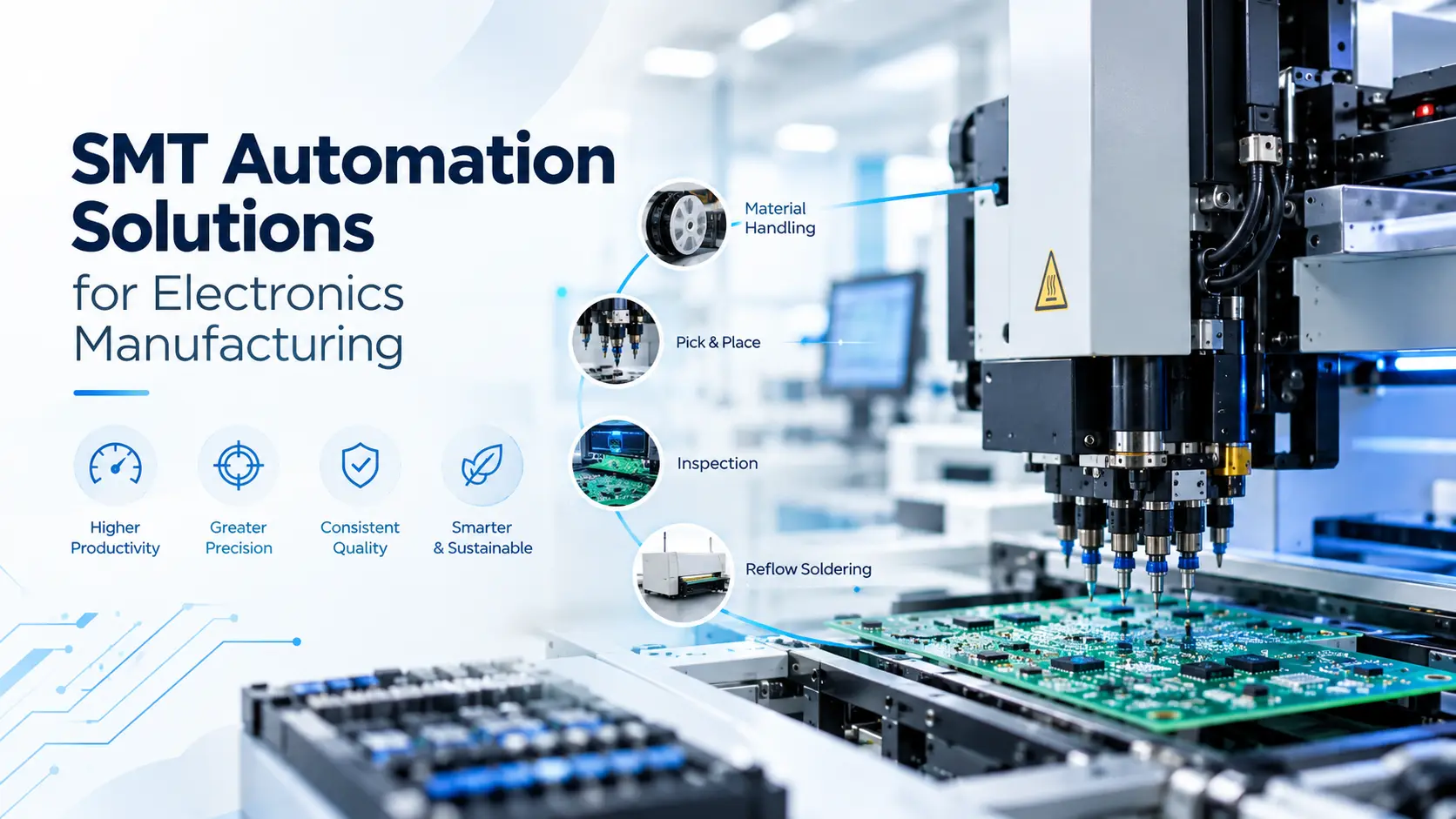
Electronics manufacturers across the USA and Europe are under constant pressure to build smaller, more complex boards faster, without sacrificing quality or yield. Manual oversight and disconnected machines simply can’t keep pace with today’s production demands. This is where SMT automation comes in.
SMT automation solutions connect, monitor, and control the equipment on a surface mount technology line so that data — not guesswork — drives every decision on the shop floor. In this guide, we’ll break down what SMT automation actually involves, why it matters for modern electronics manufacturing, and how manufacturers can implement it successfully.
What Is SMT Automation?
SMT automation refers to the use of software, equipment integration, and real-time data systems to control and optimize the surface mount technology (SMT) production process. Instead of operators manually tracking machine status, adjusting parameters by hand, or reacting to failures after the fact, automated systems continuously monitor pick-and-place machines, solder paste printers, reflow ovens, and inspection systems — flagging issues before they turn into defects or downtime.
At its core, SMT surface mount technology automation covers the entire assembly workflow: PCB loading, solder paste application, component placement, reflow soldering, automated optical inspection (AOI), and final quality verification. Automating this chain means every machine on the line can talk to a central system, and that system can talk back — adjusting recipes, triggering alerts, and logging every event for traceability.
Why SMT Automation Matters for Electronics Manufacturers
Electronics manufacturing has become a game of margins. A few percentage points of downtime or a handful of missed defects can be the difference between a profitable production run and a costly recall. SMT automation addresses this in several concrete ways:
1. Reduced Downtime
Automated monitoring detects abnormal machine behavior — a misfeed, a clogged nozzle, a drifting parameter — before it causes a full stoppage. Maintenance teams get advance warning instead of a shutdown alarm.
2. Higher Throughput and OEE
When machines communicate directly with a factory host or MES, changeovers and recipe updates happen automatically instead of manually. This shortens cycle times and improves Overall Equipment Effectiveness (OEE).
3. Better Quality Control
Real-time data collection from placement and inspection equipment allows manufacturers to catch placement drift, solder defects, or component misalignment as they happen, rather than during a post-run audit.
4. Full Traceability
Automated systems log every process parameter, timestamp, and machine event. For manufacturers serving regulated industries — automotive, medical devices, aerospace — this traceability isn’t optional; it’s a compliance requirement.
5. Reduced Manual Intervention
Automation frees operators from repetitive monitoring tasks so they can focus on higher-value work: process optimization, exception handling, and continuous improvement.
Core Components of an SMT Automation Solution
A well-designed SMT automation strategy typically includes the following building blocks:
| Software Capability | Description |
|---|---|
| Equipment-to-Host Communication | Machines report status, alarms, and process data to a central system in real time. |
| Real-Time Production Monitoring | Dashboards provide operators and managers with live visibility into line performance, machine states, and bottlenecks. |
| Smart Data Collection & Analysis | Live and historical data is captured for trend analysis, yield improvement, and predictive maintenance. |
| AI-Based Fault Detection | Machine learning models identify anomalies in equipment behavior before they escalate into failures. |
| Legacy Equipment Integration | Older machines without native connectivity can be digitized and integrated into automated production lines. |
The Role of SECS/GEM in SMT Automation
Much of the “communication backbone” behind modern SMT automation relies on a long-established equipment communication standard: SECS/GEM. Originally developed for semiconductor fabs, SECS/GEM has become increasingly relevant in electronics and SMT manufacturing because it provides a standardized way for equipment to exchange data with a factory host or MES — regardless of the machine’s original manufacturer.
For SMT lines, SECS/GEM-based integration enables:
- Automated start/stop/pause control of placement machines, printers, and ovens from a central host
- Real-time alarm and event reporting, so operators are notified the moment a fault occurs
- Recipe management, allowing product changeovers to be pushed to equipment automatically instead of configured by hand at each machine
- Standardized data collection, so information from different equipment vendors can be aggregated into a single reporting layer
One of the biggest practical challenges manufacturers face is that many SMT machines — particularly older ones — were never built with this kind of connectivity in mind. That’s exactly the gap that solutions like EIGEMBox are designed to close, adding SECS/GEM communication capability to existing equipment without requiring a full machine replacement or complex hardware modification.
Common Challenges in SMT Automation Implementation
Despite the clear benefits, manufacturers often run into a few recurring obstacles when automating an SMT line:
| Equipment Integration Challenge | Description |
|---|---|
| Mixed Equipment Vendors | Production lines often include machines from multiple OEMs, each using different data formats and communication protocols. |
| Legacy Machines | Older equipment may lack native network connectivity, making it difficult to collect and share production data. |
| Data Silos | Without a unified integration layer, valuable process data remains isolated on individual machines instead of reaching centralized MES or analytics platforms. |
| Cybersecurity Concerns | Connecting more equipment to factory networks increases the need for secure integration and built-in cybersecurity measures. |
| Skills Gap | Equipment integration requires specialized protocol, automation, and software expertise that may not be available within internal teams. |
How to Approach SMT Automation Implementation
- Audit your current line. Identify which machines already support standard communication protocols and which are “dark” — disconnected from any central monitoring system.
- Prioritize high-impact equipment first. Bottleneck machines or high-defect-rate stations typically deliver the fastest ROI from automation.
- Choose an integration approach that fits your equipment mix. This may mean native SDK integration for newer machines and gateway-based solutions for legacy equipment.
- Start with monitoring and data collection, then expand into automated control, recipe management, and predictive maintenance as your team builds confidence in the system.
- Plan for continuous improvement. Automation isn’t a one-time project — ongoing monitoring, tuning, and expansion keep the system delivering value as your line evolves.
SMT Automation in the USA and Europe: What’s Driving Adoption
Electronics manufacturers and EMS providers across North America and Europe are accelerating SMT automation investments for a mix of reasons: labor cost pressures, stricter traceability requirements in automotive and medical electronics, and the push toward reshoring or nearshoring production. In both regions, the ability to integrate mixed-vendor SMT lines — often a combination of legacy and modern equipment — has become a top priority, making flexible, standards-based automation solutions especially valuable.
Final Thoughts
SMT automation isn’t just about adding sensors or dashboards to a production line — it’s about creating a connected, data-driven manufacturing environment where equipment, data, and people work together efficiently. From real-time monitoring to standardized equipment communication and legacy machine integration, the right automation strategy directly improves uptime, quality, and traceability across the entire SMT process.
eInnoSys specializes in exactly this kind of equipment integration and automation software for SMT and electronics manufacturers, helping OEMs and factories connect mixed equipment fleets, extend the life of legacy machines, and build a smarter, more resilient production line. Whether you’re just starting to explore automation or looking to expand an existing setup, eInnoSys can help you design a solution that fits your equipment and your goals.


