
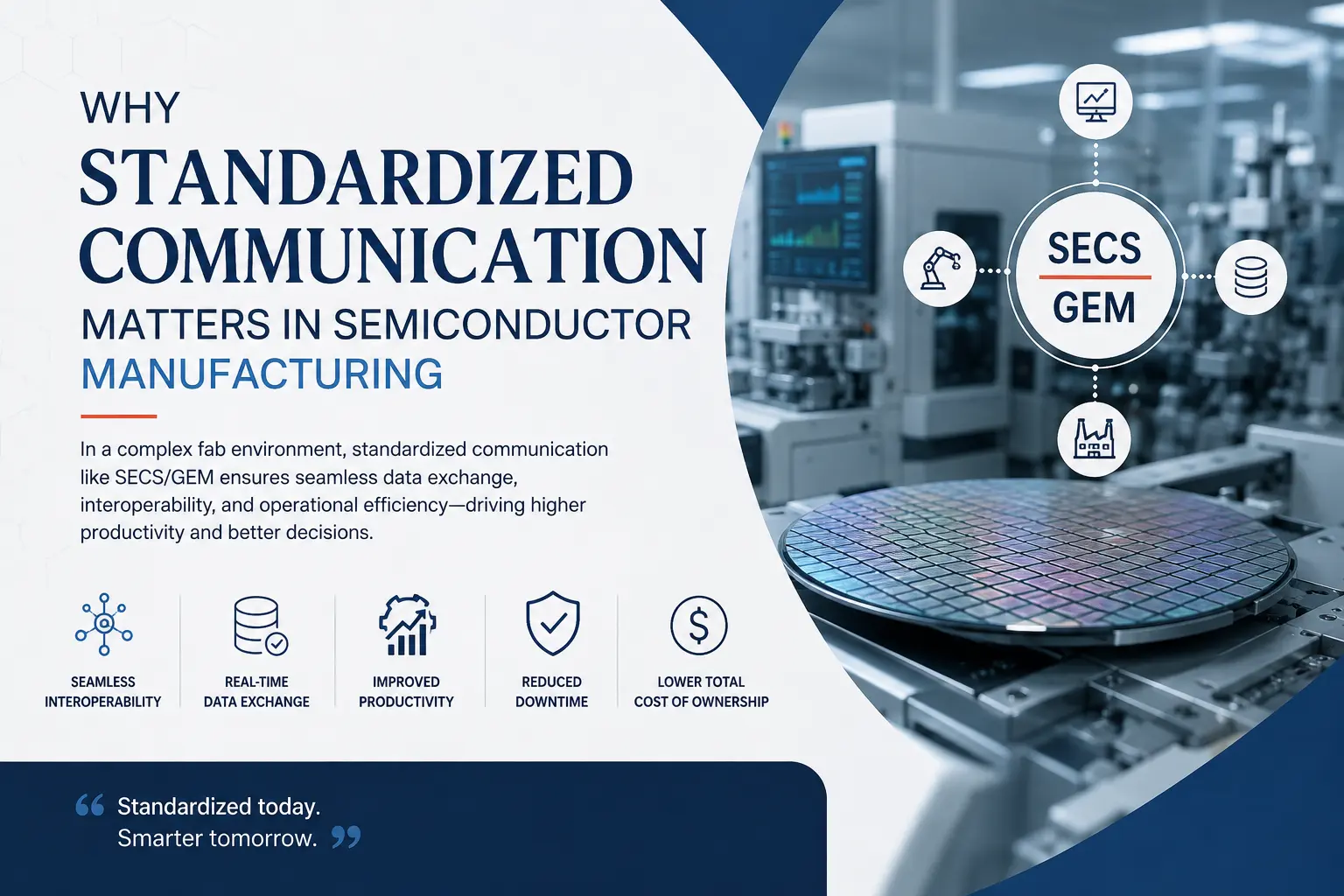
Semiconductor fabs run on precision. Every wafer that moves through etching, deposition, lithography, and testing depends on hundreds of machines exchanging instructions and data in real time. Yet many fabs still struggle with one basic problem: their equipment doesn’t “speak” the same language. This is where standardized communication in semiconductor manufacturing becomes critical — and why the SECS/GEM protocol has become the industry’s answer to fragmented, unreliable equipment communication.
In this article, we’ll break down what standardized communication really means on the fab floor, why it matters more than ever as fabs scale up automation, and how SECS/GEM makes equipment-to-host communication consistent, reliable, and future-ready.
What Is Standardized Communication in Semiconductor Manufacturing?
Standardized communication refers to a common, agreed-upon set of rules that allow manufacturing equipment — regardless of vendor or model — to exchange data with a factory’s host system in a predictable, machine-readable format.
In a modern fab, dozens of equipment types from different OEMs operate side by side: etchers, deposition tools, metrology systems, wafer sorters, and more. Without a shared communication standard, each machine could report status, errors, and production data differently, forcing engineers to build custom integrations for every single tool. That approach doesn’t scale.
Semiconductor equipment communication was standardized precisely to solve this problem, giving fabs a single, consistent framework for connecting equipment to the Manufacturing Execution System (MES), host software, and automation layers above it.
The Role of SECS/GEM in Equipment Communication
SECS/GEM (SEMI Equipment Communications Standard / Generic Equipment Model) is the semiconductor industry’s foundational standard for equipment-to-host communication. Defined by SEMI, it specifies exactly how equipment should report events, alarms, status variables, and production data to a host system — and how the host should send commands back.
SECS/GEM communication works at two layers:
- SECS-I / HSMS — defines the physical and message-transport layer (how bytes move between equipment and host)
- GEM (SEMI E30) — defines the behavior on top of that transport: standard states, events, alarms, and data collection
Together, these SECS/GEM standards create a predictable interface. A host system built to GEM specifications can integrate with any GEM-compliant tool, whether it’s from an established OEM or a newer equipment vendor, without needing custom logic for each connection.
Solutions like eInnoSys SECS/GEM are built specifically to implement this standard reliably, giving fabs and equipment manufacturers a proven path to compliant, scalable connectivity rather than building integrations from scratch.
Why Standardized Communication Matters
- Faster Equipment Integration
Without a common standard, integrating a new tool into the fab can take weeks of custom engineering — mapping data points, building drivers, and testing communication logic tool by tool. Standardized semiconductor equipment integration through SECS/GEM eliminates most of this custom work. Since the protocol is defined and consistent, new equipment can be brought online in a fraction of the time, which matters enormously when fabs are ramping capacity or qualifying new tools. - Scalable Fab Automation
Fab automation depends on software systems that can talk to hundreds of tools simultaneously — collecting data, dispatching lots, tracking recipes, and responding to alarms. This only works at scale if every tool communicates the same way. Standardized communication is the backbone that lets automation platforms, schedulers, and dispatch systems interact with equipment predictably, regardless of how many tools or vendors are on the floor. - Reliable, Real-Time Data Exchange
Modern fabs run on data — for yield analysis, predictive maintenance, and process control. Equipment-to-host communication built on GEM ensures that data variables, trace data, and event reports arrive in a consistent, structured format. This reliability is what allows MES integration and analytics systems to trust the data they’re receiving, rather than spending engineering time reconciling inconsistent outputs from different tools. - Reduced Downtime and Faster Troubleshooting
When equipment communication is standardized, alarms and error codes follow a known structure. Engineers don’t have to relearn how each tool reports faults — they can diagnose issues faster because the communication behavior is consistent across the fab. This directly reduces mean time to repair and keeps tools in production longer. - Interoperability Across OEMs
Fabs rarely run equipment from a single vendor. Standardized communication ensures that tools from different OEMs can be managed under one host system without vendor lock-in. This gives manufacturers the flexibility to choose the best equipment for each process step, rather than being constrained by communication compatibility.
Challenges Without Standardized Communication
Fabs that rely on non-standardized or partially compliant communication often run into recurring problems:
- Custom integration overhead for every new tool, driving up engineering cost and time-to-production
- Inconsistent data formats that complicate MES integration and analytics
- Higher risk of miscommunication between equipment and host, leading to production errors
- Difficulty scaling automation as tool count grows
- Vendor dependency, since proprietary communication methods can lock a fab into a single OEM’s ecosystem
These issues compound as fabs grow. What starts as a manageable inconsistency with a handful of tools becomes a serious bottleneck once a fab is running hundreds of connected machines.
How SECS/GEM Solves These Challenges
SECS/GEM was purpose-built to remove these pain points by giving the entire industry a shared, well-documented specification. Here’s how it addresses the challenges above:
- Standard equipment states and events (GEM/SEMI E30) mean host systems know exactly what to expect from any compliant tool, cutting integration time significantly.
- Structured data variables and reports make data collection consistent, which strengthens MES integration and downstream analytics.
- Defined alarm and error handling gives engineers a predictable framework for troubleshooting, regardless of tool vendor.
- Vendor-neutral design ensures fabs aren’t locked into a single OEM’s proprietary protocol, preserving flexibility in equipment sourcing.
- Proven scalability — because SECS/GEM is the semiconductor industry’s established standard, it’s already validated across thousands of fab deployments worldwide.
For fabs and equipment manufacturers looking to implement this reliably, working with an established SECS/GEM solution — rather than building a custom driver in-house — significantly reduces engineering risk and speeds up compliance with host system requirements.
Best Practices for Implementing SECS/GEM Communication
If your fab or equipment line is planning a SECS/GEM implementation, keep these best practices in mind:
- Start with a clear equipment model. Define the states, events, and data variables your tool or host actually needs before writing integration logic.
- Validate GEM compliance early. Test against SEMI E30 requirements during development, not after deployment, to avoid costly rework.
- Plan for scalability from day one. Design your host-side architecture to handle growing tool counts, not just your initial rollout.
- Use proven SECS/GEM toolkits. Building a compliant driver from scratch is time-consuming and error-prone; established SECS/GEM platforms shorten development cycles and reduce risk.
- Document your interface control document (ICD). A clear ICD prevents miscommunication between equipment and host teams during integration and future maintenance.
Conclusion
As semiconductor fabs push toward higher automation, tighter yield control, and faster time-to-market, standardized communication is no longer optional — it’s foundational. SECS/GEM gives manufacturers, equipment OEMs, and automation engineers a common language that scales across tools, vendors, and factory generations.
Fabs that invest in reliable, standards-based equipment communication reduce integration time, improve data quality, and keep production running smoother. If you’re evaluating how to bring your equipment or host systems into compliance, exploring a dedicated SECS/GEM solution from eInnoSys is a practical next step toward standardized, scalable fab communication.


