
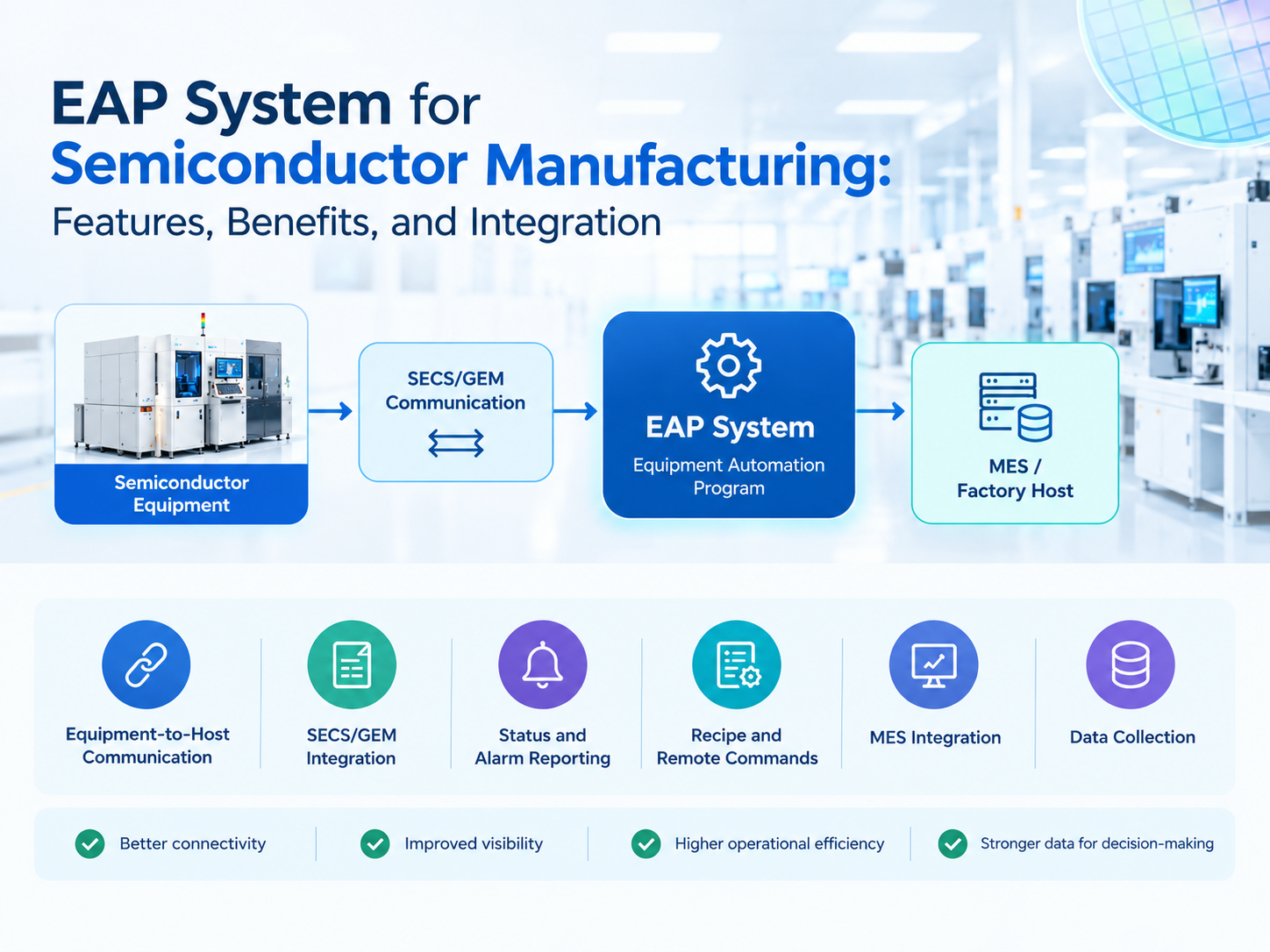
Modern fabs run on hundreds of tools from many vendors. Each tool produces data, alarms, and status changes that factory systems need to see. Each also needs instructions, such as which lot to process and which recipe to use.
Without automation, operators often carry this information by hand. The results are disconnected systems, limited equipment visibility, and inconsistent production data. An EAP system for semiconductor manufacturing closes this gap by coordinating equipment and factory-level systems in a structured, repeatable way.
This guide explains what an EAP is, its key features and benefits, and how it works with SECS/GEM and MES. It also covers implementation challenges and how to choose a solution.
What Is an EAP System in Semiconductor Manufacturing?
EAP stands for Equipment Automation Program. It is the software layer that manages communication and coordination between manufacturing equipment and factory-level systems such as the factory host or Manufacturing Execution System (MES). You may also see it called an Equipment Automation System EAP.
In practice, an EAP receives data and events from equipment and applies factory logic. It also sends instructions back to the tool. It lets the factory automate decisions that would otherwise depend on manual entry.
EAP functionality is not fixed. It depends on the equipment’s capabilities, the host architecture, the communication standards in use, and how the project is implemented. Two fabs can have very different EAP scopes.
Key Features of an EAP System
Most EAP implementations combine several capabilities. Which ones apply depends on what the equipment supports.
- Equipment-to-host communication: a reliable, standardized channel between the tool and factory systems.
- SECS/GEM protocol integration: SECS/GEM is the SEMI standard for equipment communication. It defines how tools report data and accept commands.
- Status and data monitoring: continuous visibility into equipment states, such as idle, processing, or down.
- Alarm and event reporting: alarms and events reach the right systems and people promptly.
- Recipe management and remote commands, where supported: recipes can be selected or downloaded, and commands such as start or stop can be issued remotely.
- MES and host integration: the EAP passes information in both directions so lot tracking and equipment control stay aligned.
- Data collection and production visibility: equipment data becomes available for reporting, analysis, and decisions.
| EAP Feature | What It Does | Practical Benefit |
|---|---|---|
| Equipment-to-Host Communication | Connects semiconductor equipment with factory systems. | Reduces isolated machines and improves connectivity. |
| SECS/GEM Integration | Enables standardized communication between equipment and factory hosts. | Supports consistent interfaces across compatible equipment. |
| Status and Alarm Reporting | Reports equipment status, events, and faults. | Improves visibility into equipment issues. |
| Recipe and Remote Commands | Supports recipe handling and remote commands when configured. | Reduces manual setup and potential entry errors. |
| MES Integration | Exchanges relevant production and equipment data with Manufacturing Execution Systems (MES). | Improves production traceability and data consistency. |
| Data Collection | Collects equipment, process, and event data. | Supports informed manufacturing decisions. |
Benefits of EAP Systems for Semiconductor Fabs
A well-implemented EAP can support the following outcomes. Actual results depend on the fab, the equipment, and the scope of the project.
- Production automation and consistency. Standardized logic reduces variation between operators and shifts.
- Equipment visibility. Teams see tool status and alarms without walking the floor.
- Better data for decisions. Structured equipment data supports engineering and operations reviews.
- Tighter integration. Equipment and factory systems stay synchronized instead of relying on re-keyed information.
- Fewer repetitive manual tasks. Operators spend less time on data entry and routine commands.
- Scalability. Once the framework is in place, it can extend to other compatible equipment.
How Does EAP Integrate with SECS/GEM and MES?
These three layers are related, but they do different jobs.
Semiconductor Equipment → SECS/GEM Communication → EAP / Factory Automation Layer → MES / Factory Host
The equipment exposes its data and controls through a communication interface. SECS/GEM is the common standard, and readers new to it can start with this introduction to SECS/GEM. The EAP then interprets those messages and applies the fab’s automation logic. Finally, it exchanges information with the MES, which manages lots, routes, and production flow.
EAP and SECS/GEM are not interchangeable. SECS/GEM is a communication standard. The EAP is the application logic built on top of that communication. The MES is a separate system with its own responsibilities. Actual architecture varies by implementation. Some fabs place a dedicated EAP between tools and MES, while others split functions differently.
Good EAP and MES integration depends on all three layers working together. A weak link at any layer limits what the automation can do.
Common Challenges in EAP Implementation
EAP projects are rarely plug-and-play. Teams commonly face these issues:
- Legacy equipment connectivity. Older tools may not support SECS/GEM at all.
- Vendor-specific interfaces. Even SECS/GEM tools implement the standard differently.
- Communication compatibility. Protocols, versions, and network setups must align.
- Recipe and alarm mapping. Tool-specific names and codes must map cleanly to factory systems.
- Data consistency. Inconsistent definitions across tools undermine reporting.
- Testing requirements. Integrations need thorough validation before reaching production.
A structured approach helps. Teams should audit equipment capabilities first, define the data and control scope, and map interfaces. They should then test with simulators before connecting live tools.
How eInnoSys Supports Semiconductor Equipment Automation
eInnoSys focuses on semiconductor factory automation and equipment software for fabs, OSATs, and OEMs. Its portfolio covers SECS/GEM, GEM300, equipment integration, and legacy equipment digitization. It also offers EAP-related products and implementation services.
For older tools, EIGEMBox is a patented plug-and-play SECS/GEM box. It adds SECS/GEM connectivity to legacy equipment, which supports legacy equipment automation without replacing the machines. For tools that already have HMI or PLC control, EIGEMHMI adds SECS/GEM connectivity to that existing infrastructure.
Equipment builders can use the SECS/GEM SDK to embed the standard directly into tool software. Teams validating interfaces can use the SECS/GEM simulator before going live. For equipment that lacks the standard, eInnoSys also describes SECS/GEM for non-GEM equipment.
Factory-side needs are covered as well. These include a recipe management system and MES migration and support. Teams building in-house skills can look at SECS/GEM training. Together, these help connect equipment with factory automation systems while working with the infrastructure a fab already has.
Choosing the Right EAP System for Your Semiconductor Fab
Use these criteria to compare options:
- Compatibility with existing equipment. Check support for your tool mix, including legacy tools.
- SECS/GEM and host requirements. Confirm the solution fits your MES and host environment.
- Monitoring, alarms, and data collection. Define what you need to see and record.
- Recipe and remote-control needs. Confirm which commands each tool actually supports.
- Integration and testing support. Ask how interfaces are validated before go-live.
- Maintainability and scalability. Plan for new tools, new lines, and software updates.
Start with a pilot on a representative set of tools. This exposes interface issues early and builds a repeatable template.
Conclusion
An EAP system for semiconductor manufacturing turns isolated tools into a connected, automated production environment. It uses SECS/GEM for equipment communication and feeds the MES with reliable data and control. Done well, it improves visibility, consistency, and integration without overstating what any single system can do.
If you are planning equipment automation, eInnoSys can help you assess your equipment and choose the right path. Explore the solutions above or contact the eInnoSys team to discuss your requirements.


