
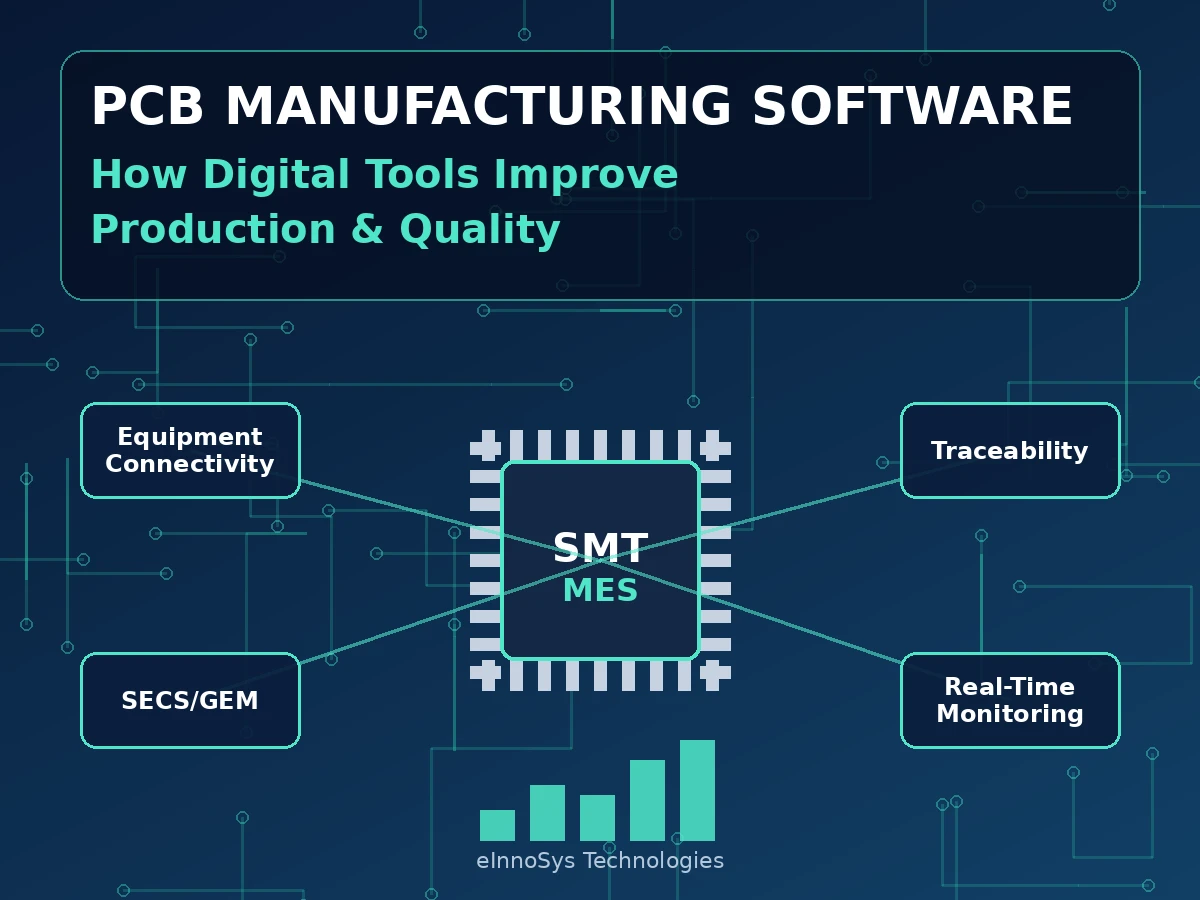
PCB manufacturing software is now central to how electronics factories control output and quality. A modern SMT line runs many machines, from printers and pick-and-place systems to reflow ovens and inspection units. When these machines work in isolation, managers depend on manual logs and guesswork. Digital tools change that. They connect equipment, capture data automatically, and give teams a live view of production.
This guide explains what PCB manufacturing software is, which problems it solves, and how SMT equipment connectivity, MES integration, and SECS/GEM support better production and quality.
What Is PCB Manufacturing Software?
PCB manufacturing software is a group of digital tools that monitor, connect, and manage the processes used to build printed circuit boards. It covers production monitoring, traceability, equipment data collection, workflow automation, and reporting.
It is rarely a single product. In most factories it is a stack. Equipment connectivity software gathers machine data. A manufacturing execution system (MES) manages work orders and traceability. Dashboards then present the results. Together, these SMT manufacturing software layers turn raw machine signals into clear decisions.
Common Challenges in PCB and SMT Manufacturing
Even well-run lines face the same recurring problems.
| Challenge | Description |
|---|---|
| Manual Data Collection | Manual recording of production counts, defects, and downtime wastes time, introduces errors, and delays problem detection. |
| Equipment Communication Gaps | Different SMT machines use different communication protocols, limiting equipment connectivity and MES data access. |
| Production Errors and Quality Issues | Incorrect feeder setups, missed process parameters, and undetected process drift cause defects, rework, and traceability challenges. |
| Limited Real-Time Production Visibility | Delayed production data prevents managers from responding quickly to line stoppages, reducing OEE and delaying shipments. |
How Digital Tools Improve PCB Production and Quality
Digital tools address each of these challenges directly.
- Production monitoring and traceability
The software records which board, material lot, machine, and parameter set were used at every step. If a defect appears, teams can trace it to a specific lot or process within minutes. This also supports customer audits and quality standards. - Equipment connectivity and data collection
Software pulls data straight from machines, including status, alarms, cycle times, and process values. Automatic collection removes transcription errors and gives engineers dependable data for analysis. - Automated workflows and reduced manual intervention
Automation can verify setups, confirm that the right program is loaded, and stop a machine from running the wrong product. Fewer manual steps mean fewer chances for mistakes. - Real-time performance monitoring
Live dashboards show throughput, downtime, and yield as they happen. Teams can react to alarms quickly and use historical trends to plan maintenance. Tools for equipment monitoring and control put this information in front of operators at the machine.
Role of SMT Equipment Connectivity and MES
SMT equipment connectivity is the foundation of a digital factory. An MES can only manage what it can see. Connectivity software acts as the bridge between machines and the MES, moving data in both directions.
Through equipment-to-MES integration, the MES sends recipes, work orders, and instructions down to machines. The machines send back status, counts, and quality data. This closed loop supports:
• Accurate work-in-progress tracking
• Automatic genealogy and traceability records
• Faster product changeovers
• More reliable OEE reporting
Every factory is different, so SMT MES integration and PCB MES integration projects must handle mixed equipment fleets. Older machines often lack modern interfaces. In those cases, hardware such as EIGEMBox supports legacy equipment connectivity without replacing the machine. Explore eInnoSys SMT manufacturing solutions to see how connectivity fits into an SMT line.
How SECS/GEM Integration Supports Electronics Manufacturing
SECS/GEM is a widely used standard for communication between equipment and a host system. It defines how a machine reports events, alarms, and variables, and how a host can send remote commands. It began in semiconductor fabs and is now common in electronics factories too.
A standard interface brings clear benefits:
• Less custom coding for each machine
• A consistent data model across vendors
• Faster SECS/GEM MES integration
• Remote monitoring and control from the host
Several eInnoSys solutions support this approach:
• EIGEMEquipment enables SECS/GEM equipment integration on the machine side.
• EIGEMLink is SECS/GEM integration software for the host side.
• EIGEM300Equipment supports GEM300 equipment integration.
• EIGEM84 supports automated equipment handshaking between machines and handling systems.
• EIGEMSim provides SECS/GEM simulation software so teams can test interfaces before connecting live equipment.
Key Features to Consider in PCB Manufacturing Software
When you compare options, look for these capabilities:
• Broad equipment connectivity: support for SECS/GEM and for legacy machines.
• Real-time data collection: automatic capture of status, alarms, and process data.
• End-to-end traceability: board, lot, machine, and parameter history.
• MES integration: open interfaces that work with your existing systems.
• Scalability: the ability to add lines and sites without rework.
• Testing tools: simulators that shorten commissioning time.
• Security and reliability: stable communication and controlled access.
How eInnoSys Supports SMT and Electronics Factory Automation
eInnoSys Technologies LLP focuses on equipment connectivity and automation for electronics and SMT manufacturing. Its products link machines to MES and host systems. They are designed to complement a complete MES platform, not replace it.
Teams use these tools to connect new and legacy equipment, standardize data, and simplify integration projects. The result is a stronger base for Industry 4.0 electronics manufacturing and PCB manufacturing automation, with better visibility and fewer manual steps.
Conclusion
PCB manufacturing software helps factories replace manual records with accurate, real-time data. Equipment connectivity, MES integration, and SECS/GEM standards work together to improve traceability, reduce errors, and raise production quality. The best results come from connecting equipment first, then building analytics and automation on top.
eInnoSys offers the connectivity and integration solutions that make this possible for SMT and electronics factories. Start by reviewing your current equipment and data gaps, then choose tools that fit your line.
Related Blogs:-
- SMT Automation Solutions for Electronics Manufacturing
- SMT Factory Automation: A Complete Guide to Smart Electronics Manufacturing
- SMT Automation: How It Improves Electronics Manufacturing Efficiency


