
Introduction
Connecting equipment to a factory host may sound simple. However, problems can arise when an alarm, recipe download, or carrier event does not work as expected. SECS/GEM provides a common way for semiconductor equipment and factory host systems to communicate. Therefore, choosing the right SECS/GEM provider plays an important role in keeping equipment connected and factory operations running smoothly.
A poor choice may not cause problems on day one. However, issues can appear later through long setup times, extra workarounds, difficult custom code, and limited technical support. Moreover, semiconductor fabs often use equipment from different generations, controllers, and PLCs. As a result, you need a provider who can handle different equipment types and support your integration needs.
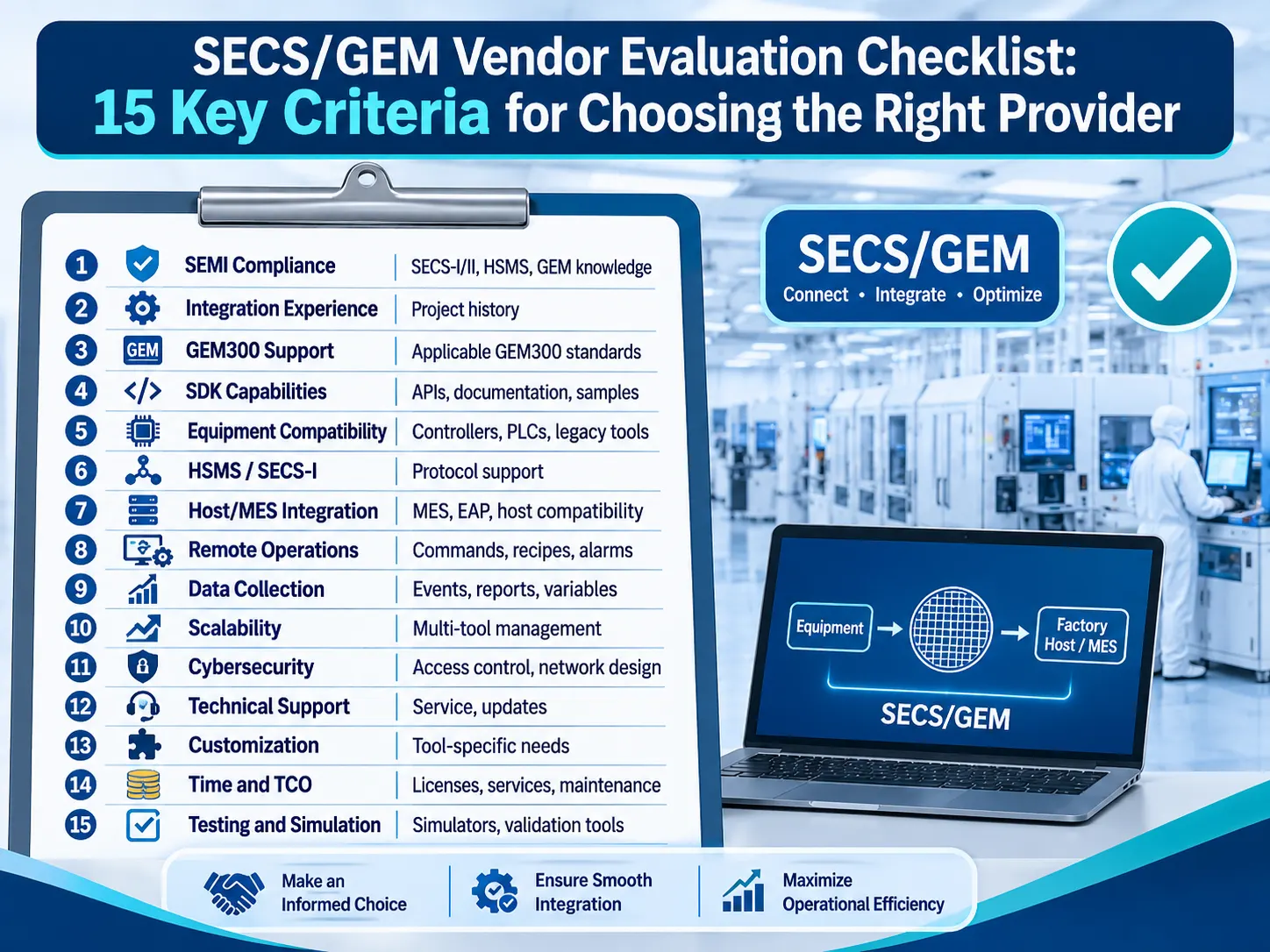
The 15 Key Criteria
1. SEMI Standards Compliance
- What it means: Real knowledge of SECS-II (E5), SECS-I (E4), HSMS (E37) and GEM (E30), plus whichever other SEMI standards apply to your tools.
- Why it matters: Hosts expect standard behavior. Gaps cause interoperability problems.
- Ask: Which standards and GEM capabilities do you implement, and which are optional or partial?
- Request: A GEM compliance statement or capability list, and the documented scenarios.
- Warning signs: Vague answers such as “fully compliant” with nothing in writing.
2. SECS/GEM Implementation Experience
- What it means: A track record of connecting real semiconductor equipment.
- Why it matters: Practical experience shortens troubleshooting and reduces surprises.
- Ask: What equipment types have you integrated, and what did commissioning involve?
- Request: Relevant references or case summaries that the vendor can share.
- Warning signs: Only generic software experience, or references that cannot be shared in any form.
3. GEM300 Compatibility
- What it means: Support for the GEM300 standards your fab requires, such as E39, E40, E87, E90 and E94.
- Why it matters: 300 mm automation depends on carrier, job and substrate handling. Not every tool needs all of them, so match the list to your equipment.
- Ask: Which GEM300 standards do you support, and how are they tested?
- Request: A standards support matrix and any test results.
- Warning signs: Claiming every standard for every tool, or no clear scope.
4. SECS/GEM SDK Capabilities
- What it means: The quality of the SECS/GEM SDK: APIs, language support, samples and documentation.
- Why it matters: The SDK determines how quickly your engineers can build and maintain the equipment interface.
- Ask: Which platforms and languages are supported? How are customizations handled?
- Request: API documentation, sample projects and a trial or evaluation build.
- Warning signs: Thin documentation, or an SDK that cannot be evaluated before purchase.
5. Equipment Compatibility
- What it means: Fit with your equipment makes, controllers, PLCs and legacy tools.
- Why it matters: A solution that works on a new tool may fail on an older one.
- Ask: What controller architectures do you support? How do you handle tools with no native GEM interface?
- Request: Supported platform lists and integration approach descriptions.
- Warning signs: “It should work” without a validation plan.
6. HSMS and SECS-I Support
- What it means: Support for HSMS over TCP/IP and, where needed, SECS-I over serial.
- Why it matters: Older tools often use serial links, newer ones use Ethernet.
- Ask: Do you support both, and how are connection modes, timers and retries configured?
- Request: Configuration guides and parameter lists.
- Warning signs: HSMS only when your fleet includes serial tools.
7. Host and MES Integration
- What it means: How well the solution works with your MES, EAP and host systems.
- Why it matters: Equipment-host communication is only useful if the host side can consume it.
- Ask: Have you integrated with systems like ours? What host-side tools are provided?
- Request: Interface specifications and integration examples.
- Warning signs: No host-side testing capability.
8. Equipment Control and Remote Operations
- What it means: Support for remote commands, recipe handling, alarms and equipment state reporting.
- Why it matters: Remote control is where host and equipment behavior must match precisely.
- Ask: How are remote commands, recipe transfers and alarm handling implemented?
- Request: Supported message lists and state model documentation.
- Warning signs: State models that differ from the standard without explanation.
9. Data Collection and Reporting
- What it means: Collecting events, variables, alarms and production data through configurable reports.
- Why it matters: Yield and traceability programs depend on data you can define and trust.
- Ask: How are collection events, reports and trace data configured at runtime?
- Request: Example data collection configurations.
- Warning signs: Fixed reports that need code changes for every new variable.
10. Scalability and Multi-Equipment Support
- What it means: The ability to grow from a few tools to a whole fab.
- Why it matters: Today’s pilot becomes tomorrow’s fleet.
- Ask: How are many connections managed, configured and updated?
- Request: Architecture notes and deployment guidance.
- Warning signs: One-off setups that cannot be reused.
11. Cybersecurity and Data Protection
- What it means: Access control, network architecture and secure deployment practices around the equipment interface.
- Why it matters: Connected tools widen your attack surface. SECS/GEM itself has limited built-in security, so surrounding practices matter.
- Ask: What access controls, logging and network segmentation do you recommend? How are vulnerabilities handled?
- Request: Security guidance and update policy.
- Warning signs: No security documentation, or dismissing the topic.
12. Technical Support and Maintenance
- What it means: Troubleshooting help, documentation, updates and long-term support.
- Why it matters: Problems surface during production, not during sales.
- Ask: What support is included, what are response expectations and how are updates delivered?
- Request: Support terms in writing.
- Warning signs: Support defined only verbally.
13. Customization and Integration Flexibility
- What it means: Handling of tool-specific requirements and non-standard behavior.
- Why it matters: Real equipment rarely matches a template.
- Ask: How do you handle custom messages, vendor-specific variables and unusual state behavior?
- Request: Examples of how customization is done and who does it.
- Warning signs: Every change requires vendor-side development.
14. Implementation Time and Total Cost of Ownership
- What it means: Development effort, licensing, integration services and ongoing maintenance together.
- Why it matters: The lowest license price can carry the highest lifetime cost.
- Ask: What is included in licensing? What typically drives effort and cost?
- Request: A clear breakdown of license, services and support fees.
- Warning signs: Vague scope or open-ended services.
15. Testing, Simulation and Validation
- What it means: Simulators, protocol validation tools and commissioning support.
- Why it matters: Testing against simulated hosts and equipment finds problems before the real tool is involved.
- Ask: Do you provide equipment and host simulators and message-level logging?
- Request: A test plan and sample test reports.
- Warning signs: Testing only on live equipment.
Vendor Evaluation Comparison Table
| Evaluation Criteria | What to Check | Questions to Ask | Importance | |
|---|---|---|---|---|
| 1 | SEMI Compliance | SECS-I/II, HSMS, GEM knowledge | Which standards do you support? | High |
| 2 | Integration Experience | Project history | Can you share relevant case studies? | High |
| 3 | GEM300 Support | Applicable GEM300 standards | Which standards are supported? | High |
| 4 | SDK Capabilities | APIs, documentation, code samples | Is the SDK customizable? | High |
| 5 | Equipment Compatibility | Controllers, PLCs, legacy tools | How are non-GEM tools handled? | High |
| 6 | HSMS / SECS-I | Protocol and configuration support | Are both protocols supported? | Medium–High |
| 7 | Host/MES Integration | MES, EAP, host compatibility | Have you completed similar integrations? | High |
| 8 | Remote Operations | Commands, recipes, alarms | How is equipment state handled? | High |
| 9 | Data Collection | Events, reports, variables | Can configurations be changed at runtime? | Medium–High |
| 10 | Scalability | Multi-equipment management | How do you manage multiple tools? | Medium |
| 11 | Cybersecurity | Access control, network design | What cybersecurity practices do you recommend? | High |
| 12 | Technical Support | Service, updates, maintenance | What support is included? | High |
| 13 | Customization | Equipment-specific requirements | Who handles customization? | Medium |
| 14 | Time and TCO | Licenses, services, maintenance | What is the total cost of ownership? | High |
| 15 | Testing and Simulation | Simulators, validation tools | What testing tools are provided? | High |
Conclusion
Choosing a SECS/GEM provider means weighing technical expertise, standards compliance, integration capability, scalability, security and long-term support together. A structured evaluation, with evidence requests and weighted scoring, gives you a defensible decision that holds up well past the purchase price comparison.


