
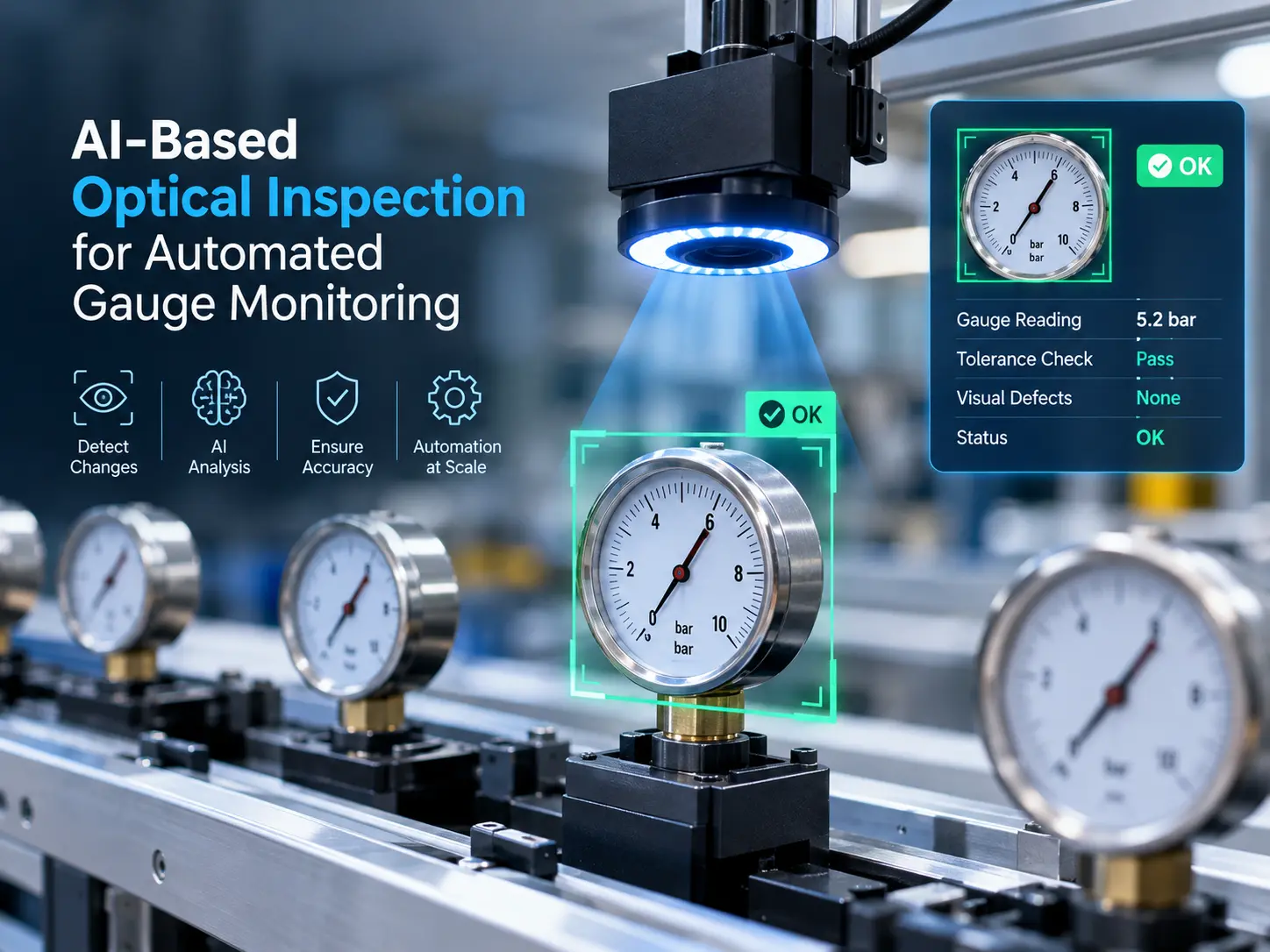
Walk through almost any fab, plant, or utility room and you will find analog gauges. They show pressure, temperature, flow, vacuum, and other process conditions, and they have done so reliably for decades. The problem is not the gauges. The problem is how people read them.
In most facilities, someone walks a route, looks at each dial, and writes down a number. That approach is slow, hard to scale, and prone to variation between people and shifts. It also leaves gaps: whatever happens between two rounds goes unseen.
EIGaugeMonitor from eInnoSys addresses this gap. It is an AI-based solution that uses optical inspection to read analog gauges automatically and turn what a person would see into data that systems and engineers can use. The sections below explain why this matters, how the approach works, and where it fits in industrial and semiconductor environments.
Why Automated Gauge Monitoring Matters
Manual gauge reading has worked for a long time, but it has clear limits.
- Human error. Parallax, rushed rounds, and transcription mistakes all affect what ends up in a log.
- Inconsistent readings. Two people can read the same needle position differently, especially on gauges with fine graduations.
- Limited frequency. A technician can only visit each gauge so often. A short excursion between rounds can pass unnoticed.
- Poor scalability. As the number of gauges grows, so does the time needed to check them, and some gauges sit in places that are inconvenient or hard to reach.
- Delayed visibility. Handwritten or spreadsheet logs are reviewed after the fact, not as conditions change.
Modern manufacturing depends on continuous process visibility. Smart manufacturing and Industry 4.0 initiatives assume that equipment and process conditions are available as data. Many analog gauges, however, are still outside that data flow. Automated gauge reading closes that gap without requiring a plant to replace instruments that already work.
What Is an Analog Gauge Reader?
An analog gauge reader is a system that reads a mechanical dial and reports its value without a person looking at it. It does what a technician does: finds the gauge, locates the needle, compares its position with the scale, and records the value.
Optical, vision-based readers do this with a camera. Machine vision software analyzes the image, interprets the dial, and returns a number. Because the reader only observes the gauge, the instrument itself usually does not need to be modified, though the specifics depend on each installation
This is a useful property in facilities where gauges are part of existing equipment, where retrofitting sensors is costly, or where adding new measurement points would mean revalidating a process.
How EIGaugeMonitor Uses AI-Based Optical Inspection
EIGaugeMonitor applies AI-based inspection to the same steps a person follows when reading a dial. At a general level, the workflow looks like this:
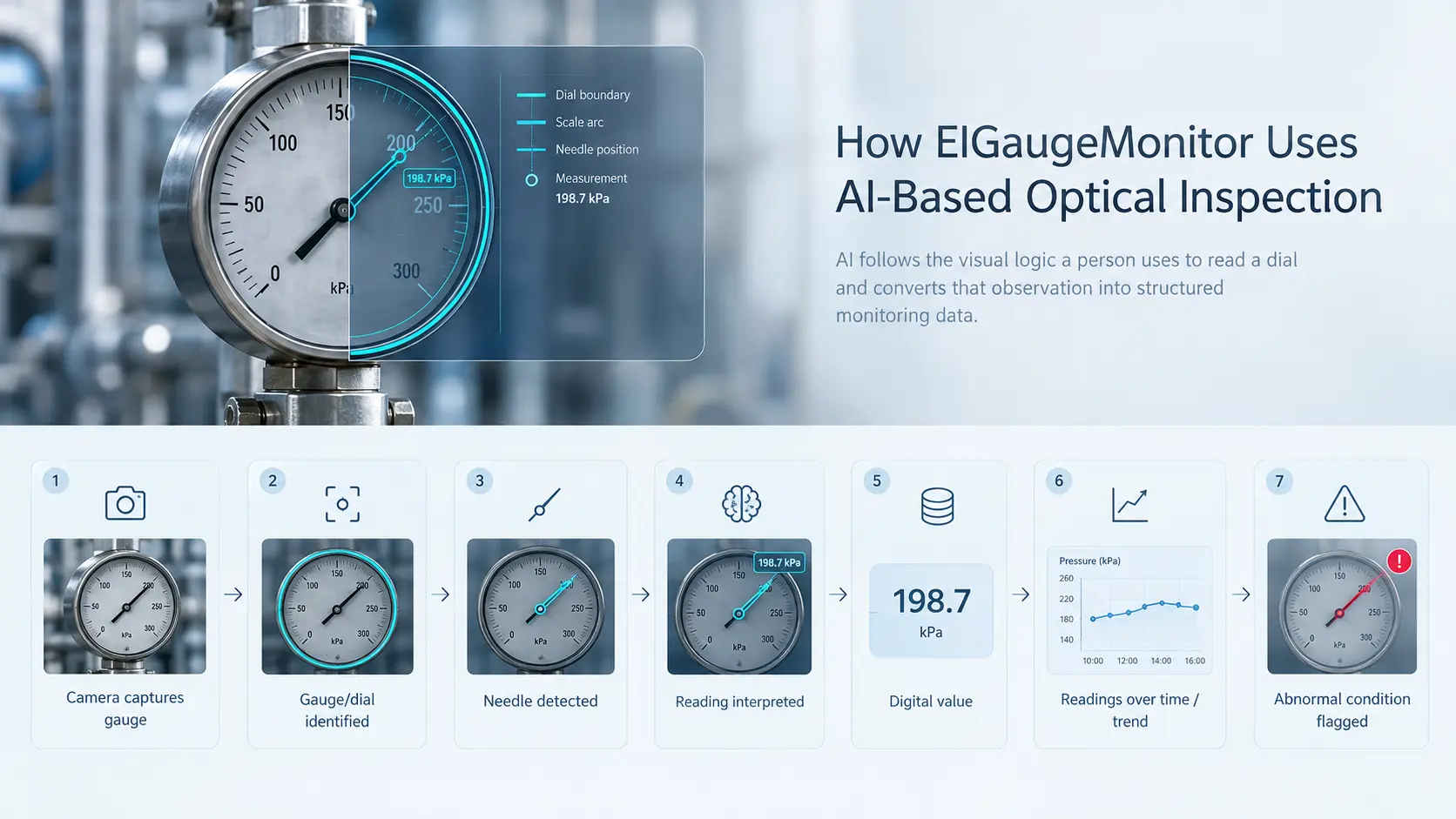
- Capturing gauge images. A camera captures images of the analog gauge so the dial and pointer are visible.
- Identifying the gauge and dial. The software locates the gauge in the image and recognizes the dial face and its scale.
- Detecting the pointer. It finds the needle and determines its position relative to the scale.
- Interpreting the reading. Using the dial’s scale, the software translates the needle position into a gauge value.
- Converting the reading into usable data. The visual reading becomes a digital value that can be stored, displayed, or passed to other systems .
- Monitoring readings over time. Repeated readings build a history, so teams can see trends instead of isolated snapshots.
- Flagging abnormal conditions. When a value moves outside an expected range, the system can highlight it for attention.
AI matters most in steps two through four. Gauges vary in size, style, scale, and lighting, and a rigid rule-based approach struggles with that variety. Learning-based vision methods are better suited to handling it. Exact accuracy, supported gauge types, and camera requirements depend on the deployment and should be confirmed for each use case.
Key Benefits of EIGaugeMonitor
The value of automated gauge monitoring is practical rather than flashy. Teams typically look for the following.
- Automated gauge reading. Readings are captured without a person standing at the gauge.
- Reduced manual inspection. Technicians spend less time on routine rounds and more on work that needs judgment.
- More consistent monitoring. The same method reads every gauge every time, which removes much of the variation between observers.
- Faster identification of abnormal readings. Continuous or frequent monitoring shortens the gap between an excursion and someone noticing it.
- Better visibility into equipment conditions. Gauge data joins other process data, giving engineers a fuller picture of how equipment behaves.
- Support for continuous monitoring. Readings can be taken far more often than a person could manage on foot.
- Less dependence on manual checks. Monitoring no longer relies on whether a round happened on schedule.
- Improved operational efficiency. Less time spent collecting readings means more time spent acting on them.
The size of these gains depends on the facility, the number of gauges, and how current monitoring works. They should be assessed against a site’s own baseline rather than assumed.
EIGaugeMonitor for Industrial and Manufacturing Applications
Any environment that still relies on analog gauges is a candidate for optical monitoring. Common examples include:
- Semiconductor manufacturing. Fabs rely on tightly controlled processes and a large installed base of process and facility equipment, where pressure, vacuum, and flow indications matter.
- Industrial equipment monitoring. Pumps, compressors, and similar assets often carry mechanical gauges that show operating condition.
- Factory automation. Gauge data can support automation teams that want fewer blind spots on the production floor.
- Process monitoring. Plants that track pressure, temperature, or flow benefit from readings that are timestamped and stored.
- Manufacturing facilities. Utilities and supporting infrastructure often depend on analog instrumentation.
- Equipment condition monitoring. A history of gauge values helps teams see gradual drift that a single reading would hide.
Which gauges and locations make sense for automated monitoring is a site-specific decision. A short assessment of gauge types, access, and lighting is usually the right starting point.
EIGaugeMonitor and Automated Optical Inspection Systems
Optical inspection is already familiar in manufacturing, mostly for checking products and components. The same idea applies to instruments. Automated optical inspection systems use cameras and software to examine what would otherwise need a human eye, and gauge reading is one more place where that approach pays off.
The real value lies in what happens after the reading. A gauge that is only read by sight produces a number in a notebook. A gauge that is read optically produces a digital value with a timestamp. That value can be trended, compared against limits, and shared with the people and systems that need it.
Optical monitoring also complements existing practice rather than replacing it. Fixed sensors, PLC data, and equipment interfaces remain the right choice where they exist. EIGaugeMonitor is most useful where a gauge is the only available indication, where retrofitting a sensor is impractical, or where teams want a second, independent view of a critical reading. Used this way, it extends monitoring coverage instead of competing with current systems.
Why Choose EIGaugeMonitor from eInnoSys?
eInnoSys works in industrial technology for semiconductor and manufacturing environments. Its work centers on connecting equipment and making operational data usable, including equipment connectivity and automation, equipment monitoring, and AI/ML-based approaches.
That background shapes how EIGaugeMonitor is positioned:
- Practical automation approach. The goal is to get dependable readings into the hands of the people who need them, not to add complexity.
- Fit with manufacturing data flows. Gauge readings are most valuable when they sit alongside other equipment and process data in a smart manufacturing environment.
- Domain familiarity. Semiconductor and industrial settings have particular expectations around reliability, traceability, and equipment integration.
- Monitoring beyond a single instrument. Gauge data can support wider equipment monitoring and maintenance planning.
Conclusion
Analog gauges are not going away, but reading them by hand does not have to continue. EIGaugeMonitor helps organizations move from manual observation to automated, AI-based optical monitoring, with consistent readings, a continuous record, and earlier visibility into abnormal conditions.
If your team still depends on manual gauge checks, or you want to bring existing instruments into a connected monitoring setup, explore EIGaugeMonitor or contact eInnoSys to discuss your gauge-monitoring requirements.


