
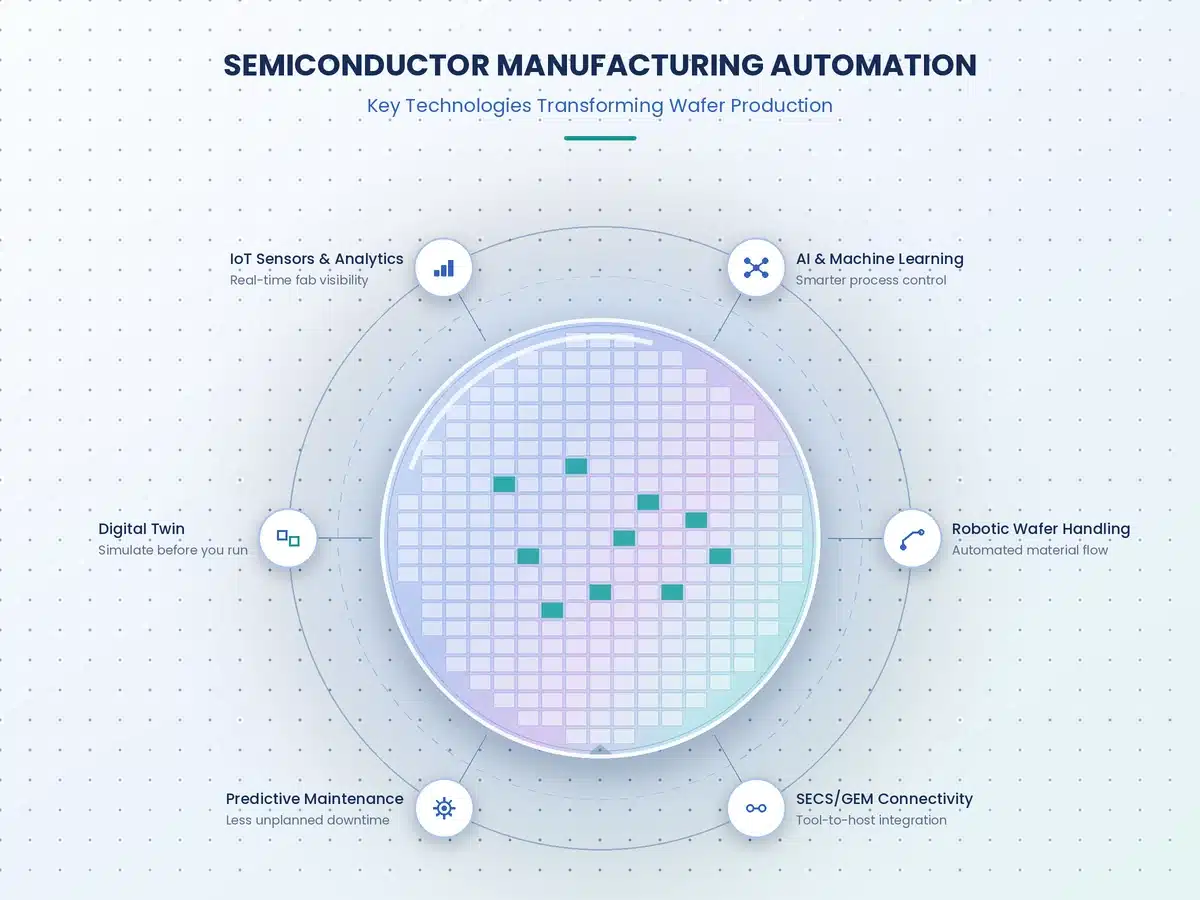
Wafer production leaves almost no room for error. A single deviation can affect yield, cycle time, and cost across hundreds of process steps. That is why semiconductor manufacturing automation is now essential for modern fabs.
Manual operation cannot deliver the consistency, speed, and traceability that today’s production demands. Automation connects tools, systems, and people. It improves efficiency, equipment utilization, and process control at the same time.
This guide explains the key technologies behind automated wafer production and how they work together.
What Is Semiconductor Manufacturing Automation?
Semiconductor manufacturing automation is the automated control of four things:
- Equipment: tools run and report status with minimal manual input.
- Material movement: wafers and carriers travel through the fab automatically.
- Production workflows: process steps follow defined, repeatable rules.
- Data: information flows between tools and factory systems without manual entry.
Each layer supports the others. Together they form the digital backbone of a modern fab, and they are the foundation of any effective semiconductor manufacturing software environment.
Equipment Automation
Equipment automation allows tools to operate, report status, and communicate with host systems automatically. Operators no longer need to key in commands or record results by hand.
As a result, tools respond faster, human error drops, and the host always knows what each machine is doing. Every other automation layer builds on this one.
SECS/GEM Communication
SECS/GEM is the standard language between semiconductor equipment and host systems. It defines how tools report events, alarms, and status, and how hosts send commands.
Because the standard is shared, fabs can integrate tools from different vendors in a consistent way. This reduces custom development and shortens integration time.
eInnoSys supports this layer with EIGEMEquipment for the equipment side and EIGEMHost for the host side.
MES Integration
A Manufacturing Execution System (MES) tracks lots, manages workflows, and enforces process rules. However, it can only work with the data it receives.
Integrating equipment with the MES closes that gap. Production tracking becomes accurate, lot genealogy stays complete, and process management happens in real time. Learn more in our microelectronics solutions overview.
Automated Material Handling
Automated material handling moves wafers and carriers without manual transport. It also handles equipment-to-equipment transfers.
The benefits are clear:
- Less wafer handling, which means lower contamination and breakage risk
- Faster, more predictable lot movement
- Higher tool utilization because tools wait less for material
Recipe Management
Recipes define how each process step runs. Managing them by hand invites mistakes, such as the wrong recipe, an outdated version, or an unauthorized change.
Automated recipe management controls selection and execution. It standardizes recipes across tools, so every wafer follows the approved process. This consistency directly supports yield.
Real-Time Data Collection
Real-time data collection captures equipment and process information automatically. It records events, parameters, and alarms as they happen.
Manual logging is slow and error-prone. Automatic collection gives engineers complete, timestamped data for analysis and traceability. It is also the fuel for every analytics and AI initiative that follows.
Process Monitoring
Process monitoring uses collected data to watch equipment status, production parameters, and abnormalities.
When a parameter drifts, the system flags it quickly. Engineers can then act before the issue affects more wafers. In practice, this shifts a fab from reacting to problems toward preventing them.
AI and Predictive Maintenance
AI and machine learning analyze equipment data to find patterns that people often miss. They can detect early signs of tool degradation.
Predictive maintenance uses those signals to schedule service before a failure happens. The result is fewer surprises and less unplanned downtime. It also extends the life of expensive equipment.
Legacy Equipment Automation
Many fabs still run older tools that lack modern communication interfaces. Replacing them is costly and disruptive.
Legacy equipment automation offers another path. It adds connectivity and protocol conversion without major equipment modifications. Older tools can then join the automated environment and share data with MES and host systems.
eInnoSys addresses this need with EIGEMLink for universal protocol conversion and EIGEMBox for plug-and-play automation of legacy tools.
How These Technologies Work Together
Each technology delivers value alone, but the real gains come from connection. Equipment automation and SECS/GEM provide the link. MES integration and recipe management provide control. Data collection, monitoring, and AI provide insight. Material handling keeps wafers moving.
The table below summarizes the roles.
| Technology | Role in Wafer Production |
|---|---|
| SECS/GEM | Equipment-to-host communication |
| MES Integration | Production tracking and process management |
| Material Handling Automation | Automated wafer and carrier movement |
| Recipe Management | Standardized process recipes |
| Real-Time Data Collection | Automatic equipment and process data |
| AI/ML and Predictive Maintenance | Early detection of equipment issues |
| Protocol Conversion | Connects tools with different protocols |
| Legacy Equipment Digitization | Adds automation to older tools |
Conclusion
Connected automation makes wafer production more efficient, consistent, and scalable. Fabs that integrate equipment, data, and systems gain tighter process control and higher equipment utilization.
eInnoSys helps semiconductor manufacturers achieve this with proven equipment integration and automation solutions. From SECS/GEM connectivity to legacy tool modernization, eInnoSys supports every stage of the journey.
Related Blogs:-
- How Semiconductor Manufacturing Software Supports End-to-End Production Management
- Microelectronics Manufacturing Software: How Digital Tools Improve Production Control


