
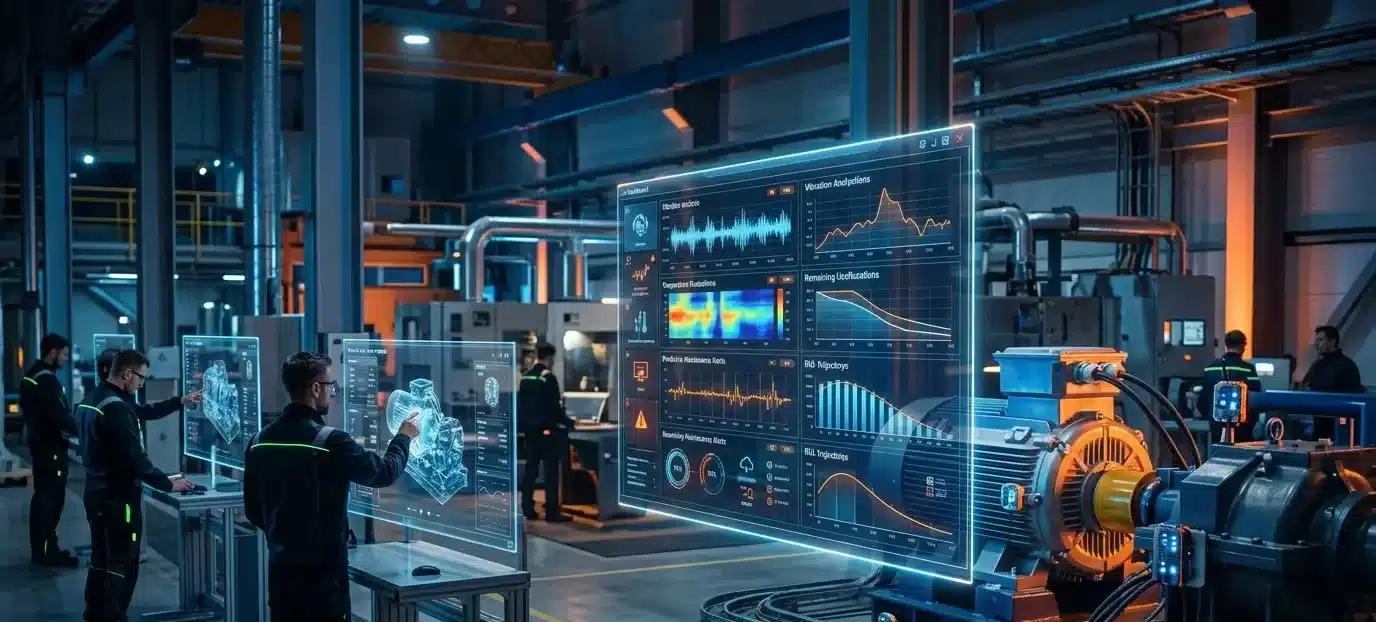
Motors are the quiet workhorses of every industrial facility. They drive pumps, compressors, blowers, conveyors, exhaust systems, and vacuum systems across semiconductor fabs, automotive plants, oil & gas installations, pharmaceutical lines, and power stations. When a motor fails unexpectedly, it rarely fails alone — it takes production schedules, yield targets, and maintenance budgets down with it.
AI motor predictive maintenance is changing that equation. By combining industrial-grade sensors with machine learning, plants can now detect the earliest signs of motor degradation — sometimes weeks before a failure would otherwise occur — and act before an unplanned shutdown happens.
This guide walks through what AI motor predictive maintenance actually is, how it works, why it outperforms traditional maintenance strategies, and how manufacturers across industries are putting it into practice. Along the way, we’ll look at where a purpose-built solution like eInnoSys xPump fits into the picture.
What Is AI Motor Predictive Maintenance?
AI motor predictive maintenance is the practice of using machine learning models, condition monitoring sensors, and industrial IoT infrastructure to continuously assess the health of motors and motor-driven equipment (pumps, blowers, fans, exhausts, compressors) — and to predict when a failure is likely to occur, before it actually happens.
Unlike calendar-based maintenance, which services equipment on a fixed schedule regardless of actual condition, AI predictive maintenance relies on real, continuous data: vibration signatures, temperature trends, current draw, voltage fluctuations, and acoustic patterns. Machine learning models trained on this data learn what “normal” looks like for a specific asset and flag deviations that correlate with developing faults — bearing wear, rotor imbalance, misalignment, insulation breakdown, or lubrication failure — long before those faults become audible, visible, or catastrophic.
In short: preventive maintenance guesses when a motor might fail based on time; predictive maintenance measures how a motor is actually behaving and calculates when it will fail.
Preventive vs. Predictive vs. AI-Driven Predictive Maintenance
It’s worth separating three terms that get used interchangeably but mean very different things operationally.
The key differentiator of AI-driven predictive maintenance is that it doesn’t just alert when a value crosses a fixed limit — it recognizes the trajectory of degradation across multiple correlated signals (vibration + temperature + current, for example) and estimates a remaining useful life. That’s what allows teams to plan a repair during a scheduled shutdown window instead of scrambling during a live production run.
| Maintenance Approach | Trigger | Data Used | Typical Outcome |
|---|---|---|---|
| Reactive Maintenance | The equipment has already failed | None | Emergency repairs, unplanned downtime, production loss, and the highest maintenance costs. |
| Preventive Maintenance | Fixed time interval or usage schedule | Manufacturer recommendations, maintenance schedules, and historical averages | Reduces some failures but often results in unnecessary part replacements or unexpected breakdowns between service intervals. |
| Condition-Based Maintenance (CBM) | Sensor values exceed predefined thresholds | Real-time sensor data such as vibration, temperature, pressure, or current | Detects abnormal conditions earlier than preventive maintenance but only reacts after thresholds are crossed. |
| AI Predictive Maintenance | Machine learning identifies developing fault patterns before failure | Continuous multi-sensor data (vibration, temperature, current, acoustics, oil analysis, etc.) combined with historical failure data | Predicts failures days or weeks in advance, enabling proactive maintenance, minimizing downtime, extending equipment life, and reducing maintenance costs. |
The key differentiator of AI-driven predictive maintenance is that it doesn’t just alert when a value crosses a fixed limit — it recognizes the trajectory of degradation across multiple correlated signals (vibration + temperature + current, for example) and estimates a remaining useful life. That’s what allows teams to plan a repair during a scheduled shutdown window instead of scrambling during a live production run.
Why Motor Failures Are So Costly
Unplanned motor and pump downtime is one of the most expensive events in industrial operations, and the cost extends well beyond the price of a replacement part.
- Production loss — A single failed vacuum pump or exhaust blower can halt an entire process tool or production line.
- Production loss — A single failed vacuum pump or exhaust blower can halt an entire process tool or production line.
- Emergency repair premiums — Rush parts, overtime labor, and expedited service calls typically cost 3–5x more than planned maintenance.
- Cascading failures — A degraded motor often damages coupled equipment (seals, impellers, gearboxes) before it’s finally caught, multiplying repair scope.
- Yield and quality impact — In semiconductor and pharmaceutical environments, a pump or motor fault can compromise an entire lot or batch, not just the equipment itself.
- Safety risk — Overheating motors, failed bearings, and electrical faults are fire and injury hazards.
- Energy waste — A motor with worsening mechanical friction or misalignment draws more current long before it fails outright, quietly inflating energy bills.
None of these costs are visible on a maintenance calendar. They only become visible after the fact — which is exactly the gap AI predictive maintenance is designed to close.At a high level, an AI motor predictive maintenance system follows four stages:
Step 1: Data Acquisition
Industrial-grade sensors are installed on or near the motor and driven equipment to continuously capture:
- Vibration (accelerometers across multiple axes)
- Temperature (bearing housing, windings, ambient)
- Electrical parameters (current, voltage, power factor)
Acoustic signatures (in some systems)
Speed/RPM and load data
Step 2: Edge & Cloud Data Processing
Raw sensor data is filtered, time-synced, and often pre-processed at the edge to reduce bandwidth and enable near-real-time response, before being sent to a cloud or on-premises analytics platform.
Step 3: Machine Learning Analysis
This is where the “AI” in AI motor predictive maintenance does its work. Models — often a combination of statistical anomaly detection, supervised classification (trained on known failure signatures), and time-series forecasting — analyze the incoming data to:
- Establish a baseline “healthy” signature for each asset
- Detect anomalies and drift from that baseline
- Classify the likely fault type (bearing wear, imbalance, misalignment, cavitation, electrical fault, lubrication breakdown)
- Estimate the remaining useful life (RUL) and the probable failure window
Step 4: Alerting & Action
When the model’s confidence crosses a threshold, the system issues an alert — via email, SMS, dashboard, or integration into SCADA/MES/SECS-GEM alarm systems — giving maintenance teams a defined window (often weeks, not hours) to schedule an inspection or repair.
5. Key Technologies: Vibration Analysis, IIoT Sensors & Machine Learning
Vibration Analysis
Vibration analysis remains the single most reliable indicator of mechanical motor health. Every rotating asset has a vibration “fingerprint,” and specific fault types produce specific frequency-domain signatures:
- Bearing defects show up at characteristic bearing fault frequencies
- Imbalance appears as a strong signal at 1x running speed
- Misalignment typically shows up at 1x and 2x running speed
- Looseness produces harmonics across multiple frequencies
AI systems apply Fast Fourier Transform (FFT) and more advanced spectral techniques automatically, continuously, and at a resolution no human walking the floor with a handheld meter could match.
Industrial IoT (IIoT) Sensors
Wireless, industrial-grade IIoT sensors have made continuous condition monitoring economically viable at scale. Instead of periodic manual readings, IIoT sensors stream data 24/7, which is essential because failure precursors can develop gradually — data captured once a month can easily miss the inflection point.
Machine Learning Predictive Maintenance Models
Common approaches include:
- Anomaly detection (unsupervised) — flags any deviation from learned normal behavior, useful when failure history is limited
- Classification models (supervised) — trained on labeled historical failure data to identify specific fault types
- Time-series/RUL forecasting — projects degradation trends forward to estimate when a threshold will be crossed
- Continuous learning — models retrain on new data over time, improving accuracy as more equipment history accumulates
The strongest systems combine all of these rather than relying on a single static rule set.
6. Benefits of AI Predictive Maintenance for Industrial Motors
- Reduced unplanned downtime — Facilities implementing AI-based condition monitoring commonly report unplanned downtime reductions in the range of 30–70% commonly, depending on baseline maturity.
- Lower maintenance and repair costs — Planned repairs avoid rush parts, overtime labor, and secondary damage, often cutting repair costs significantly.
- Extended equipment life — Catching faults early prevents secondary damage that would otherwise shorten the life of bearings, seals, windings, and coupled components.
- Improved OEE (Overall Equipment Effectiveness) — Less downtime and fewer speed losses directly raise OEE scores.
- Better maintenance planning — Teams shift from firefighting to scheduling, improving spare parts inventory management and labor allocation.
- Energy savings — Motors operating outside their healthy baseline often consume more energy; early correction restores efficiency.
- Safety improvements — Early detection of overheating, electrical faults, and mechanical failure reduces fire and injury risk.
- Data-driven root cause analysis — Historical trend data helps engineering teams identify recurring failure modes and fix design or process issues, not just symptoms.
7. Industry-Specific Applications
Semiconductor Manufacturing & OSAT Facilities
Vacuum pumps, dry pumps, turbomolecular pumps, exhaust systems, and cleanroom HVAC motors run continuously and are directly tied to wafer yield. A single pump failure can scrap an entire lot. AI predictive maintenance here typically integrates with SECS/GEM and fab MES systems so alerts appear directly in existing equipment automation workflows — critical for fabs and OSAT facilities where every minute of tool downtime has a yield cost.
Automotive Manufacturing
Conveyor motors, robotic actuators, and press-line drives operate on tightly synchronized lines where one motor failure can stop the entire assembly line. Predictive maintenance protects takt time and prevents costly line-wide stoppages.
Oil & Gas
Pumps, compressors, and blowers often run in remote or hazardous locations where manual inspection is difficult and failure consequences (leaks, fires) are severe. Continuous remote condition monitoring reduces both safety risk and inspection labor costs.
Food & Beverage
Motors driving mixers, pumps, and packaging lines must meet strict hygiene and uptime requirements. Predictive maintenance helps avoid contamination risks tied to emergency repairs and unplanned line stoppages.
Pharmaceutical Manufacturing
Batch integrity depends on continuous, validated equipment operation. Predictive maintenance supports both uptime and the documentation trail needed for regulatory compliance.
Chemical Processing
Pumps and blowers handling corrosive or hazardous media benefit from early fault detection that reduces the risk of leaks, spills, and unplanned shutdowns in continuous process environments.
Power Generation
Motors driving cooling systems, feed pumps, and auxiliary equipment are critical to plant availability. Predictive maintenance supports the tight reliability margins power generation facilities operate under.
8. Building Blocks of a Predictive Maintenance Program
A successful AI motor predictive maintenance rollout generally includes:
- Asset prioritization — Start with critical, high-downtime-cost motors and pumps, not every asset in the plant.
- Sensor selection and installation — Match sensor type (vibration, temperature, current) to the failure modes most relevant to each asset class.
- Connectivity infrastructure — Reliable IIoT network (wired or wireless) to move data from the floor to the analytics platform.
- Analytics and machine learning platform — Software that turns raw sensor data into fault classification and remaining-useful-life estimates.
- Integration with existing systems — SCADA, MES, SECS/GEM, or CMMS integration so alerts reach the right team through the right channel.
- Alerting and escalation workflow — Defined thresholds, notification channels (SMS/email), and response procedures.
- Continuous model improvement — Feedback loop where confirmed failures and false alarms are used to retrain and refine models over time.
9. Common Challenges and How to Overcome Them
- Legacy equipment without built-in monitoring — Older motors and pumps often lack any native connectivity. Retrofit-friendly sensor kits and universal-compatibility platforms solve this without requiring equipment replacement.
- Data overload without actionable insight — Raw sensor dashboards without machine learning analysis just create more noise. The value is in AI-driven fault classification, not raw charts.
- Integration with existing factory systems — Predictive maintenance tools need to plug into SCADA, MES, and (in semiconductor environments) SECS/GEM — not operate as an isolated silo.
- Alert fatigue — Poorly tuned thresholds generate false positives that erode trust. Systems that combine multiple parameters and continuously learn reduce false alarms over time.
- Organizational change management — Shifting maintenance teams from a reactive/calendar mindset to a data-driven one requires training and a visible early-win pilot program.
10. Choosing the Right Predictive Maintenance Software
When evaluating predictive maintenance software and condition monitoring platforms, industrial buyers should look for:
- Genuine machine learning, not static thresholds — Ask specifically how failure predictions are generated and whether the model learns from your equipment’s own history.
- Universal equipment compatibility — The platform should support your existing pump and motor brands rather than locking you into a single OEM’s monitoring ecosystem.
- Lead time on alerts — Days of warning are useful; weeks of warning are what actually allow planned maintenance scheduling.
- Turnkey deployment — Hardware, software, installation, and configuration bundled together reduces integration risk and time-to-value.
- Enterprise integration — Native support for SCADA, MES, and (for semiconductor/electronics manufacturers) SECS/GEM connectivity.
- Deployment flexibility — Cloud, on-premises, or hybrid options depending on data governance and network requirements.
- Multi-channel alerting — Email and SMS notifications, plus alarm integration into existing operator workflows.
- Vendor domain expertise — Especially in specialized environments like semiconductor fabs, a vendor with equipment automation and fab process experience will integrate faster and more reliably than a generic IoT platform.
11. How eInnoSys xPump Delivers AI Motor Predictive Maintenance
eInnoSys xPump is a turnkey AI/ML-based predictive maintenance system purpose-built for pumps, motors, and motor-driven equipment — including vacuum pumps, blowers, dry pumps, turbopumps, exhausts, cleanroom HVAC systems, furnaces, ovens, and robots.
Here’s how xPump maps directly to the framework covered in this guide:
- Proprietary AI/ML analytics — xPump uses machine learning models trained specifically for industrial equipment failure prediction, continuously learning from equipment patterns to improve accuracy over time — rather than relying on static, rule-based thresholds.
- Comprehensive sensor suite — Industrial-grade sensors monitor vibration, temperature, voltage, and current at critical measurement points, built for harsh industrial environments.
- True predictive lead time — xPump is designed to predict pump and motor failures weeks in advance, giving maintenance teams a real planning window rather than a same-day emergency alert.
- Universal equipment compatibility — xPump works across pump types and motor-based devices regardless of manufacturer, with proven deployment on brands including Edwards Vacuum, Pfeiffer Vacuum, EBARA, Busch Vacuum Solutions, Atlas Copco, ULVAC, and KNF Neuberger.
- Enterprise-grade integration — Native SECS/GEM support for semiconductor fab environments, plus SCADA and MES connectivity, along with API access for custom integrations.
- Multi-channel alerting — Real-time email and SMS notifications, with SECS/GEM alarm integration for fab environments and customizable alert thresholds.
- Turnkey deployment — xPump is a complete package covering hardware, software, installation, and configuration, available as cloud-based, on-premise, or hybrid deployment.
- Energy monitoring — Continuous tracking of equipment energy consumption helps identify efficiency degradation alongside mechanical health.
Manufacturers using xPump have reported up to 70% reduction in unplanned pump and motor downtime and up to 45% reduction in pump and motor repair costs, along with extended equipment life through early fault detection. Case studies include semiconductor manufacturers reducing unplanned pump shutdowns and improving yield through earlier intervention on vacuum pump systems — exactly the kind of outcome AI motor predictive maintenance is meant to deliver in high-stakes manufacturing environments.
For semiconductor fabs, OSAT facilities, and electronics manufacturers in particular, xPump’s native SECS/GEM connectivity is a meaningful differentiator: predictive alerts surface directly inside the equipment automation and alarm workflows your fab teams already use, rather than requiring a separate monitoring dashboard.
Request a live demo of xPump →
12. Implementation Roadmap: Getting Started
- Audit critical assets — Identify motors and pumps with the highest downtime cost, safety risk, or yield impact.
- Run a pilot — Instrument a small set of high-priority assets first to validate accuracy and build internal confidence before scaling.
- Define alert workflows — Decide who receives alerts, through what channel, and what the response procedure is.
- Integrate with existing systems — Connect the platform to SCADA, MES, or SECS/GEM so alerts reach existing operator and maintenance dashboards.
- Train maintenance teams — Shift scheduling practices from calendar-based to condition-based as confidence in predictions grows.
- Scale plant-wide — Expand sensor coverage to additional asset classes once the pilot demonstrates measurable downtime and cost reduction.
- Review and refine — Use confirmed failure and false-alarm data to continuously tune model thresholds and improve prediction accuracy.
13. ROI and Business Case
Building the business case for AI motor predictive maintenance typically comes down to comparing:
- Cost of the platform (hardware, software, deployment, ongoing subscription)
Against
- Avoided unplanned downtime (production hours saved × cost per hour of downtime)
- Reduced emergency repair premiums (planned vs. rush repair cost differential)
- Extended asset life (deferred capital replacement cost)
- Energy savings from correcting inefficient operation earlier
- Reduced scrap/yield loss in process-critical environments like semiconductor fabs
Because a single unplanned failure on a critical motor or vacuum pump can cost far more than a year of monitoring subscription fees, most industrial predictive maintenance programs — including deployments like xPump — are designed to pay back their cost within months rather than years, particularly when starting with the highest-criticality assets first.


