
Every wafer that moves through a semiconductor fab depends on one thing going exactly right, over and over, thousands of times a day: the recipe. A recipe tells a piece of equipment precisely what temperature to hold, how long to etch, how much gas to flow, and in what sequence. When that recipe is wrong — outdated, mismatched, or manually mistyped — the cost isn’t a minor inconvenience. It’s scrapped wafers, missed yield targets, and hours of engineering time spent tracing the error back to its source.
This is exactly the problem semiconductor recipe management software is built to solve. As fabs, OSATs, and equipment OEMs push toward tighter process windows and higher automation, recipe management has moved from a “nice to have” to one of the most direct levers for process control, yield, and equipment uptime.
What Is Semiconductor Recipe Management Software?
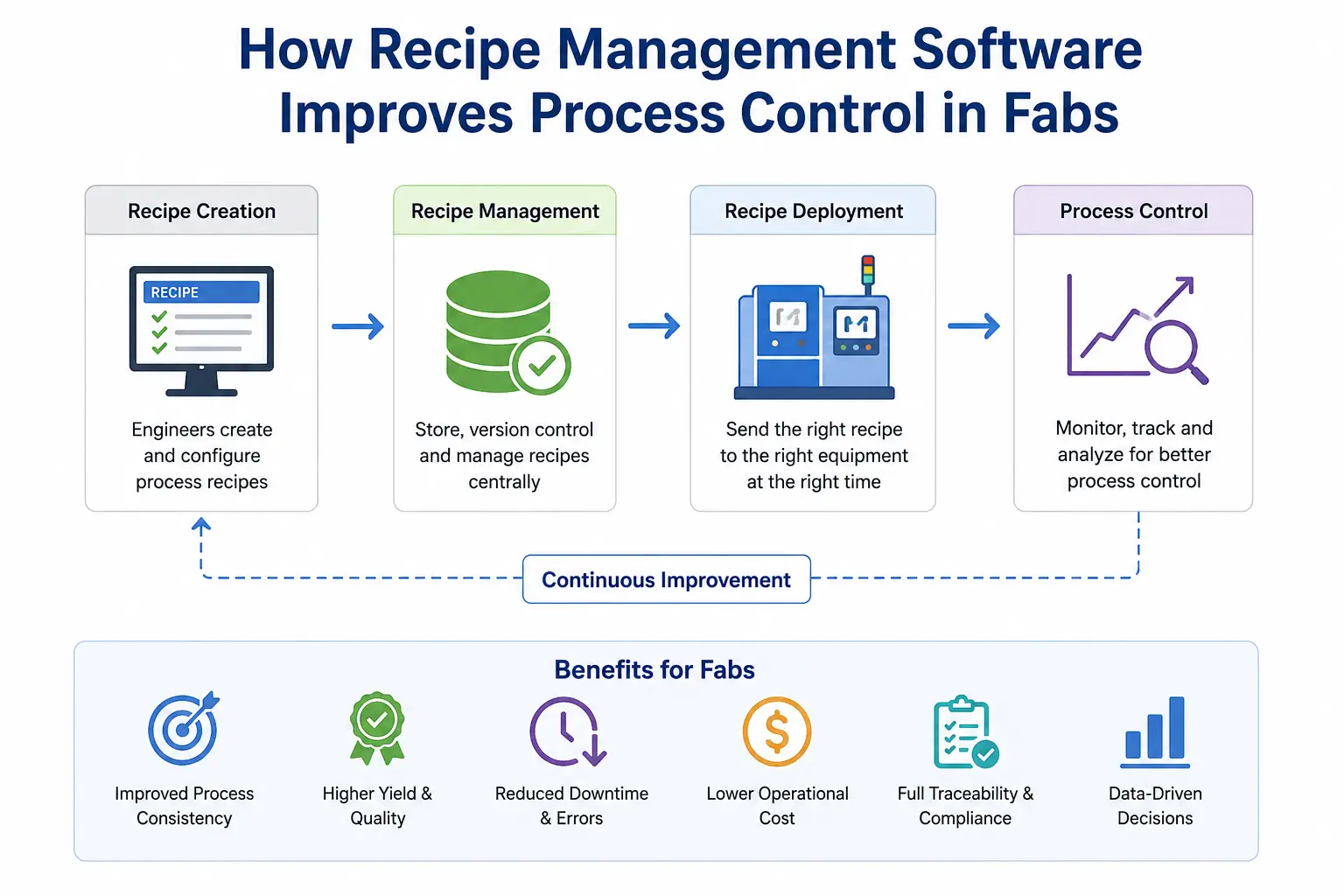
Recipe management software is a centralized system that creates, validates, stores, version-controls, and distributes process recipes across every tool in a fab or ATM (assembly, test, and packaging) facility. Instead of recipes living on individual tool controllers — where they can drift out of sync, get overwritten, or be edited without approval — a recipe management system keeps a single source of truth and pushes verified recipes out to equipment automatically.
In most modern fabs, this system communicates with equipment using the SECS/GEM protocol, the SEMI-standard communication framework that has governed fab automation since the 1980s. Recipe management is actually one of the core functions built into GEM itself: the host system can select, download, upload, delete, and verify recipes on a piece of equipment in real time. A dedicated recipe management platform builds on top of this SECS/GEM foundation, adding version control, approval workflows, audit trails, and cross-tool consistency checks that the base protocol doesn’t provide on its own.
Why Process Control Depends on Recipe Accuracy
Process control in a fab is really about eliminating variation — keeping every wafer, every lot, and every tool as close as possible to the target process window. Recipes are where that variation most often creeps in, for a few recurring reasons:
- Manual data entry: Recipes typed or copied by hand into a tool controller are one keystroke away from a costly mistake.
- Version mismatches: An engineer updates a recipe on one tool but the change never reaches identical tools running the same step elsewhere in the fab.
- Unauthorized edits: Without an approval workflow, a recipe parameter can be changed on the fly without anyone verifying it against the qualified process.
- Legacy equipment gaps: Older tools without native SECS/GEM recipe support often rely on manual recipe transfer altogether, removing any safety net.
Each of these failure points shows up downstream as yield loss, unplanned downtime, or a scrapped lot — and each one is exactly what recipe management software is designed to close off.
Key Ways Recipe Management Software Improves Process Control

1. Centralized Version Control
A recipe management system stores every recipe in one place, with a complete revision history. Engineers can see exactly which version is running on which tool, roll back to a previous version if a new recipe underperforms, and prevent two chambers from silently running slightly different parameters for the same process step.
2. Recipe Validation Before Execution
Rather than trusting that a recipe downloaded to equipment is correct, the system validates parameters against approved ranges before the recipe is allowed to run. This single check catches out-of-spec values before they reach a wafer, not after.
3. SECS/GEM-Based Recipe Download and Upload Automation
By integrating directly with each tool’s SECS/GEM interface, the system automates recipe download and upload between host and equipment. This removes manual transfer entirely and keeps host and equipment recipes synchronized without operator intervention — a foundational requirement for GEM300 compliance in 300mm fabs.
4. Cross-Tool and Cross-Chamber Consistency
Fabs frequently run the same process step on multiple identical tools to keep up with volume. A recipe management system enforces that every chamber running “Step 12” is actually running the identical, approved version of that recipe — closing a gap that otherwise shows up as unexplained yield variation between nominally identical tools.
5. Full Traceability and Audit Trails
Every recipe change, approval, download, and execution is logged, creating a traceable record tied to specific lots and wafers. This matters for internal root-cause analysis and for the compliance documentation that Tier-1 fab and foundry customers often require of their equipment and process suppliers.
6. Faster, Safer Recipe Rollout for New Processes
When a new process or product is qualified, the recipe has to reach every relevant tool correctly and quickly. Centralized recipe management turns what used to be a manual, tool-by-tool rollout into a controlled, auditable push from a single source — shortening time-to-production for new recipes.
7. Integration With MES and Smart Factory Systems
Recipe management doesn’t operate in isolation. Feeding recipe execution data into the Manufacturing Execution System (MES) closes the loop between what a recipe was supposed to do and what actually happened on the tool — supporting the broader Industry 4.0 and smart-manufacturing initiatives most fabs are now investing in.
Why This Matters for Different Teams in the Fab
- Process and equipment engineers get a single, trustworthy source for recipe parameters instead of chasing discrepancies across tool controllers.
- Manufacturing and production managers see fewer recipe-related scrap events and faster new-process ramp-up.
- MES integration teams get a system that speaks SECS/GEM natively, reducing custom integration work.
- Quality control engineers get the audit trail needed to satisfy internal and customer compliance requirements.
- OSAT and equipment OEMs can offer recipe management as part of a broader factory automation and connectivity package, rather than leaving each tool to manage recipes independently.
Recipe Management Across the Industry — Not Just Wafer Fabs
While wafer fabrication is the most recipe-intensive environment in semiconductor manufacturing, the same principles apply wherever process parameters must be repeated precisely: OSAT and assembly/test operations, MEMS manufacturing, and flat panel/display production all depend on consistent recipe execution across many tools. As these industries adopt more factory automation and Industry 4.0 practices, recipe management software is increasingly treated as core infrastructure rather than an optional add-on.
What to Look for in a Recipe Management System
When evaluating a recipe management platform, a few capabilities matter most:
- Native SECS/GEM and GEM300 compatibility for real-time recipe download/upload
- Centralized version control with rollback capability
- Recipe validation against approved parameter ranges before execution
- Full audit trails for compliance and root-cause analysis
- MES integration for closed-loop process data
- Support for both modern and legacy equipment across a mixed fleet
eInnoSys’s Recipe Management System (EIRMS) is built around exactly this set of capabilities — centralizing recipe control, version tracking, and SECS/GEM integration for fabs and ATM facilities that need tighter process control without replacing their existing equipment fleet.
Conclusion
Process control in a modern fab is only as reliable as the recipes running on the equipment floor. Manual recipe handling, version mismatches, and unvalidated changes are avoidable sources of yield loss — and they’re precisely what a dedicated recipe management system is designed to eliminate. For fabs, OSATs, and equipment OEMs working toward tighter process control, better OEE, and smart-factory integration, recipe management software isn’t a peripheral tool. It’s one of the more direct paths to fewer scrapped wafers and a more predictable fab.


