
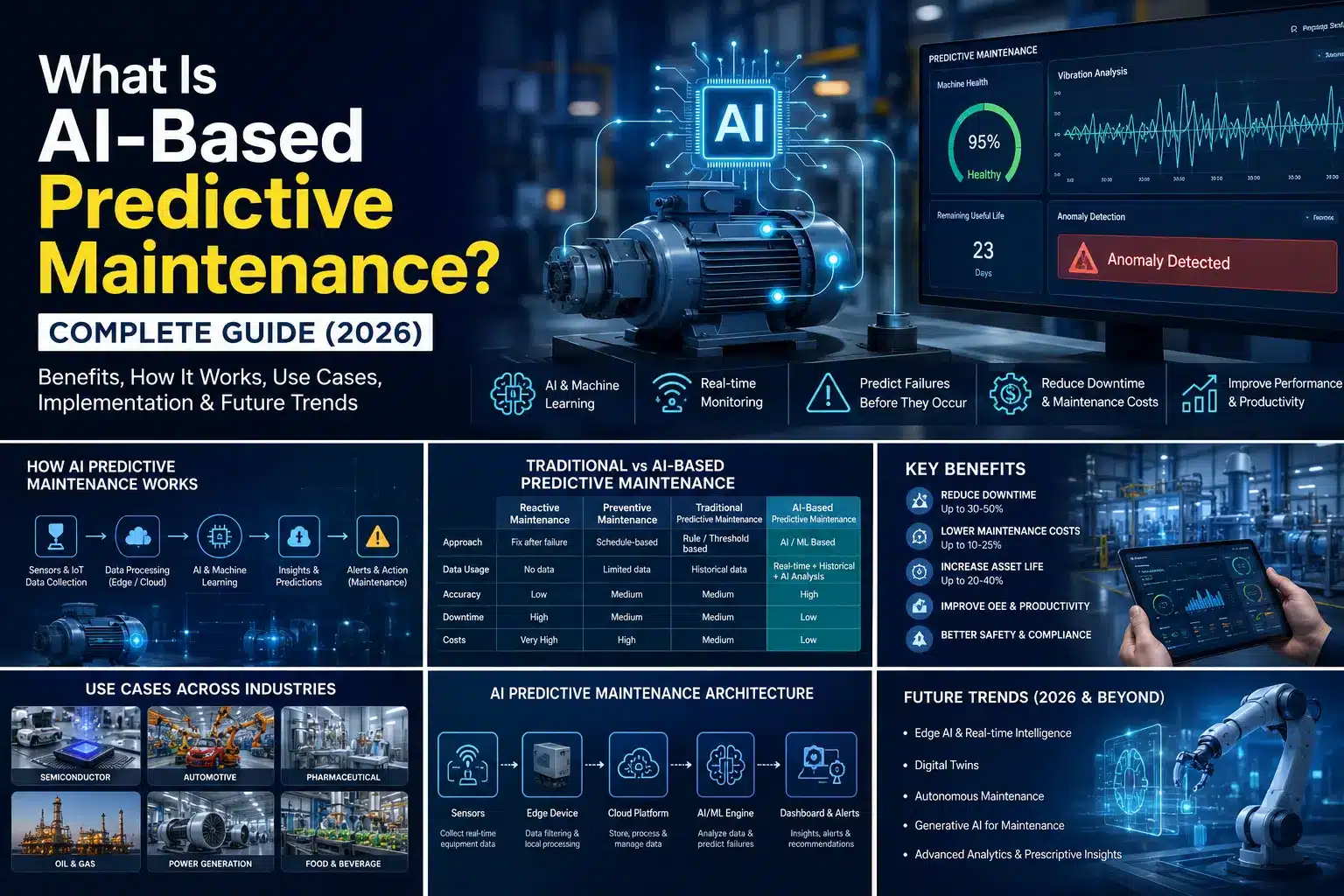
Unplanned downtime is one of the most expensive problems in modern manufacturing. A single failed vacuum pump in a semiconductor fab, a seized motor on an automotive line, or a degraded compressor in a chemical plant can halt production, damage product quality, and cost six figures in a matter of hours. For decades, manufacturers have relied on scheduled maintenance and reactive repairs to manage this risk. Neither approach is good enough anymore.
AI-based predictive maintenance has emerged as the standard for capital-intensive, high-uptime industries — from semiconductor fabs in Taiwan to power plants in Germany. This guide explains what it is, how it works, why it matters specifically for semiconductor and industrial manufacturing, and how to evaluate a solution for your facility.
What Is AI-Based Predictive Maintenance?
AI-based predictive maintenance (AI-PdM) is the use of artificial intelligence and machine learning models to analyze real-time sensor data from industrial equipment and predict failures before they happen — often weeks in advance. Instead of relying on a fixed maintenance calendar or waiting for a breakdown, AI-PdM continuously monitors signals like vibration, temperature, current, and pressure, learns what “normal” looks like for each specific machine, and flags subtle deviations that indicate developing faults.
The Core Idea
Equipment rarely fails instantly. Bearings wear gradually, seals degrade slowly, and motor windings show electrical signatures of stress long before a hard failure. AI models are exceptionally good at detecting these faint, multivariate patterns across thousands of data points — patterns a human technician or a simple threshold alarm would miss entirely.
This is a meaningful step beyond traditional predictive maintenance, which typically used static rules (“alert if vibration exceeds X”). AI-based systems instead learn the unique behavioral fingerprint of each asset and adapt as conditions change, which is why they catch problems earlier and generate far fewer false alarms.
How AI-Based Predictive Maintenance Works
While implementations vary, most AI-PdM systems follow the same general pipeline:
1. Data Collection
Industrial-grade sensors are installed on critical equipment — pumps, motors, exhausts, furnaces, and other rotating or motor-driven assets — to continuously capture vibration, temperature, current, voltage, and acoustic data.
2. Data Integration
Sensor data is combined with existing factory systems such as SECS/GEM, SCADA, and MES, giving the AI model context about equipment state, recipe, and production load — not just raw vibration numbers.
3. Model Training
Machine learning algorithms are trained on historical and real-world failure data to recognize the early signatures of specific fault modes: bearing wear, imbalance, misalignment, cavitation, electrical degradation, and more.
4. Real-Time Anomaly Detection
Once deployed, the model scores incoming data continuously, comparing live equipment behavior against its learned baseline and flagging deviations.
5. Alerting and Action
When a developing fault is detected, the system sends alerts — typically via email, SMS, or SECS/GEM alarm integration — giving engineering teams a window of weeks, not hours, to schedule a repair before failure occurs.
6. Continuous Learning
The model refines itself over time as it ingests more operating data, improving accuracy and reducing false positives.
AI-Based Predictive Maintenance vs. Preventive and Reactive Maintenance
| Approach | Trigger | Strength | Weakness |
|---|---|---|---|
| Reactive maintenance | Equipment has already failed | No upfront planning cost | Unplanned downtime, highest repair cost, production risk |
| Preventive (time-based) | Fixed schedule (e.g., every 90 days) | Predictable, simple to plan | Wastes good parts, misses failures between intervals |
| AI-based predictive | Real-time AI analysis of equipment condition | Catches faults weeks early, minimizes unnecessary servicing | Requires sensor and AI infrastructure investment |
The economic case is straightforward: emergency repairs typically cost three to five times more than planned maintenance, and they almost always come with production losses that dwarf the repair bill itself. AI-PdM shifts maintenance from a fixed cost center to a controllable, scheduled activity.
Why AI-Based Predictive Maintenance Matters for Semiconductor Manufacturing
Semiconductor fabs operate some of the most expensive, failure-intolerant equipment on earth, which makes them the clearest use case for AI-based equipment monitoring.
- •
Vacuum pumps are mission-critical and fail expensively: Dry pumps, turbopumps, and cryopumps run continuously in process chambers. A single unplanned pump failure can contaminate a chamber, scrap an entire lot of wafers, and take a tool offline for days. Semiconductor predictive maintenance specifically targets these pump and motor assets because the cost of failure is so disproportionate to the cost of the part itself. - •
Fabs already run on SECS/GEM: Unlike generic industrial facilities, semiconductor fabs have a standardized equipment communication protocol already in place. Predictive maintenance for semiconductor equipment that integrates natively with SECS/GEM can feed alarms directly into existing fab automation and MES workflows, rather than requiring a parallel monitoring system. - •
Tool uptime drives capacity: In a smart semiconductor factory, Overall Equipment Effectiveness (OEE) is the single biggest lever on output. AI in semiconductor manufacturing reduces unplanned downtime directly, which translates into more available tool-hours without any capital expansion. - •
Legacy and mixed-fleet equipment is common: Many fabs run equipment from multiple vendors — Edwards, Pfeiffer, EBARA, Busch, Atlas Copco, ULVAC — spanning different generations. Effective semiconductor equipment monitoring needs to work across this heterogeneous fleet, including older tools that were never designed with built-in connectivity.
Key Benefits of AI-Based Predictive Maintenance
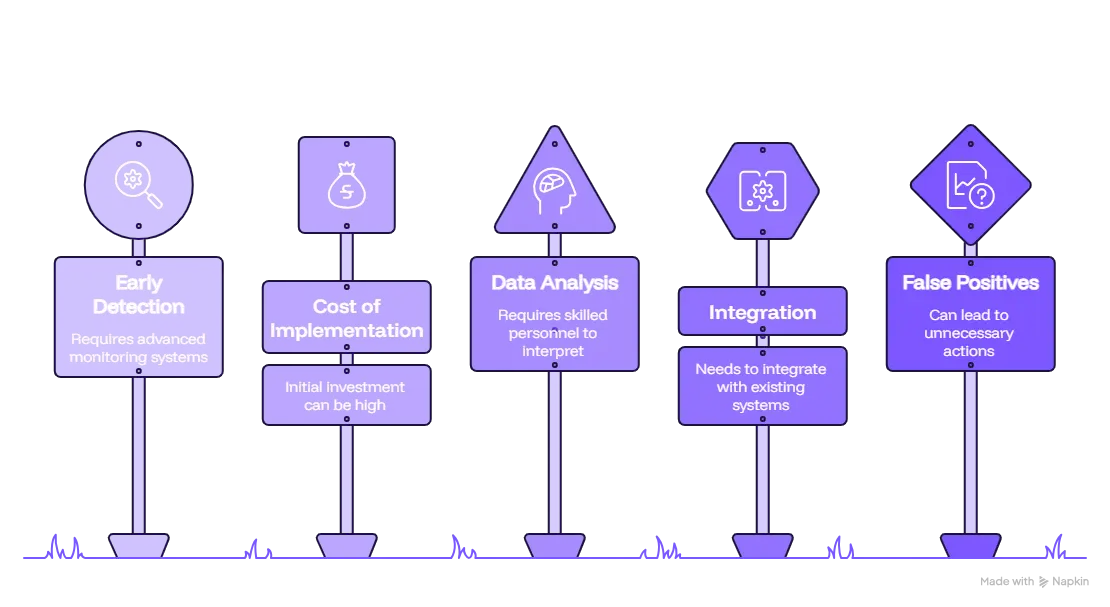
Early detection of developing faults — often weeks before failure — lets teams plan repairs during scheduled downtime.
Fewer emergency repairs, less rush parts procurement, and less unnecessary preventive servicing on healthy assets.
Catching abnormal stress, vibration, or thermal patterns early prevents secondary damages down the manufacturing line.
More uptime on mission-critical tools directly increases operational factory output capacity instantly.
Industries Beyond Semiconductor That Benefit
- Electronics Manufacturing (EMS)
- Automotive Manufacturing
- Pharmaceutical Production
- Food & Beverage Processing
- Chemical Processing
- Oil & Gas Facilities
- Power Generation Plants
- Water & Wastewater
What to Look for in an AI-Based Predictive Maintenance Solution
- Genuine prediction, not just alerting: The system should flag developing faults weeks in advance, not simply alarm once a critical threshold has already been crossed.
- Native fab system integration: Look for SECS/GEM, SCADA, and MES connectivity so alerts flow seamlessly into existing active production workflows.
- Equipment-agnostic compatibility: A strong solution must work across pump and motor brands and hardware generations, including your mixed legacy infrastructure.
- Turnkey deployment: Sensors, processing software, and base configurations should come as an all-inclusive complete package to ease rollout.
- Continuously learning models: Prediction precision weights must refine dynamically over time as the system ingests more historical field metrics.
How eInnoSys Helps: xPump AI/ML-Based Predictive Maintenance
eInnoSys built xPump specifically to address the predictive maintenance gap in semiconductor and industrial environments. xPump combines proprietary AI/ML analytics with industrial-grade sensors to continuously monitor pumps, motors, exhausts, ovens, furnaces, and other motor-driven equipment, predicting failures weeks before they occur.
What sets xPump apart for fabs and OEMs:
- ✓Native Automation Plugins: Plugs directly into existing SECS/GEM, SCADA, and MES nodes.
- ✓Universal Compatibility: Supports legacy/modern Edwards, Pfeiffer, EBARA, Busch, Atlas Copco, etc.
- ✓Multi-Channel Alerting: Instant alarms pushed via SMS, email, or native protocols windows ahead.
- ✓Proven Field Metrics: Cuts unplanned pump/motor downtime by up to 70% and lowers repair bills by up to 45%.
Final Thoughts
AI-based predictive maintenance has moved from an emerging concept to a baseline expectation in semiconductor fabs, electronics manufacturing, and other high-uptime industrial environments. The combination of industrial sensors, machine learning, and integration with existing fab systems like SECS/GEM gives manufacturers a genuine early-warning capability that reactive and time-based maintenance simply cannot match.
Ready to Eliminate Unplanned Outages?
If your facility relies on critical assets, the question isn’t whether to adopt AI-PdM—it’s how soon you can deploy.


