
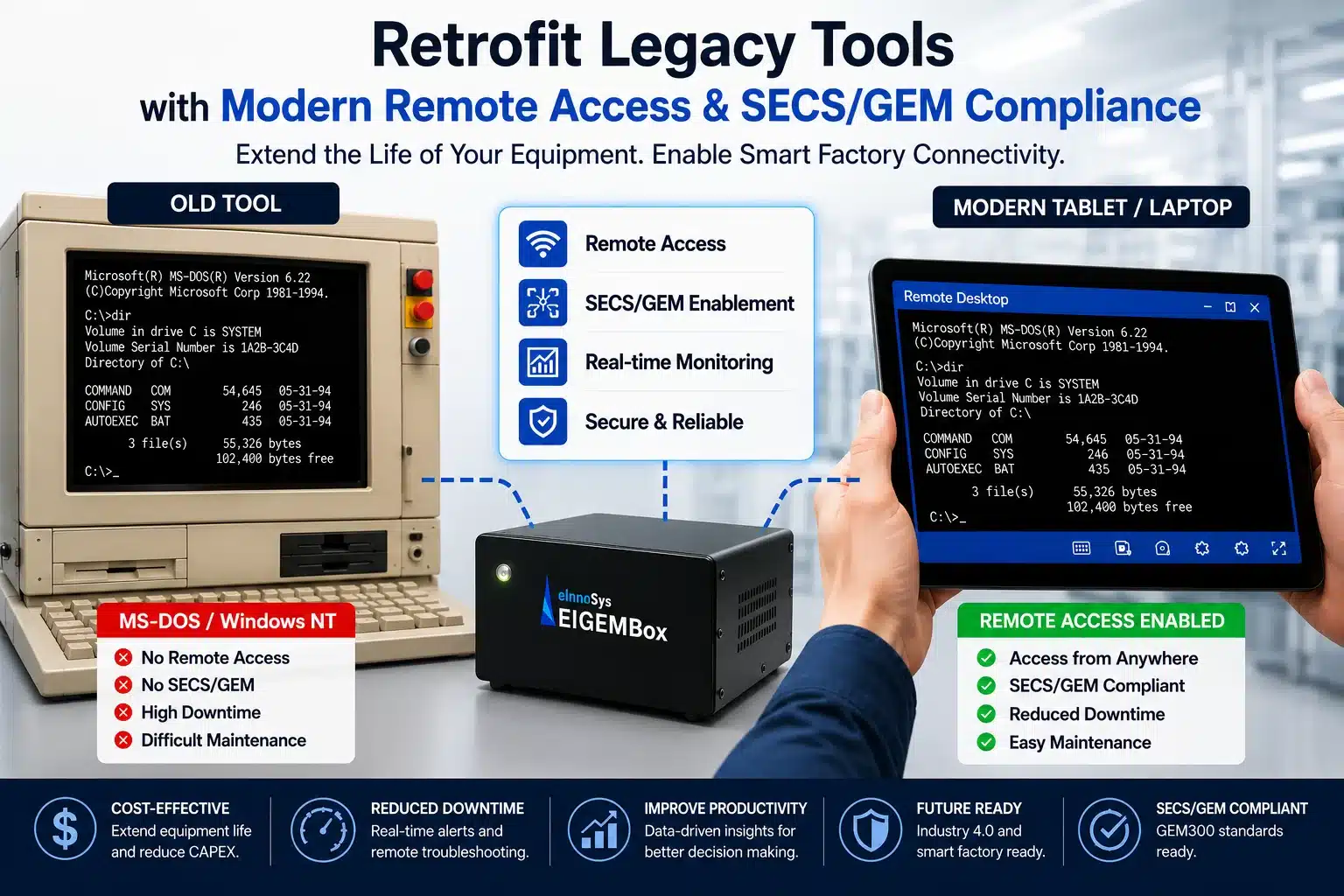
Introduction: The Brownfield Reality in Semiconductor Fabs
Walk through most 200mm or mixed-node fabs today and you will find equipment that was installed before SECS/GEM became a floor-level expectation — wire-bond platforms, legacy testers, dicing saws, and inspection tools still running proprietary RS-232 or GPIB interfaces with zero network presence. These machines are mechanically sound, fully depreciated, and operationally irreplaceable in the near term. The problem is that the factory around them has moved on.
Modern AMHS, MES, and scheduling systems expect every tool on the floor to speak a defined equipment communication standard. The gap between what those legacy machines can offer and what the fab’s host infrastructure demands is no longer a nuisance — it is a yield-loss and throughput risk. Remote access for semiconductor equipment has become equally critical: with distributed engineering teams, contract fabs spread across geographies, and 24/7 production pressure, the ability to connect to a tool remotely for diagnostics, recipe management, or alarm response is a baseline operational requirement, not a luxury.
The good news is that brownfield equipment integration does not require capital replacement. A well-engineered SECS/GEM retrofit solution can bring any legacy tool into full GEM300 compliance while simultaneously enabling secure, standards-based remote connectivity — without modifying the tool’s core control software.
Why Legacy Equipment Connectivity Is Now a Strategic Priority
Equipment that cannot report status, log events, or accept host commands in a standardized format creates three compounding problems.
Manual intervention cost. Operators must physically visit tools to collect run data, clear alarms, and confirm process state. In high-mix environments where engineers already manage more equipment than headcount allows, this is unsustainable.
MES blind spots. A fab’s manufacturing execution system can only optimize what it can see. Legacy tools without SECS/GEM integration appear as black boxes in scheduling algorithms, which forces conservative WIP buffering and inflates cycle times — exactly the metric pressure OSAT and ATMP sites face as they compete on turn time.
Audit and traceability exposure. Automotive and advanced packaging customers now routinely demand per-unit process traceability that maps back to equipment state at the time of process. Without structured event reporting, that data either does not exist or must be reconstructed manually from paper logs — a significant quality system liability.
Semiconductor equipment modernization, when approached as a brownfield integration project rather than a replacement program, resolves all three problems at a fraction of the CapEx cost. The right SECS/GEM retrofit solution layers communication intelligence on top of the existing tool controller, leaving the mechanical and process logic untouched.
| Feature | Legacy Tool (Pre-Retrofit) | Modernized Tool (Post-Retrofit) |
|---|---|---|
| Connectivity | Proprietary/Isolated (RS-232/GPIB) | SEMI-Compliant (HSMS/SECS-II) |
| Data Visibility | “Black Box” (No real-time data) | Transparent (MES-Integrated) |
| Operational Control | Manual/Physical Intervention | Remote Access & Control |
| Traceability | Paper Logs / Manual Entry | Automated per-unit Traceability |
| Maintenance | Reactive (Break-fix) | Predictive (FDC/Data-Driven) |
| Compliance | Non-Compliant | GEM / GEM300 Compliant |
| Integration | Isolated from MES/Scheduling | Seamlessly integrated in AMHS |
What a SECS/GEM Retrofit Solution Actually Looks Like
A retrofit is not a software patch. It is an integration architecture that sits between the legacy tool’s native interface and the fab host. Here is how leading implementations are structured.
Hardware gateway or embedded adapter. A small industrial-grade gateway — sometimes a ruggedized PC, sometimes an embedded ARM module — connects to the tool’s existing RS-232, RS-485, GPIB, or PLC I/O ports. This gateway runs a SECS/GEM stack that translates native tool signals into SEMI E5 (SECS-II) messages transported over SEMI E37 (HSMS). For newer GEM300 implementations, E30, E39, E40, E87, E90, E94, and E116 compliance layers are added on top.
Legacy tool automation middleware. The middleware layer handles variable mapping, alarm dictionary construction, and process program management. Engineers define which native PLC registers or serial responses map to which GEM Collection Events, Data Variables, and Equipment Constants. This is where deep domain knowledge matters — a competent SECS/GEM integration services team will have pre-built libraries for common PLC families (Siemens, Allen-Bradley, Mitsubishi, Omron) and legacy tool controllers from major OEMs.
Remote access for semiconductor equipment. The gateway simultaneously hosts a secure remote access channel — typically VPN-encapsulated or certificate-authenticated — that allows authorized engineers to connect to the tool’s HMI, review log files, push configuration changes, and monitor live process variables from anywhere on the corporate network or via cloud relay. This remote equipment monitoring capability is implemented at the gateway level, meaning it works even if the legacy tool’s embedded OS cannot support modern network security protocols.
GEM300 compliance layer. For fabs transitioning to 300mm or running mixed-geometry lines with 300mm hosts, the retrofit must satisfy the full suite of GEM300 capability classes. This includes substrate tracking (E90), carrier management (E87), and process job management (E40/E94). Achieving GEM300 compliance for legacy equipment that was never designed for it requires careful state-machine mapping — an area where experienced integration engineers earn their fees.
Remote Equipment Monitoring: The Operational Force Multiplier
Semiconductor factory automation increasingly depends on the ability to act on equipment data in real time without requiring physical presence. Remote equipment monitoring enables several capabilities that are difficult to price but impossible to ignore once deployed.
Distributed engineering coverage. A single SECS/GEM engineer can simultaneously monitor a tool population across two shifts or two buildings. Alarm escalation policies can route critical events to mobile devices, allowing engineers to triage remotely and dispatch human intervention only when necessary.
OEM service acceleration. Equipment OEMs offering SECS/GEM integration services to their installed base can embed remote access for semiconductor equipment into their service contracts. Rather than shipping a field service engineer to diagnose a communication fault, the OEM’s application team connects remotely, reviews the gateway’s SECS/GEM transaction log, and resolves the issue in minutes. This is a direct competitive differentiator for OEMs selling into cost-sensitive OSAT accounts.
Predictive maintenance data pipelines. Remote access for semiconductor equipment, when combined with structured SECS/GEM event streams, feeds the time-series databases that predictive maintenance and fault detection/classification (FDC) systems require. Legacy tools that previously generated no digital process history can, post-retrofit, supply rich equipment telemetry to analytics platforms — enabling condition-based maintenance without any hardware modification to the tool itself.
Smart factory equipment connectivity. Industrial remote access solutions that comply with IEC 62443 cybersecurity standards are now available specifically for semiconductor environments. These solutions segment tool-level networks from corporate IT infrastructure while still allowing authorized data flows, satisfying both IT security teams and fab operations requirements.
Implementation Considerations for Engineering Teams
Teams undertaking a SECS/GEM retrofit should plan around four workstreams.
Interface characterization. Before any software is written, the tool’s native communication interface must be fully documented — baud rate, parity, command syntax, timing constraints, and any undocumented vendor extensions. For tools where OEM documentation is incomplete, protocol sniffing with a serial analyzer is often necessary.
State machine modeling. GEM requires a well-defined equipment state model. Legacy tools often have implicit states that must be made explicit — particularly around INIT, IDLE, EXECUTING, and PAUSE transitions. This modeling work takes time but is the foundation on which reliable SECS/GEM integration rests.
Host qualification. The retrofit gateway must pass qualification tests against the fab’s actual MES host — not a generic SECS/GEM test tool. Host-specific behaviors around connection timing, message sequencing, and error recovery must be validated in a staging environment before the tool goes back into production.
Cybersecurity review. Any industrial remote access solution added to a fab network should pass a security review that addresses authentication, encryption, session logging, and network segmentation. This is non-negotiable in facilities with automotive, defense, or government customers.
Conclusion: Modernize What You Have, Accelerate What Comes Next
Replacing functional equipment to satisfy connectivity requirements is a capital decision that rarely survives scrutiny when a viable retrofit path exists. Brownfield equipment integration, done with the right SECS/GEM retrofit solution and properly engineered remote access for semiconductor equipment, delivers the communication standards compliance, remote visibility, and factory automation integration that modern fabs demand — at a fraction of replacement cost and on a timeline that does not disrupt production.
For semiconductor equipment OEMs, SECS/GEM integration services are increasingly a product line in their own right: a value-added capability that extends tool lifetime for customers and creates recurring service revenue. For fab automation engineers and GEM300 implementation teams, a retrofit-first strategy means the smart factory equipment connectivity vision does not have to wait for the next capital budget cycle.
The legacy tool in bay 14 may be twenty years old. With the right retrofit architecture, it can be a fully compliant, remotely accessible, MES-integrated asset by next quarter.
Looking to evaluate a SECS/GEM retrofit for your specific tool type or fab environment? The implementation details vary significantly by equipment generation and host infrastructure — engaging an integration team with hands-on experience across PLC families and SEMI standards will compress your qualification timeline considerably.


