
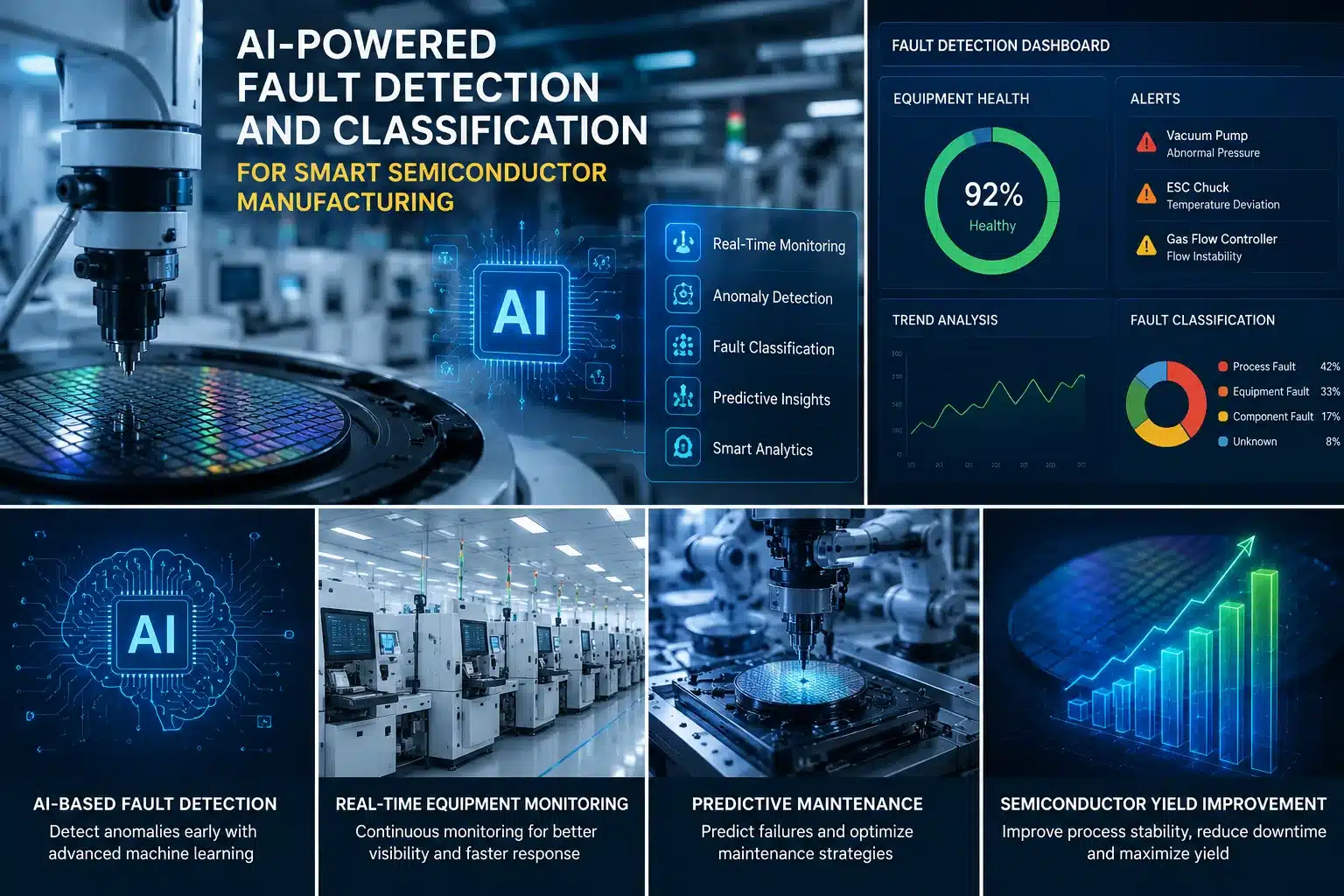
The semiconductor industry operates in one of the most demanding manufacturing environments in the world. As device geometries shrink and production complexity increases, manufacturers face growing challenges in maintaining equipment reliability, process stability, and product quality. Even minor equipment deviations can lead to significant yield loss, increased downtime, and higher operating costs.
To address these challenges, semiconductor manufacturers are increasingly adopting Fault Detection and Classification (FDC) systems powered by artificial intelligence and machine learning. These advanced solutions continuously analyze equipment behavior, process parameters, and sensor data to identify abnormalities before they impact production.
Modern fabs generate massive volumes of equipment and process data every second. Traditional monitoring methods are often unable to detect subtle performance variations hidden within this data. AI-powered FDC solutions provide a smarter approach by enabling real-time analysis, automated fault identification, and predictive insights that help engineers take proactive action.
This article explores how AI-driven Fault Detection and Classification is transforming semiconductor manufacturing and helping organizations improve equipment performance, yield, and operational efficiency.
Understanding Fault Detection and Classification in Semiconductor Manufacturing
Fault Detection and Classification is a manufacturing intelligence methodology used to identify abnormal equipment behavior and classify potential process issues before they cause production failures.
In semiconductor fabs, thousands of process variables are continuously monitored, including:
- Temperature
- Pressure
- Flow rates
- Vacuum levels
- Motor performance
- Chemical concentrations
- Equipment cycle times
An FDC system evaluates these parameters against established process models and operational baselines. When deviations occur, the system automatically detects the anomaly and categorizes the fault according to its severity and potential impact.
Modern Semiconductor Fault Detection and Classification solutions extend beyond simple alarm monitoring. They leverage advanced analytics and AI algorithms to identify hidden patterns that may indicate emerging equipment degradation or process instability.
The Role of AI in Fault Detection and Classification
Artificial intelligence has significantly enhanced the capabilities of traditional FDC systems. Instead of relying solely on fixed thresholds, AI-Based Fault Detection solutions learn from historical equipment behavior and continuously improve their ability to identify abnormal conditions.
Machine learning algorithms analyze vast amounts of manufacturing data to establish normal operating patterns. As equipment conditions evolve, the system adapts its models and becomes more accurate over time.
Key AI capabilities include:
- Pattern recognition
- Anomaly detection
- Predictive modeling
- Root cause identification
- Automated fault classification
By integrating AI with Fault Detection and Classification, semiconductor manufacturers can detect issues much earlier than conventional monitoring systems, reducing the risk of unexpected downtime and process excursions.
Machine Learning for Advanced Equipment Monitoring
One of the biggest advantages of AI-powered FDC systems is the ability to perform Machine Learning Fault Detection across multiple equipment types and manufacturing processes.
Machine learning models continuously evaluate relationships between thousands of process variables. These models can identify subtle changes that would otherwise go unnoticed by operators or rule-based systems.
For example, a vacuum pump may gradually lose efficiency over several weeks. Traditional alarms may not trigger until performance falls below a critical threshold. However, machine learning algorithms can recognize early warning signs and alert maintenance teams before a failure occurs.
This capability enables:
- Earlier fault detection
- Reduced equipment downtime
- Improved process stability
- Better asset utilization
As semiconductor manufacturing becomes increasingly automated, machine learning will continue to play a critical role in improving operational performance.
Real-Time Equipment Monitoring for Proactive Manufacturing
Today’s fabs require immediate visibility into equipment performance. Real-Time Equipment Monitoring provides continuous insight into machine health and process conditions across the factory floor.
AI-powered FDC systems collect and analyze data from:
- Process tools
- Pumps
- Motors
- Exhaust systems
- Exhaust systems
- Chemical delivery systems
- Utility infrastructure
Continuous monitoring enables engineers to identify abnormal trends before they become critical issues. Instead of reacting to failures after they occur, organizations can proactively manage equipment health and maintain stable production conditions.
When combined with Fault Detection and Classification, real-time monitoring helps reduce process interruptions and improve manufacturing reliability.
Predictive Maintenance Software and Equipment Health Monitoring
Traditional maintenance strategies often rely on fixed schedules or reactive repairs. Both approaches can result in unnecessary maintenance activities or unexpected equipment failures.
Modern Predictive Maintenance Software uses AI and FDC technologies to determine actual equipment condition and forecast future failures.
Through continuous Equipment Health Monitoring, maintenance teams gain visibility into asset performance and can prioritize interventions based on real operational risk.
Benefits include:
- Reduced unplanned downtime
- Lower maintenance costs
- Extended equipment life
- Improved spare parts management
- Higher equipment availability
In semiconductor manufacturing environments where uptime directly impacts profitability, predictive maintenance has become a critical component of operational excellence.
Enhancing Semiconductor Process Monitoring and Yield
Process control remains one of the most important factors in semiconductor production. Even small process deviations can affect wafer quality and overall manufacturing yield.
AI-driven Semiconductor Process Monitoring helps engineering teams identify process variations before they impact production results.
By combining process data with Fault Detection and Classification, manufacturers can:
- Detect process drift earlier
- Identify root causes faster
- Improve process consistency
- Reduce scrap and rework
- Increase production throughput
This proactive approach contributes directly to Semiconductor Yield Improvement, allowing manufacturers to maximize output while maintaining strict quality standards.
As device complexity continues to increase, advanced process monitoring technologies will become even more essential for competitive semiconductor manufacturing.
Smart Manufacturing Analytics and Industry 4.0
The transition toward Industry 4.0 has accelerated the adoption of intelligent manufacturing technologies. Smart Manufacturing Analytics integrates data from equipment, processes, maintenance systems, and production operations to provide comprehensive operational visibility.
AI-powered FDC solutions serve as a foundation for these analytics initiatives by transforming raw equipment data into actionable insights.
Organizations can leverage these insights to:
- Improve decision-making
- Optimize maintenance strategies
- Reduce operational risks
- Increase factory efficiency
- Support continuous improvement programs
By integrating Fault Detection and Classification with smart manufacturing platforms, semiconductor manufacturers can create highly connected, data-driven production environments.
Conclusion
As semiconductor manufacturing continues to evolve, the ability to detect and respond to equipment and process issues quickly has become a competitive necessity. Traditional monitoring approaches are no longer sufficient for managing the complexity of modern fabs.
AI-powered Fault Detection and Classification provides a powerful solution by combining real-time monitoring, machine learning, predictive analytics, and intelligent fault diagnosis. These technologies help manufacturers improve equipment reliability, reduce downtime, enhance process stability, and achieve sustainable yield improvements.
By leveraging Semiconductor Fault Detection and Classification, AI-Based Fault Detection, Predictive Maintenance Software, and Smart Manufacturing Analytics, semiconductor manufacturers can build more resilient, efficient, and future-ready operations.
Organizations that invest in intelligent monitoring and predictive technologies today will be better positioned to meet the increasing demands of advanced semiconductor manufacturing tomorrow.
More Blog Posts:


