
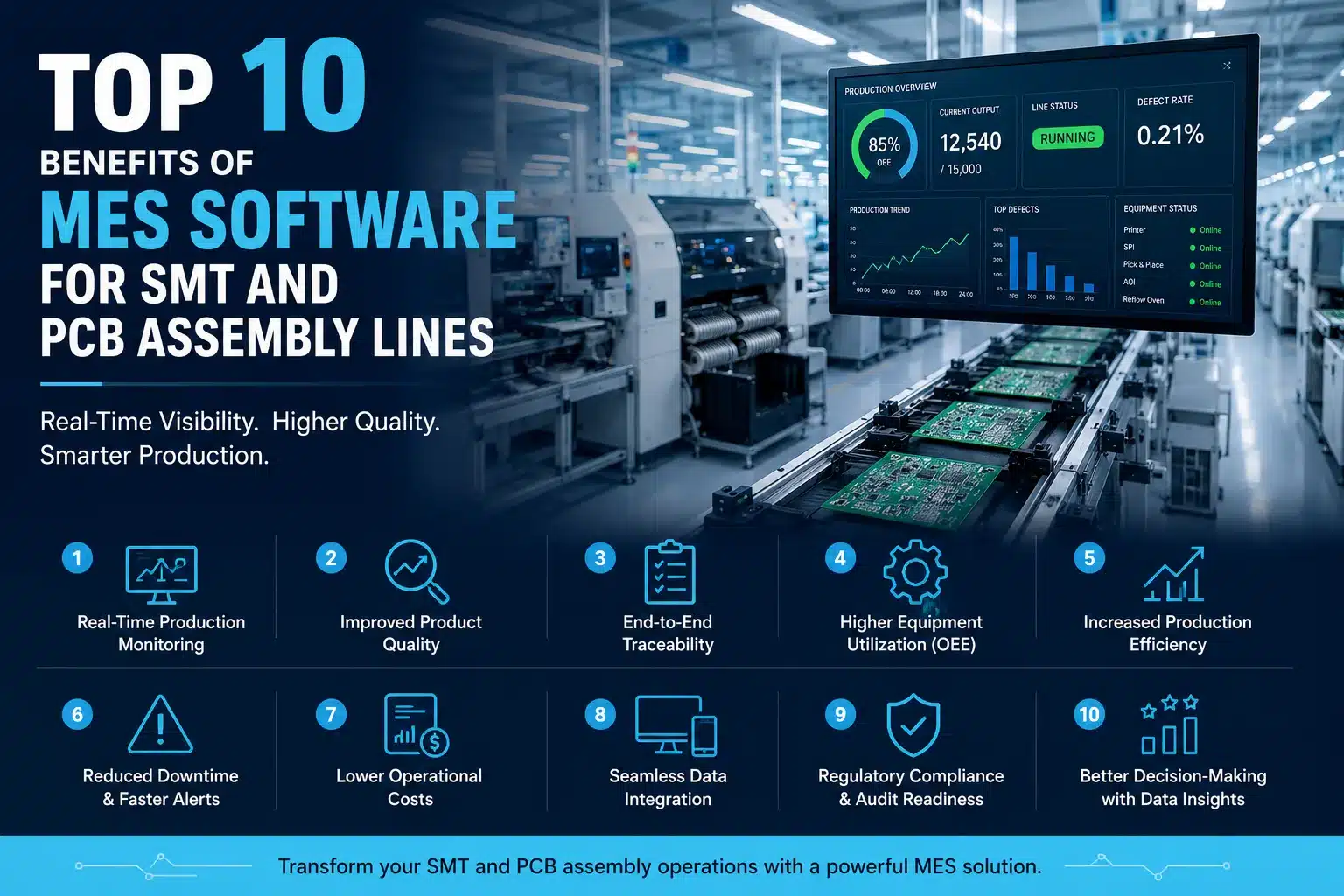
Electronics Manufacturing Services (EMS) providers, SMT manufacturers, and PCB assembly companies are under constant pressure to do more with less: tighter tolerances, shorter lead times, higher mix-low volume production, and zero tolerance for defects. Add rising customer demands for full traceability and audit-ready documentation, and it becomes clear why spreadsheets, paper travelers, and disconnected line-monitoring tools no longer cut it.
This is where a Manufacturing Execution System (MES) built for electronics production earns its place on the factory floor. A purpose-built MES software for SMT doesn’t just digitize paperwork — it connects SMT placement machines, AOI/AXI inspection systems, reflow ovens, and testing stations into a single, real-time data backbone that gives manufacturing engineers, quality teams, and plant managers the visibility they need to run a truly smart factory.
In this article, we break down the top 10 benefits of implementing MES for PCB assembly and SMT production lines — and why more EMS companies across the United States, Germany, Japan, Taiwan, South Korea, Singapore, Malaysia, and India are prioritizing MES integration as a core part of their Industry 4.0 roadmap.
What Is MES Software in the Context of SMT and PCB Assembly?
A Manufacturing Execution System is the software layer that sits between your ERP system and your shop floor equipment. For electronics manufacturing, this means connecting directly to SMT placement machines, solder paste printers, reflow ovens, AOI/SPI/AXI inspection stations, wave soldering lines, and functional test equipment.
Unlike generic MES platforms, an electronics MES is designed around the specific workflows of SMT and PCB assembly: component genealogy, reel-level traceability, IPC-compliant documentation, line balancing, and machine-level data collection via SMEMA, CFX, or Hermes protocols. This specialization is exactly why so many EMS companies eventually outgrow generic or homegrown systems and look for MES for PCB assembly platforms — or need structured MES migration support to move from legacy systems to modern, connected platforms without disrupting production.
Let’s look at the ten most impactful benefits.
1. Real-Time Production Monitoring Across the SMT Line
One of the most immediate benefits of MES software is real-time production monitoring. Instead of relying on hourly walk-throughs or end-of-shift reports, production managers and process engineers get a live dashboard showing:
- Machine status (running, idle, down, changeover)
- Current job, program, and board count per station
- Line speed and cycle time versus target
- Alerts for stoppages, starvation, or blocking
For SMT line monitoring, this visibility is critical because SMT lines are only as fast as their slowest station. When a pick-and-place machine slows down or a printer goes into fault, real-time alerts let operators and supervisors react in minutes rather than discovering the issue at shift-end reporting. This directly supports faster root-cause response and less unplanned downtime.
2. Full PCB Traceability — Component to Finished Board
Traceability is often the single biggest driver behind an MES investment, especially for EMS providers serving automotive, medical, aerospace, and defense customers. PCB traceability software built into a modern MES captures:
- Component lot and reel-level genealogy at each placement
- Operator, machine, program version, and timestamp for every process step
- SPI/AOI/AXI inspection results linked to the specific board and panel
- Reflow oven profile data tied to each production run
If a field failure or customer complaint traces back to a specific component lot, a proper production traceability system lets your quality team pull a complete genealogy report in minutes instead of days of manual log-checking. This capability alone often justifies the cost of MES adoption for EMS companies working under IPC-A-610, ISO 9001, IATF 16949, or AS9100 requirements.
3. Improved OEE (Overall Equipment Effectiveness)
OEE improvement is one of the most quoted KPIs when evaluating MES ROI, and for good reason. MES software automatically calculates Availability, Performance, and Quality — the three components of OEE — using actual machine data rather than manually logged estimates, which are often inaccurate or optimistic.
With accurate OEE data, engineering teams can pinpoint:
- Which machines or shifts are underperforming
- Recurring micro-stoppages that don’t show up in manual logs
- Changeover time that’s eating into available run time
- Quality losses tied to specific programs or component types
Many EMS companies see OEE gains of 10–20% within the first year of MES deployment simply because problems that were previously invisible become measurable — and what gets measured gets improved.
4. Reduced Defects and Improved First-Pass Yield
Quality engineers rely on MES to close the loop between inspection and correction. By integrating SPI, AOI, and AXI data directly into the MES, defect trends become visible by machine, program, operator, component, or even feeder slot — not just by final yield numbers.
This level of granularity allows quality teams to:
- Identify systemic issues (e.g., a specific feeder causing tombstoning) before they scale
- Trigger automatic holds when defect thresholds are exceeded
- Feed SPC (Statistical Process Control) data back into process engineering
- Reduce reliance on manual visual inspection sign-offs
The result is a measurable improvement in first-pass yield — often one of the fastest-realized benefits of MES software for SMT environments.
5. Seamless SMT Line and Factory Automation Integration
A modern SMT MES doesn’t operate in isolation. It integrates directly with placement machines, printers, ovens, conveyors, and inspection equipment using standard electronics industry protocols — including SMEMA, Hermes, and the newer CFX (Connected Factory Exchange) standard championed by IPC.
This MES integration capability means:
- No manual data entry between machines and the MES
- Machine programs and job data pushed automatically to equipment (closed-loop SMT)
- Automatic feeder verification and setup validation before a job starts
- Reduced changeover errors from wrong-component or wrong-program mistakes
For factory automation engineers, this is where MES becomes the connective tissue of a true smart SMT line — not just a reporting tool layered on top of existing equipment.
6. Paperless Shop Floor Control
Paper travelers, printed work instructions, and manual sign-off sheets are still common in electronics assembly — and they’re a major source of error, delay, and lost traceability data. MES replaces this with digital shop floor control, where:
- Work instructions and revision-controlled documents appear directly at the operator’s station
- Electronic sign-offs replace paper checklists
- Engineering change orders (ECOs) automatically update instructions across all affected lines
- Operators can’t proceed to the next step without completing required checks
This benefit matters especially for high-mix, low-volume EMS operations running dozens of different board configurations per week, where keeping paper documentation current across every line is practically impossible to manage reliably.
7. Faster Changeovers and Higher Throughput
For SMT lines running high-mix production, changeover time is one of the biggest hidden costs. MES software supports faster changeovers by:
- Pre-validating that the correct feeders, reels, and programs are staged before changeover begins
- Guiding operators through a digital changeover checklist
- Flagging component or program mismatches before the line starts running scrap
- Tracking changeover time as a KPI so bottleneck stations are identified and addressed
Combined with real-time line balancing data, this SMT production monitoring capability helps production managers sequence jobs more intelligently, minimizing changeover frequency and maximizing available run time.
8. Better Material Management and Component Genealogy
Component shortages and counterfeit parts remain persistent risks in electronics manufacturing. MES software strengthens material management by tracking:
- Real-time inventory levels tied to actual consumption at each machine
- Reel and lot-level genealogy for every component used
- Expiration tracking for moisture-sensitive devices (MSD) per IPC/JEDEC J-STD-033
- Automatic alerts when incorrect or unauthorized components are loaded
This tight integration between materials and production data reduces both scrap from expired or incorrect components and the administrative burden of manual kitting verification — a benefit that resonates strongly with operations managers focused on cost control.
9. Data-Driven Decision Making for Smart Manufacturing
Perhaps the most strategic benefit of MES is what it enables beyond the shop floor: smart manufacturing decision-making at the plant and enterprise level. With centralized production data, digital transformation leaders and plant managers can:
- Compare performance across lines, shifts, and even multiple facilities
- Feed accurate, real-time data into ERP and supply chain planning systems
- Build predictive maintenance models using machine downtime history
- Support customer-facing dashboards and quality reports without manual compilation
As EMS companies expand across multiple sites — common among manufacturers serving customers across the US, Germany, Taiwan, South Korea, Japan, and Southeast Asia — this centralized, data-driven visibility becomes essential for standardizing processes and comparing plant performance on equal footing.
10. Regulatory Compliance and Audit Readiness
For EMS providers serving regulated industries, audit preparation can consume weeks of engineering and quality time. MES software for PCB assembly dramatically reduces this burden by maintaining a continuous, automatically generated record of:
- Process parameters for every board and panel produced
- Operator certifications and training records tied to specific process steps
- Non-conformance reports and corrective action tracking
- Full genealogy reports available on demand, not reconstructed after the fact
Instead of scrambling to assemble documentation when an auditor arrives, quality engineers can generate compliant traceability and process records in minutes — a benefit that pays for itself the first time it prevents a failed audit or delayed customer qualification.
Choosing — and Migrating to — the Right MES for Your SMT Operation
The benefits above assume one important thing: that the MES is properly implemented, correctly integrated with your existing SMT and PCB assembly equipment, and configured around your actual production workflows — not a generic template.
This is where many EMS companies run into trouble. Legacy MES systems, custom-built in-house tools, or platforms that were never designed for electronics manufacturing often become obstacles rather than enablers as production scales. Common triggers for an MES change include:
- An aging or unsupported legacy MES that can’t integrate with newer SMT equipment
- A homegrown system that lacks traceability depth or scalability
- Multi-plant operations needing a standardized MES across facilities
- Customer or regulatory requirements outgrowing current system capabilities
Migrating between MES platforms — without halting production or losing historical traceability data — requires careful planning around data migration, equipment re-integration, operator retraining, and validation testing. This is precisely the kind of transition that benefits from experienced, electronics-focused MES migration support, rather than a generic IT migration approach.
If your team is evaluating a move to a modern MES platform, or migrating away from a legacy or unsupported system, Einnosys’ MES Migration Support services are built specifically around the realities of SMT and PCB assembly environments — helping EMS providers, PCB assembly companies, and electronics OEMs transition with minimal disruption to production, full data continuity, and equipment integration handled correctly the first time.


