
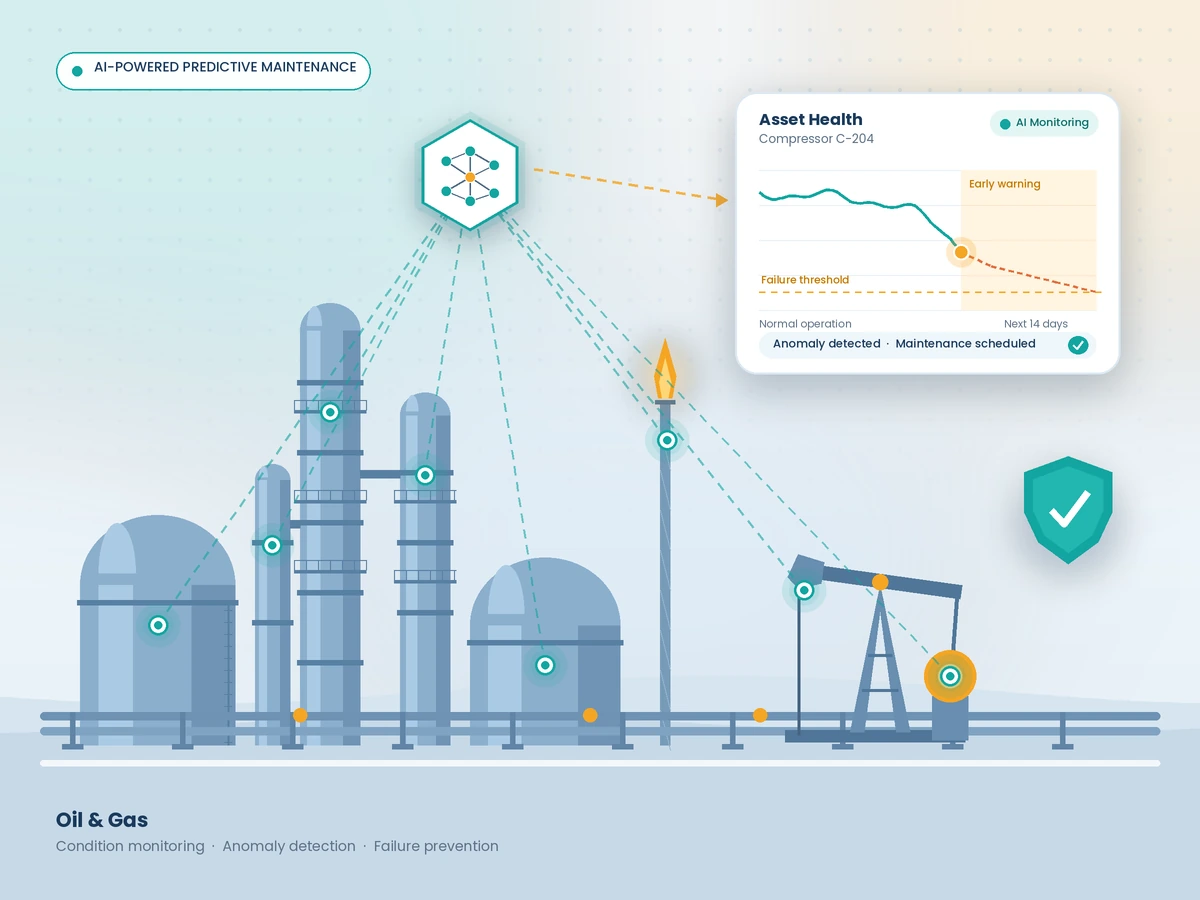
An unplanned pump failure on an offshore platform or in a refinery is expensive. Lost production, emergency repair crews, and safety risks pile up within hours. Yet many operators still maintain equipment on fixed schedules or wait for breakdowns. AI-powered predictive maintenance changes this by analyzing live equipment data to spot trouble weeks before a failure occurs.
This guide explains how AI predicts failures, which equipment benefits most, what results to expect, and how to implement it successfully.
What Is AI-Powered Predictive Maintenance and How Does It Work?
AI-powered predictive maintenance uses sensor data, machine learning, and analytics to forecast when equipment will fail, so teams can repair it at the right time rather than too early or too late.
Unlike reactive maintenance (fix it after it breaks) or preventive maintenance (service it on a calendar), the predictive approach acts on actual asset condition. The process works in four steps:
- Collect data: Sensors capture vibration, temperature, pressure, flow, and power consumption.
- Establish a baseline: AI models learn what “normal” looks like for each asset under different loads.
- Detect anomalies: The system flags deviations that signal developing faults.
- Predict and recommend: Algorithms estimate remaining useful life and suggest maintenance actions.
For oil and gas, this means fewer surprises and better-planned shutdowns. Explore predictive maintenance solutions to see how these steps fit together in practice.
Common Equipment Failures in Oil and Gas Operations
Harsh environments, continuous operation, and corrosive fluids make failures common. The most frequent include:
- Bearing wear and lubrication failure in pumps, motors, and compressors
- Seal leaks in centrifugal and reciprocating pumps
- Shaft misalignment and imbalance causing excess vibration
- Cavitation in pumps from poor suction conditions
- Motor winding insulation breakdown and overheating
- Valve and compressor fouling that reduces efficiency
- Corrosion and erosion in pipelines and process equipment
Most of these faults develop gradually and produce measurable warning signs, which is exactly what AI is built to detect.
How AI Detects Anomalies Using Vibration, Temperature, Pressure and Energy Data
Each data type reveals different failure modes. AI combines them for a far clearer picture than any single gauge.
- Vibration data. Rising vibration at specific frequencies points to bearing defects, misalignment, looseness, or imbalance. Machine learning can separate these patterns long before a human analyst would notice.
- Temperature data. Gradual heat increases in bearings, windings, or seals often signal friction, lubrication problems, or electrical faults.
- Pressure data. Drops or fluctuations in discharge or suction pressure can indicate cavitation, blockages, internal wear, or leaks.
- Energy data. An asset drawing more power for the same output is losing efficiency. Current and power signatures also reveal motor and electrical issues.
The real strength of oil and gas predictive analytics is correlation. A slight temperature rise alone may be harmless. Combined with a vibration shift and higher energy draw, it becomes a clear early warning. AI evaluates these relationships continuously and reduces false alarms over time.
Key Benefits of AI Predictive Maintenance in Oil and Gas
- Reduced downtime: Failures are caught early, so repairs happen during planned windows.
- Lower maintenance costs: Teams stop replacing healthy parts and avoid expensive emergency repairs.
- Improved equipment reliability: Assets run closer to optimal condition and last longer.
- Enhanced safety: Fewer catastrophic failures mean fewer leaks, fires, and emergency interventions for personnel.
- Better planning: Spare parts, crews, and shutdowns are scheduled with confidence.
Industry studies commonly report downtime reductions of 30–50% and maintenance cost savings of 10–40% for well-run programs, though results vary by asset base and starting maturity.
Predictive Maintenance for Pumps, Motors, Compressors and Rotating Equipment
Rotating equipment is the backbone of oil and gas production and the most failure-prone.
- Pumps. Predictive maintenance for pumps monitors vibration, seal condition, flow, pressure, and efficiency to catch cavitation, wear, and bearing faults early. Pumps run continuously and are often critical, so even small improvements deliver large returns.
- Motors. Current signature analysis, temperature trends, and vibration data reveal winding degradation, rotor issues, and overload before a motor trips.
- Compressors. AI tracks pressure ratios, temperatures, and vibration to detect valve problems, fouling, and surge conditions.
- Other rotating equipment. Turbines, gearboxes, fans, and blowers benefit from the same condition-based approach.
The Role of AI Analytics and Predictive Maintenance Software in Oil and Gas
Sensors alone don’t prevent failures. Insight does. Predictive maintenance software for oil and gas turns raw data into action by:
- Integrating data from sensors, SCADA, and historians
- Running AI models for anomaly detection and failure prediction
- Prioritizing alerts by asset criticality and severity
- Presenting health scores and trends on easy-to-read dashboards
- Triggering work orders so findings lead to timely repairs
Without software, data sits unused. With it, maintenance and reliability teams get clear, ranked recommendations. Broader oil and gas software solutions can connect these insights with operations, reporting, and asset management.
Example: Measurable Business Outcomes
The scenario below is illustrative. Replace it with your own client data before publishing.
A mid-sized upstream operator ran 40 critical pumps and motors across several sites. Before predictive maintenance, it averaged 12 unplanned pump failures a year, each costing roughly 18 hours of downtime plus emergency repair expenses.
After deploying AI-based condition monitoring on vibration, temperature, and power data:
- Unplanned failures fell from 12 to 5 per year (about 58% reduction)
- Unplanned downtime dropped by more than 100 hours annually
- Emergency repair spend decreased by around 30%
- Maintenance teams shifted from firefighting to planned work
Early alerts on bearing wear and cavitation gave the team weeks of lead time to schedule repairs, which is the practical value of AI predictive maintenance in oil and gas.
How eInnoSys XPump Supports AI-Driven Pump and Motor Monitoring
eInnoSys XPump is built to bring this capability to pump-intensive operations. It supports teams by:
- Monitoring pump and motor health in real time
- Using AI analytics to identify abnormal vibration, temperature, pressure, and energy patterns
- Providing early alerts so issues are addressed before they cause shutdowns
- Offering clear dashboards for operators, maintenance engineers, and plant managers
- Supporting data-driven decisions on repairs, replacements, and efficiency
Because pumps and motors are among the most critical and failure-prone assets in oil and gas, XPump helps teams start where the payoff is highest.
Best Practices for Implementing AI-Powered Predictive Maintenance
- Start with critical assets. Focus first on equipment whose failure causes the greatest production, safety, or cost impact.
- Check data quality. Make sure sensors are reliable, calibrated, and properly placed.
- Define clear goals. Set targets such as fewer unplanned stoppages or lower repair spend.
- Run a pilot. Prove value on a small asset group, then scale.
- Involve your people. Bring maintenance, operations, and reliability teams in early, and train them to act on alerts.
- Integrate with workflows. Link alerts to your CMMS or work-order process so insights turn into action.
- Refine continuously. Review predictions against actual findings and keep improving the models.
Conclusion
AI-powered predictive maintenance gives oil and gas operators a practical way to cut downtime, control costs, improve reliability, and protect people. By combining vibration, temperature, pressure, and energy data with machine learning, teams can act on failures weeks before they happen. With purpose-built solutions like XPump from eInnoSys, operators can begin monitoring pumps and motors with confidence and build toward a plant-wide reliability strategy.


