
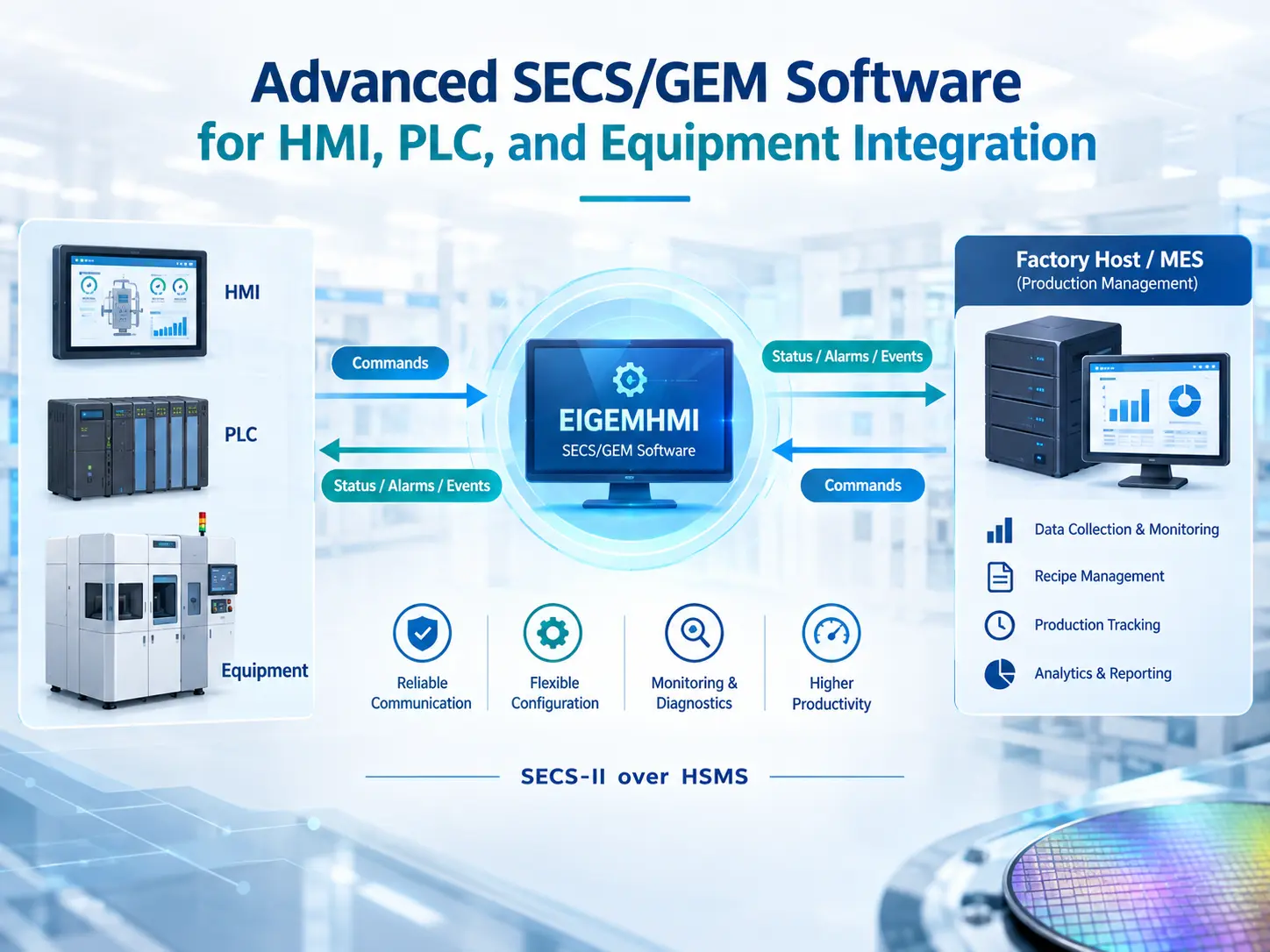
Semiconductor fabs depend on connected equipment. Factory hosts and MES platforms need reliable access to tool status, alarms, events, and process data. Equipment manufacturers (OEMs) are increasingly expected to deliver tools that communicate in a standardized way, and that expectation shapes how new equipment is designed.
For many OEMs, the difficulty is in the equipment’s architecture. Many tools are built around an HMI and one or more PLCs, each with its own protocols and data structures. Connecting them to a factory host is rarely a plug-and-play task. SECS/GEM gives the industry a common language for equipment-to-host communication. Advanced SECS/GEM software helps developers apply that language without building every layer from scratch.
This article explains how SECS/GEM software supports HMI, PLC, and equipment integration. It also covers what to look for in a solution and where EIGEMHMI from eInnoSys fits.
Understanding SECS/GEM in Semiconductor Equipment Integration
SECS/GEM is a set of related standards that define how equipment and a factory host exchange information. Three terms come up most often:
- SECS-II defines the message format: the structure of the messages that carry data, commands, and responses.
- HSMS (High-Speed SECS Message Services) is the transport. It carries SECS-II messages over a TCP/IP Ethernet connection.
- GEM (Generic Equipment Model) defines how equipment should behave from the host’s point of view. That covers communication states, control states, event reporting, alarm handling, and data collection.
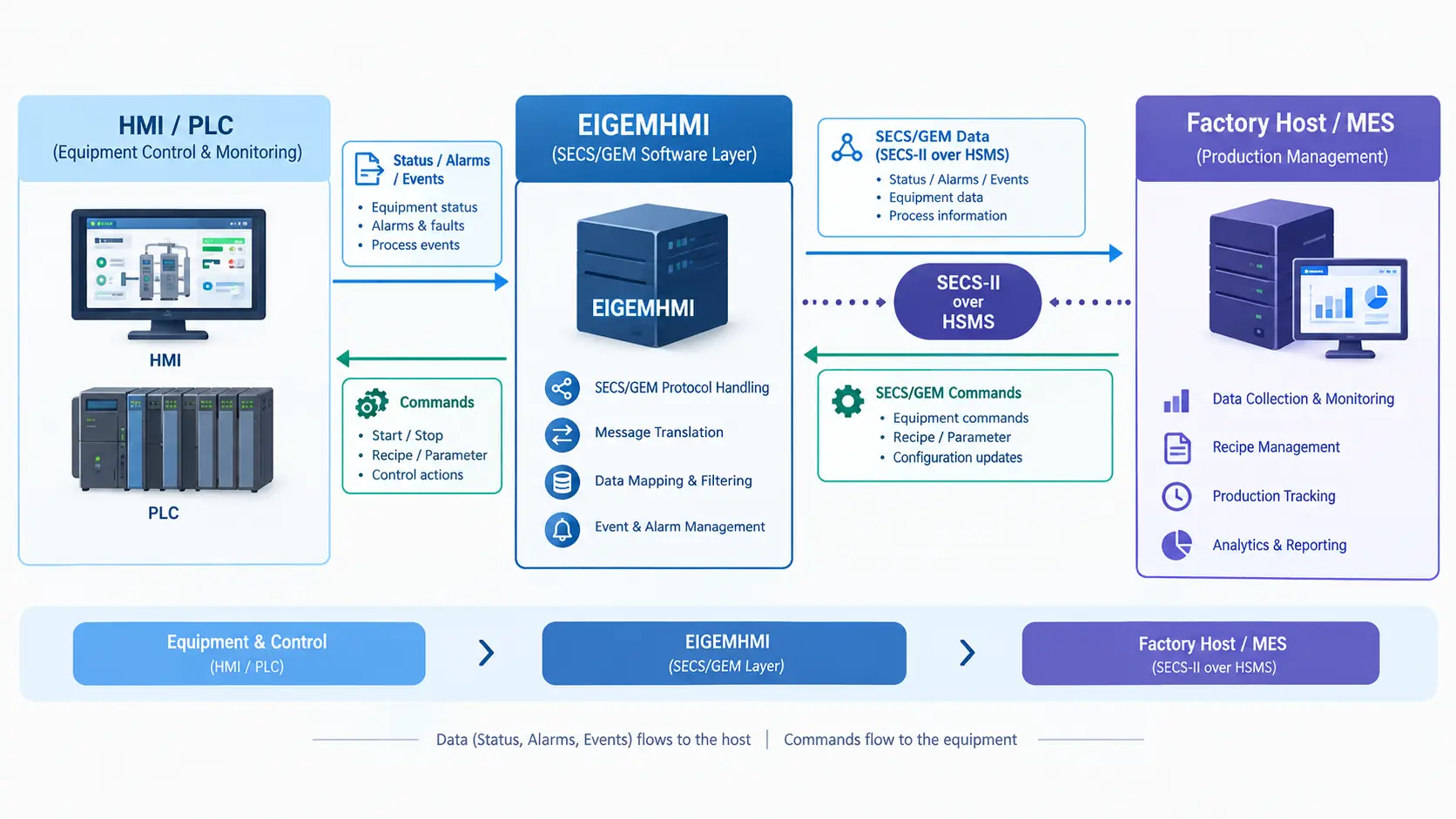
In practice, the equipment reports its status and raises alarms. It sends event notifications and delivers collected data to the host. The host can also send remote commands and change equipment settings where the equipment supports it. A consistent model lets the same host integrate many tools without writing custom logic for each one.
Common HMI and PLC Integration Challenges
Implementing SECS/GEM on HMI- and PLC-based equipment raises practical issues.
- Legacy communication limitations. Older tools may expose data through proprietary or serial interfaces. Those were never designed for host-level integration.
- Different PLC and HMI architectures. PLC brands, HMI platforms, and tag structures vary widely. Data that must be reported to a host may sit in several places.
- Data collection and event reporting. Mapping equipment signals to GEM concepts means deciding which variables, events, and alarms the host can see and what each one means.
- MES and host integration. Each factory host has its own requirements. The equipment’s behavior must match what the host expects and what the fab specifies.
- Maintenance and scalability. A custom implementation can be hard to maintain as equipment models multiply and host requirements change. Knowledge often concentrates in a few developers.
How Advanced SECS/GEM Software Supports HMI and PLC Integration
Suitable software gives developers a ready-made communication layer. They can then spend their effort on equipment-specific logic.
Typically, such software helps developers to:
- Implement SECS-II/HSMS communication and the GEM behaviors the host expects.
- Map equipment data from the HMI or PLC to status variables, data variables, and equipment constants.
- Configure collection events and alarms so the host receives meaningful information.
- Handle host messages and equipment responses in a structured way.
- Connect the equipment application with host applications and MES environments.
The result is a clearer separation between the equipment’s control logic and its host communication. That makes the system easier to test, document, and maintain. The exact scope depends on the product and on the equipment’s configuration.
Key Capabilities to Look for in SECS/GEM Integration Software
When evaluating SECS/GEM communication software, consider the following:
- SECS/GEM communication support: coverage of the standards and behaviors your fab customers require.
- HMI and PLC data integration: a practical way to connect to your control platform and data sources.
- Host communication and message handling: reliable connection management and message processing.
- Equipment status and alarm reporting: the ability to report states, alarms, and changes clearly.
- Event and variable configuration: flexible setup of reports, events, and variables without heavy rework.
- Diagnostic tools and integration support: message visibility and troubleshooting aids for development and commissioning.
- Compatibility with your equipment architecture: fit with your operating system, HMI platform, PLC environment, and development approach.
Specific capabilities depend on the software and the equipment configuration. Confirm each requirement directly with the vendor.
Why Choose EIGEMHMI for Equipment Integration?
EIGEMHMI is part of eInnoSys’s portfolio of semiconductor connectivity products. It is intended for equipment that uses an HMI-based architecture and needs to communicate with a factory host through SECS/GEM. For OEMs, the practical value lies in using a purpose-built SECS/GEM layer. The alternative is to develop and maintain that communication stack internally.
eInnoSys focuses on semiconductor equipment connectivity. Its solutions address the communication and integration needs of OEMs and fab teams. Before you evaluate EIGEMHMI, review the official product documentation for supported features, platforms, and integration methods.
Applications Across Semiconductor Manufacturing
SECS/GEM integration applies wherever equipment must communicate with a host:
- Semiconductor equipment OEMs delivering tools that must meet customer connectivity requirements.
- HMI-based manufacturing tools that need a structured host communication layer.
- PLC-controlled equipment where process and status data must reach the factory host.
- Factory automation projects that connect many tools to an MES or host environment.
- Retrofit and upgrade projects where existing equipment must be brought into a connected fab environment.
Architecture Overview
Manual Integration vs. SECS/GEM Software-Based Integration
| Factor | Manual / Custom Integration | Structured SECS/GEM Software Approach |
|---|---|---|
| Development Effort | Often substantial because the communication stack is built in-house. | Typically reduces communication-layer development, although equipment-specific work remains. |
| Communication Implementation | Developed and tested internally. | Provided by the software within its supported scope. |
| Data Mapping | Defined through custom code. | Usually supported through configuration tools or structured methods. |
| Diagnostics | Depends on the tools developed by the team. | May include message monitoring and troubleshooting tools, depending on the product. |
| Maintainability | May depend on individual developers’ knowledge. | Can be more consistent with vendor documentation and technical support. |
Conclusion
Reliable SECS/GEM communication is a practical requirement for equipment that will operate in a connected fab. For HMI- and PLC-based tools, the right software layer can simplify integration, clarify data mapping, and make long-term maintenance easier. The best choice is software that suits your equipment architecture and your customers’ host requirements.
Talk to eInnoSys About Your SECS/GEM Integration
If you are an equipment manufacturer or automation engineer planning SECS/GEM integration, eInnoSys can help you assess your requirements. Contact eInnoSys to discuss your project or request a product demonstration.


