
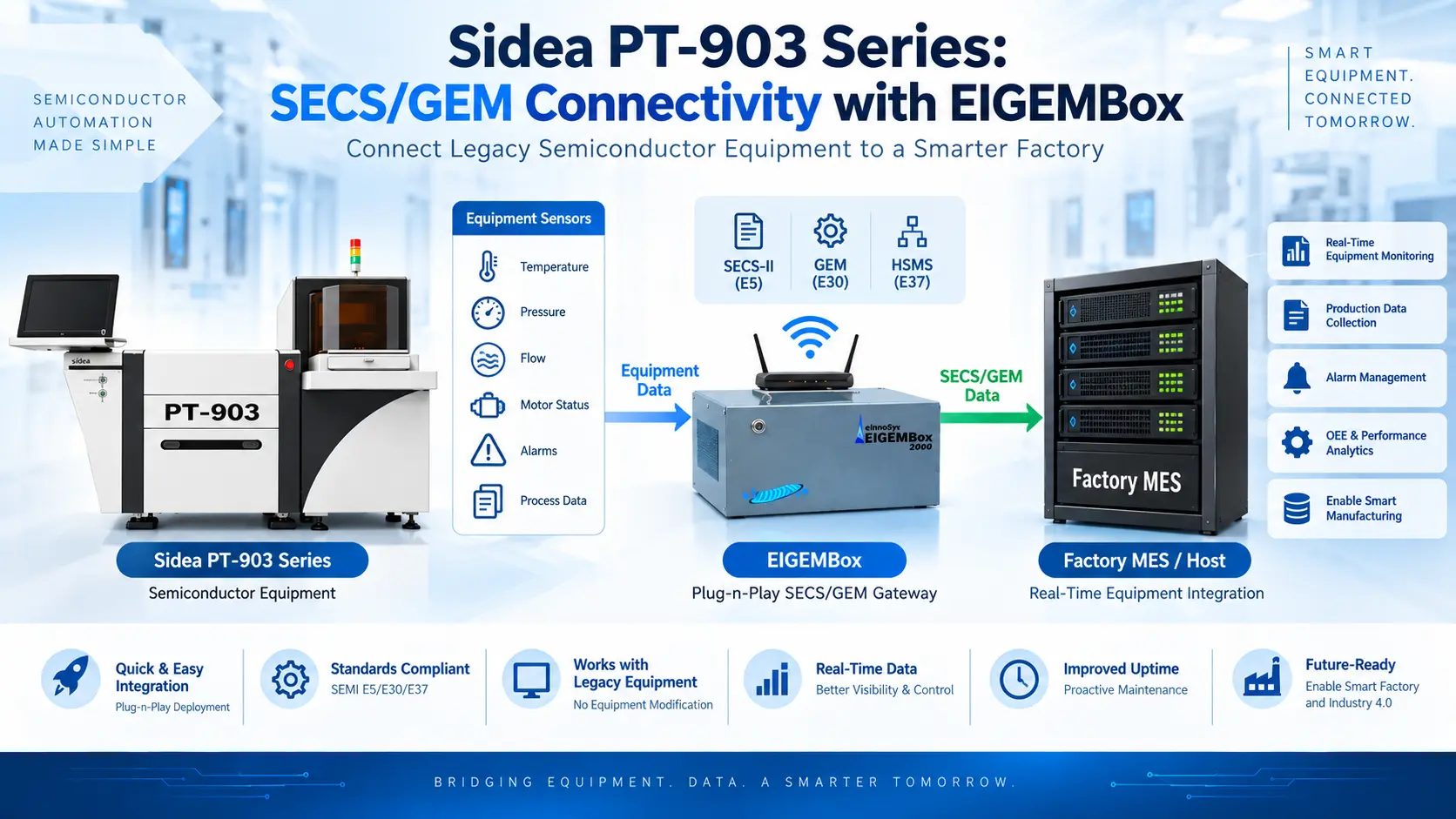
Semiconductor fabs run on communication. Every tool on the floor, from etch chambers to metrology stations, needs a reliable way to exchange status, data, and commands with the factory host. For equipment like the Sidea PT-903 Series, establishing dependable Sidea PT-903 SECS/GEM connectivity is often the deciding factor in how smoothly that equipment fits into a modern fab automation environment.
This article looks at why SECS/GEM connectivity matters for equipment such as the Sidea PT-903 Series, the integration challenges engineers commonly run into, and how a solution like EIGEMBox can serve as a practical connectivity layer between the equipment and the host system.
Understanding SECS/GEM Connectivity
SECS/GEM is the long-standing communication framework that lets semiconductor equipment and factory host systems talk to each other in a standardized way. It is made up of a few distinct pieces that are often used interchangeably in conversation, but which actually serve different purposes.
SECS-II defines the message structure and data format used in equipment-to-host communication — essentially the vocabulary and grammar of the exchange.
HSMS (High-Speed SECS Message Services) is the transport mechanism that carries those SECS-II messages over an Ethernet connection, replacing the older serial-based SECS-I approach with something faster and more suited to modern fab networks.
GEM (Generic Equipment Model) builds on top of SECS-II to define standardized equipment behaviors — how a tool reports its state, how it handles events and alarms, how it responds to remote commands, and how it exposes equipment data for collection.
It’s worth being clear about one distinction: SECS/GEM is a communication standard between equipment and a host, not the MES itself. The MES (Manufacturing Execution System) is the higher-level software that plans, tracks, and manages production; SECS/GEM is one of the mechanisms equipment can use to communicate with that system or with an intermediate host layer.
Sidea PT-903 Series and Factory Automation
Any piece of equipment on a fab floor, the Sidea PT-903 Series included, becomes far more valuable to an automation strategy when it can communicate consistently with the host. That communication typically needs to support a few core functions:
- Reporting equipment status and state changes in real time
- Collecting process and equipment data for quality and yield analysis
- Notifying the host of events and alarms as they occur
- Accepting remote commands from the host or MES where appropriate
Whether the Sidea PT-903 Series supports these functions natively, or needs an external layer to expose them in SECS/GEM terms, is a question that depends on the specific equipment configuration and interfaces available. This article does not assume a particular communication protocol or hardware architecture for the PT-903 Series beyond what is verified — the focus here is on the broader connectivity and integration perspective.
Common Equipment Integration Challenges
Fabs rarely have the luxury of connecting brand-new, SECS/GEM-native equipment exclusively. Engineers regularly face a mix of tool generations and interface types, and that creates a familiar set of challenges:
- Legacy equipment interfaces that were never designed with SECS/GEM communication in mind, or that use older serial connections
- Lack of native SECS/GEM support, requiring an intermediate layer to translate equipment signals or data into standardized SECS/GEM messages
- Communication configuration work, including HSMS connection setup, message definitions, and state model alignment with the host’s expectations
- Host integration requirements that vary by fab, since each host or MES may expect slightly different message handling or data formats
- Equipment data accessibility, particularly when relevant data points are not readily exposed through the equipment’s existing controller
- Minimizing changes to existing equipment, since modifying validated production tools carries cost, downtime, and requalification implications
For equipment integration teams, the goal is usually to solve these problems without disrupting a tool that is already running in production.
How EIGEMBox Supports SECS/GEM Connectivity
EIGEMBox is eInnoSys’s plug-and-play SECS/GEM equipment integration solution, designed to sit between semiconductor equipment and the factory host as a dedicated connectivity layer. Rather than requiring a full rework of the equipment’s control system, EIGEMBox is intended to provide the SECS/GEM communication capability that equipment may be missing.
Depending on the equipment environment and configuration, EIGEMBox can support functions such as:
- SECS/GEM communication using SECS-II message structures
- HSMS connectivity for host communication over Ethernet
- Equipment data collection for relevant process and status parameters
- Events and alarms reporting to the host system
- Remote command handling, where the equipment and host configuration support it
- Integration into existing factory automation and host environments
It’s important to note that not every one of these capabilities is automatically available for every piece of equipment, including the Sidea PT-903 Series, without proper verification of the equipment’s interfaces and data points. The actual scope of what EIGEMBox can expose depends on what the underlying equipment makes available and how the integration is configured and validated for that specific tool.
Benefits of a Structured SECS/GEM Integration Approach
Taking a structured, verified approach to SECS/GEM integration — rather than an ad hoc one — tends to produce more consistent results for equipment connectivity projects. Some of the benefits engineers typically look for include:
- Simplified equipment-to-host communication through a standardized message framework
- Better equipment visibility for operations and engineering teams
- More consistent data exchange between the tool and the host system
- Easier integration into broader factory automation and smart manufacturing environments
- Reduced integration complexity when a dedicated connectivity layer, such as EIGEMBox, handles the SECS/GEM communication work
- Support for the kind of automation environments modern fabs are building toward, including GEM300-aligned workflows where the equipment and host configuration support it
These benefits can vary depending on the equipment, the host system, and how thoroughly the integration has been tested and validated. They are not guarantees of a particular outcome, but rather the kind of improvements a well-planned SECS/GEM integration approach can help deliver.
Key Considerations Before Integrating the Sidea PT-903 Series
Before starting a SECS/GEM integration project for equipment such as the Sidea PT-903 Series, engineers generally benefit from working through a short list of practical questions:
- What communication interfaces does the equipment currently expose, and are they documented?
- Which specific SECS/GEM functionality does the fab actually require — data collection, alarms, remote control, or a combination?
- What does the host or MES expect in terms of message formats, state models, and connection behavior?
- Which equipment variables and data points need to be collected, and are they accessible from the controller?
- What events and alarms need to be reported, and how should they map to the host’s alarm handling?
- Are remote commands required, and if so, which ones, and under what conditions should the equipment accept them?
- What does the network configuration look like, including IP addressing, port assignments, and any security requirements for HSMS connections?
- How will the integration be tested and validated before it goes into production, including failure scenarios and reconnection behavior?
Working through these questions early tends to reduce surprises later in the integration process, particularly for equipment that wasn’t originally designed with SECS/GEM in mind.
Conclusion
Connecting equipment like the Sidea PT-903 Series to a fab’s host and MES environment is rarely just a matter of running a cable. It requires understanding what SECS/GEM communication actually involves, being realistic about the equipment’s existing interfaces, and planning the integration around the fab’s actual requirements rather than assumptions.
A structured approach to Sidea PT-903 SECS/GEM connectivity — one that accounts for legacy interfaces, host requirements, and data accessibility — gives engineering teams a clearer path to reliable equipment-to-host communication. EIGEMBox is one option worth evaluating as part of that approach, offering a dedicated SECS/GEM integration layer that can be configured to the equipment and fab environment at hand. As always, the right fit depends on verifying the specific equipment’s capabilities and the fab’s integration requirements before committing to an implementation path.


