
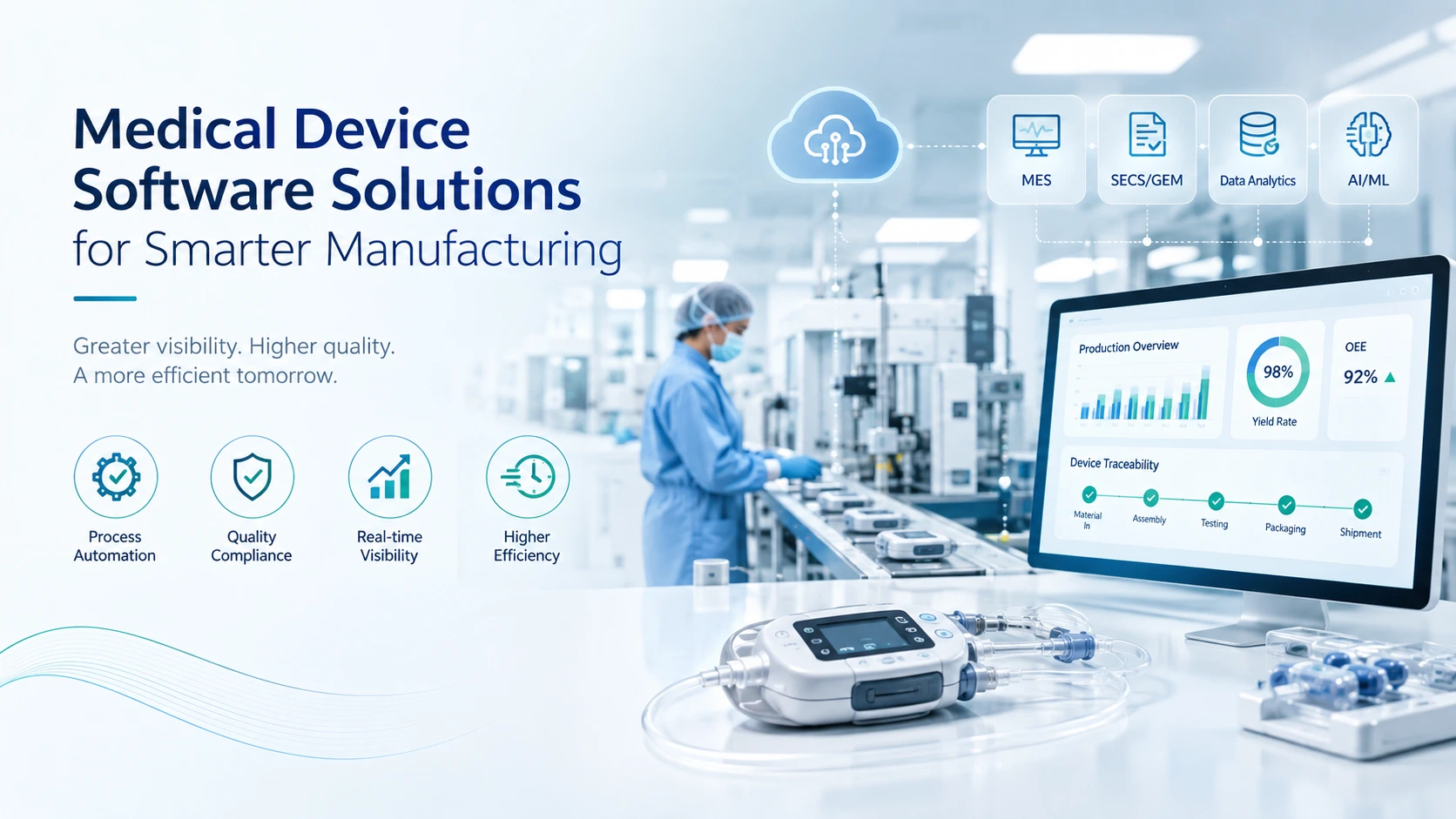
Medical device production leaves no room for guesswork. Every component, process step, and inspection result must be traceable, repeatable, and ready for audit. Yet many factories still rely on disconnected machines, manual data entry, and spreadsheets.
That is where medical device manufacturing software makes a real difference. It connects equipment, collects production data in real time, and automates routine tasks. As a result, manufacturers gain the visibility they need to build safer devices with fewer delays.
In this guide, you will learn what this software does, which features matter most, and how to choose the right solution for your factory.
What Is Medical Device Manufacturing Software?
Medical device manufacturing software is a set of digital tools that connect, monitor, and manage the equipment and processes on a production floor. It sits between your machines and your business systems, such as MES, ERP, and quality management platforms.
Instead of operators logging values by hand, the software pulls data straight from the equipment. It then shares that data with the systems that need it. Typical uses include:
- Connecting machines from different vendors
- Tracking equipment status and performance
- Recording process parameters for traceability
- Triggering alerts when a value drifts out of range
In short, it turns isolated machines into a connected production network.
Why Medical Device Manufacturers Need Smarter Automation
Medical device manufacturers face pressure from several directions at once. Regulators expect complete documentation under FDA requirements, ISO 13485, and EU MDR. Customers expect consistent quality. Meanwhile, product lifecycles keep getting shorter.
Manual processes struggle to keep up. Handwritten records create errors. Mixed equipment fleets make it hard to see the full picture. Unplanned downtime often goes unnoticed until output drops.
Smarter medical device manufacturing automation solves these problems at the source. When machines report their own data, teams spend less time collecting information and more time acting on it. Moreover, audits become simpler because records are accurate and easy to retrieve.
Key Features of Medical Device Software Solutions
The best medical device software solutions share a few core capabilities. Look for each of the following.
Equipment Connectivity
Connectivity is the foundation. Software must communicate with CNC machines, molding systems, inspection stations, and assembly equipment, whatever their age or brand. Dedicated medical device equipment software translates each machine’s data into a common, standard format, so every system speaks the same language.
Real-Time Equipment Monitoring
Live dashboards show machine status, cycle times, alarms, and utilization. Consequently, supervisors spot problems within minutes rather than at the end of a shift. This kind of medical device equipment monitoring also helps teams compare performance across lines.
Production Data Collection
Automated collection captures process parameters, batch details, and timestamps without manual input. This data supports traceability and device history records. It also removes the transcription errors that often appear in paper-based systems.
Process Automation
Recipes, work instructions, and equipment settings can be sent to machines automatically. This reduces setup mistakes and keeps every batch consistent. Operators can then focus on quality checks instead of repetitive entry.
Manufacturing Data Management
Collected data must be stored, organized, and shared with quality and engineering teams. Good data management turns raw machine signals into reports, trends, and audit-ready records that anyone can find quickly.
How SECS/GEM and GEM300 Support Equipment Integration
SECS/GEM is a widely used communication standard for equipment-to-host interaction. It was first developed for semiconductor fabs. Today, it is increasingly valuable in medical device manufacturing, especially for producing micro-components, sensors, and electronics used in modern devices.
The standard defines how equipment reports status, sends events, raises alarms, and accepts remote commands. Because the messages follow a common structure, integration is faster and more predictable than custom, machine-by-machine coding.
GEM300 extends this model for automated material handling. It adds carrier management, job control, and process management. Factories running cleanroom or highly automated lines can benefit from this added control.
Manufacturers who want standards-based connectivity can explore SECS/GEM and GEM300 solutions to see how it works in practice.
How Equipment Software Supports Smarter Medical Device Factories
Consider a typical line with a CNC machine, a cleaning station, an assembly cell, and an inspection unit. Without integration, each one runs alone. Operators check screens, write down values, and pass paper records along.
With equipment software in place, every machine reports to a central system. The host knows when a machine goes idle, which lot it is running, and whether a parameter has drifted. Alerts reach the right person instantly. Quality teams receive complete records without chasing paperwork.
The outcome is a factory that responds quickly, wastes less material, and proves compliance with confidence.
Benefits of Automation Software in Medical Device Manufacturing
Adopting automation software delivers measurable gains across the factory:
- Better equipment utilization: Live data reveals idle time and bottlenecks.
- Improved production visibility: Managers can see every line from a single screen.
- Fewer manual processes: Automated capture cuts transcription errors and saves time.
- Faster issue detection: Alerts flag deviations before they turn into scrap.
- Greater scalability: Standard interfaces make adding new machines simpler.
Together, these benefits lower operating costs and support consistent product quality.
Medical Device Manufacturing and Industry 4.0
Industry 4.0 ideas are reshaping medical device factories. A smart factory connects machines, data, and people, so decisions rely on facts instead of assumptions.
Equipment software is the entry point. Once machines share data, manufacturers can add predictive maintenance, which uses trends in temperature, vibration, or cycle time to anticipate failures. They can also feed clean data into MES and analytics tools for deeper optimization. Therefore, connecting equipment first creates a strong base for every later smart manufacturing step.
Choosing the Right Medical Device Manufacturing Software
Not every platform suits every factory. Consider these points before you decide:
- Protocol support: Look for SECS/GEM, GEM300, OPC UA, and other common standards.
- Equipment compatibility: Confirm it works with both new and legacy machines.
- Compliance support: Check for audit trails, access control, and data integrity features.
- Scalability: Choose a solution that grows with your production lines.
- Vendor expertise: Pick a partner with deep equipment integration experience.
Start with a pilot on one line. Then expand once the results are clear.
Conclusion
Medical device manufacturing software gives factories the connectivity, visibility, and control they need to meet quality and regulatory demands. From real-time monitoring to standards-based integration through SECS/GEM and GEM300, the right tools turn scattered machines into a smarter production system.
eInnoSys helps manufacturers make that shift with proven equipment integration and automation expertise. To see how it can support your plant, explore our medical device manufacturing solutions and take the first step toward smarter production.


