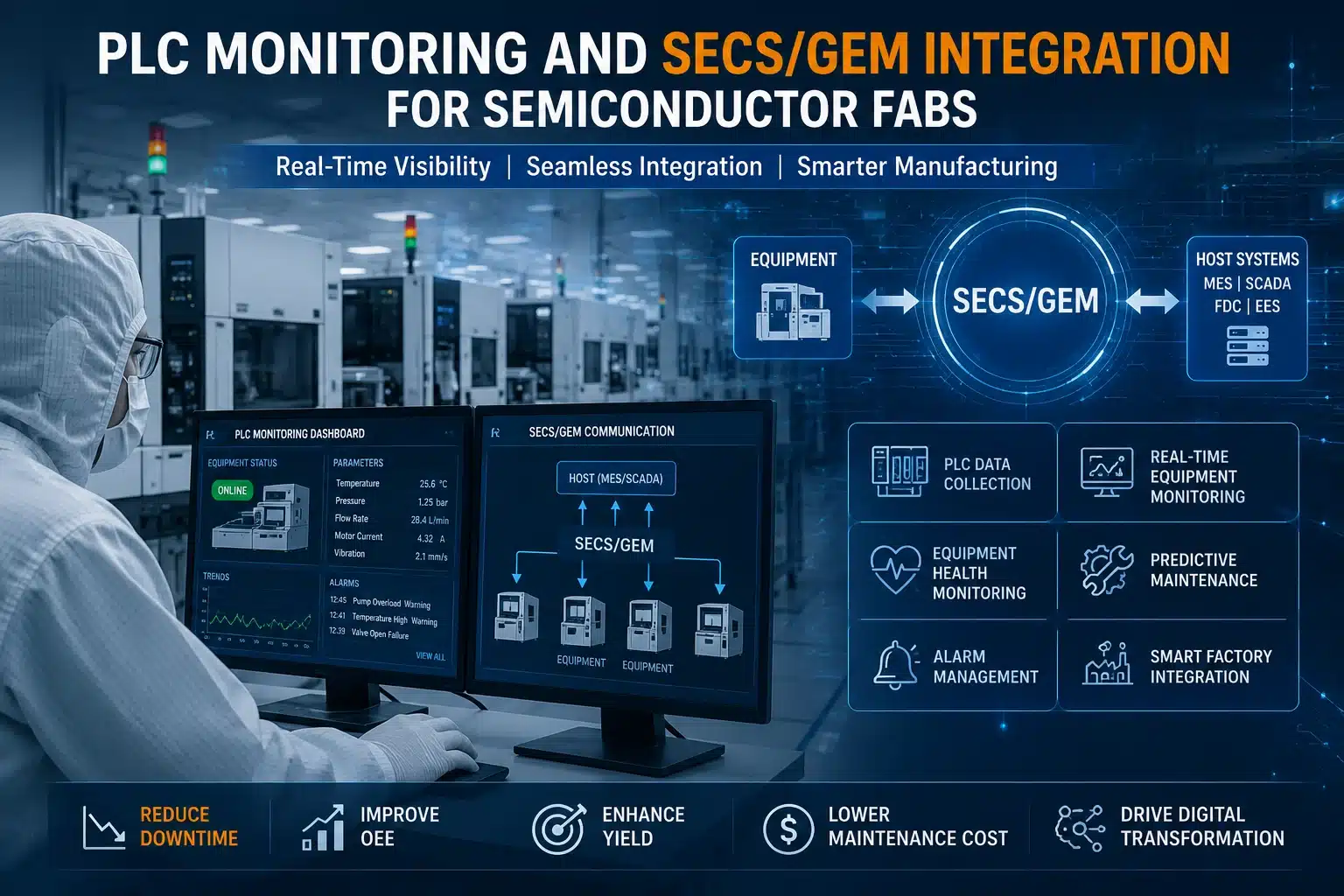
As semiconductor manufacturing facilities continue to pursue higher productivity, lower downtime, and improved equipment visibility, the need for seamless communication between factory systems and production equipment has become increasingly important. Modern fabs rely on vast amounts of operational data to maintain process stability, improve Overall Equipment Effectiveness (OEE), and support predictive maintenance initiatives.
One of the most effective approaches is combining
PLC Monitoring for Semiconductor Fabs with SECS/GEM communication standards. While Programmable Logic Controllers (PLCs) manage machine-level operations and collect valuable equipment data, SECS/GEM enables standardized communication between equipment and factory host systems such as MES, SCADA, and factory automation platforms.
By integrating these technologies, semiconductor manufacturers can achieve real-time visibility, enhanced equipment utilization, and smarter decision-making across the factory floor.
Why PLC Monitoring Matters in Semiconductor Manufacturing
Semiconductor production equipment contains numerous subsystems controlled by PLCs, including pumps, chillers, gas delivery systems, robotic handlers, exhaust systems, and environmental controls. Monitoring these components is essential for maintaining production quality and minimizing unexpected failures.
Effective PLC Monitoring for Semiconductor Fabs provides continuous access to operational parameters such as:
- Temperature
- Pressure
- Flow rates
- Motor currents
- Vibration levels
- Valve status
- Equipment alarms
Through advanced PLC Data Collection Software, manufacturers can gather critical operational information and transform raw machine data into actionable insights.
Without proper monitoring, equipment degradation often goes unnoticed until a failure occurs, leading to production interruptions, yield loss, and costly maintenance activities.
Understanding SECS/GEM Integration
SECS/GEM is the global semiconductor industry standard for equipment communication. It allows manufacturing systems to communicate with equipment using standardized messages and data structures.
SECS/GEM Integration Services enable fabs to:
- Collect equipment data automatically
- Track equipment status in real time
- Receive alarms and event notifications
- Execute remote commands
- Support recipe management
- Improve production traceability
Many semiconductor tools already support SECS/GEM natively. However, legacy equipment and PLC-controlled subsystems often require additional integration layers to expose operational data to factory systems.
This is where PLC Monitoring and SECS/GEM Integration become a powerful combination.
Connecting PLC Data to Factory Automation Systems
A common challenge in semiconductor manufacturing is that critical operational data remains trapped inside PLCs and is not accessible through factory automation platforms.
By implementing PLC Monitoring for Semiconductor Fabs alongside SECS/GEM interfaces, manufacturers can bridge this communication gap.
The integration process typically includes:
1. PLC Data Acquisition
Data is collected from PLCs using industrial communication protocols such as:
- Modbus TCP
- OPC UA
- Ethernet/IP
- Profinet
- Mitsubishi MC Protocol
- Siemens S7 Protocol
2. Data Mapping
Collected PLC variables are mapped into standardized SECS/GEM variables and status indicators.
Examples include:
| PLC Parameter |
SECS/GEM Variable |
| Pump Current |
Equipment Variable |
| Temperature |
Process Variable |
| Valve Status |
Equipment State |
| Motor Speed |
Equipment Data Item |
3. Host Communication
Mapped data is transmitted to:
- MES systems
- SCADA platforms
- Equipment Engineering Systems
- Factory Automation Servers
- Data Analytics Platforms
This creates a fully connected environment that supports Semiconductor Factory Automation initiatives.
Benefits of Real-Time Equipment Monitoring
Modern fabs generate enormous amounts of equipment data every second. Capturing and analyzing this information through Real-Time Equipment Monitoring significantly improves operational efficiency.
Some key benefits include:
Faster Problem Detection
Engineers receive immediate notifications when equipment parameters move outside normal operating ranges.
Reduced Downtime
Potential failures can be identified before they cause production interruptions.
Better Equipment Utilization
Equipment performance trends help optimize maintenance schedules and operational efficiency.
Improved Yield
Stable equipment operation directly contributes to process consistency and higher production yields.
Organizations implementing PLC Monitoring for Semiconductor Fabs often discover hidden inefficiencies that were previously difficult to identify using manual inspections alone.
Supporting Equipment Health Monitoring and Predictive Maintenance
Traditional maintenance strategies rely heavily on scheduled servicing or reactive repairs. However, semiconductor manufacturing increasingly requires data-driven maintenance approaches.
Through Equipment Health Monitoring, fabs can continuously assess equipment condition using real-time operational data.
Important indicators include:
- Motor current trends
- Bearing vibration levels
- Pump performance degradation
- Temperature abnormalities
- Pressure fluctuations
- Energy consumption patterns
When integrated with modern
Predictive Maintenance Software, machine learning algorithms can identify early warning signs of equipment failure.
For example, a vacuum pump may exhibit increasing motor current and vibration levels several weeks before an actual breakdown occurs. Predictive analytics can detect these patterns and generate maintenance recommendations before production is affected.
This proactive approach reduces maintenance costs while improving equipment reliability.
Enhancing Smart Factory Equipment Monitoring
The semiconductor industry is rapidly adopting Industry 4.0 technologies and smart manufacturing strategies.
A successful smart factory depends on accurate, real-time equipment visibility. This is where Smart Factory Equipment Monitoring plays a critical role.
Combining PLC monitoring with SECS/GEM communication enables:
- Centralized equipment dashboards
- Automated alarm management
- Real-time KPI tracking
- Equipment performance analytics
- OEE monitoring
- Energy management
- Remote equipment diagnostics
As factories become more connected, decision-makers gain access to comprehensive operational intelligence that supports continuous improvement programs.
Implementing PLC Monitoring for Semiconductor Fabs provides the foundation necessary for achieving smart factory objectives.
Integrating Legacy Equipment into Modern Semiconductor Fabs
Many fabs continue operating legacy equipment that was installed years before modern communication standards became common.
Replacing these tools can be expensive and disruptive.
Fortunately, Semiconductor Equipment Integration solutions allow legacy equipment to participate in modern factory automation environments.
Using gateway technologies, protocol converters, and SECS/GEM middleware, operational data can be extracted directly from PLC systems and presented through standardized interfaces.
This approach delivers several advantages:
- Extended equipment lifespan
- Reduced capital expenditure
- Improved factory visibility
- Faster digital transformation
- Consistent communication standards
As a result, manufacturers can modernize operations without replacing critical production assets.
Best Practices for Successful Implementation
To maximize the value of PLC Monitoring and SECS/GEM Integration, semiconductor manufacturers should follow several best practices:
Define Monitoring Objectives
Identify which equipment parameters are most critical to production performance.
Standardize Data Structures
Use consistent naming conventions and variable mappings across equipment types.
Prioritize Critical Assets
Focus first on high-value equipment where downtime has the greatest impact.
Enable Real-Time Alerts
Implement alarm notifications for abnormal operating conditions.
Leverage Historical Analytics
Store equipment data for trend analysis and predictive maintenance applications.
Ensure Cybersecurity
Protect communication channels and factory networks using industry-standard security practices.
Following these guidelines helps ensure long-term success and scalability.
Conclusion
As semiconductor manufacturing becomes increasingly data-driven, the ability to collect, analyze, and act on equipment information is essential. PLC Monitoring for Semiconductor Fabs provides the visibility needed to understand machine performance at the subsystem level, while SECS/GEM communication enables seamless integration with factory automation systems.
Together, PLC Monitoring and
SECS/GEM Integration create a powerful foundation for Real-Time Equipment Monitoring, Equipment Health Monitoring, Predictive Maintenance Software, and Smart Factory Equipment Monitoring initiatives. By connecting PLC-controlled assets to standardized semiconductor communication frameworks, manufacturers can reduce downtime, improve productivity, extend equipment life, and accelerate their digital transformation journey.
For semiconductor fabs seeking greater operational efficiency and future-ready automation, integrating PLC monitoring with SECS/GEM is no longer just an option—it is becoming a competitive necessity.
Explore SECS/GEM Integration Solutions
Ready to Modernize Your Semiconductor Equipment Connectivity?