
Semiconductor fabs depend on reliable communication. Every tool, from etch chambers to metrology stations, must exchange status updates, process data, and commands with factory host systems.
However, equipment from different vendors may use different communication methods. Without a standard approach, connecting each tool to a central host can require custom integration.
This is where HSMS in semiconductor manufacturing becomes important. HSMS provides a standardized communication service for equipment-to-host connectivity. It supports reliable data exchange between semiconductor equipment and factory systems.
For engineers new to SECS/GEM, HSMS is a useful starting point. Once you understand how HSMS establishes and manages communication, it becomes easier to understand SECS-II and the broader GEM framework.
What Is HSMS?
HSMS stands for High-Speed SECS Message Services. It is a communication standard, defined by SEMI E37, that specifies how semiconductor equipment and host systems exchange messages over a TCP/IP network.
In simple terms, HSMS defines the rules for establishing a connection, maintaining it, and passing messages back and forth reliably. It does not define what those messages mean or how they are structured internally — that part belongs to a separate standard called SECS-II, which is covered in the next section.
Think of HSMS as the delivery mechanism. It makes sure a message gets from equipment to host, or host to equipment, in an orderly and predictable way. What is written inside that message is a separate matter entirely.
Why Is HSMS Used in Semiconductor Manufacturing?
Semiconductor manufacturing involves hundreds of tools from many different equipment vendors, all needing to communicate with a central host or factory system. Without a shared communication standard, each piece of equipment could use its own proprietary method, making integration slow, inconsistent, and expensive.
HSMS solves this by giving equipment OEMs and factory integrators a common, TCP/IP-based communication service that works the same way regardless of the tool manufacturer. As a result, this consistency matters for several practical reasons:
Equipment from different vendors can connect to the same host using the same underlying communication approach.
New equipment can come online with far less engineering effort.
Factory systems gain the real-time visibility into equipment status that monitoring and control depend on.
How Does HSMS Work?
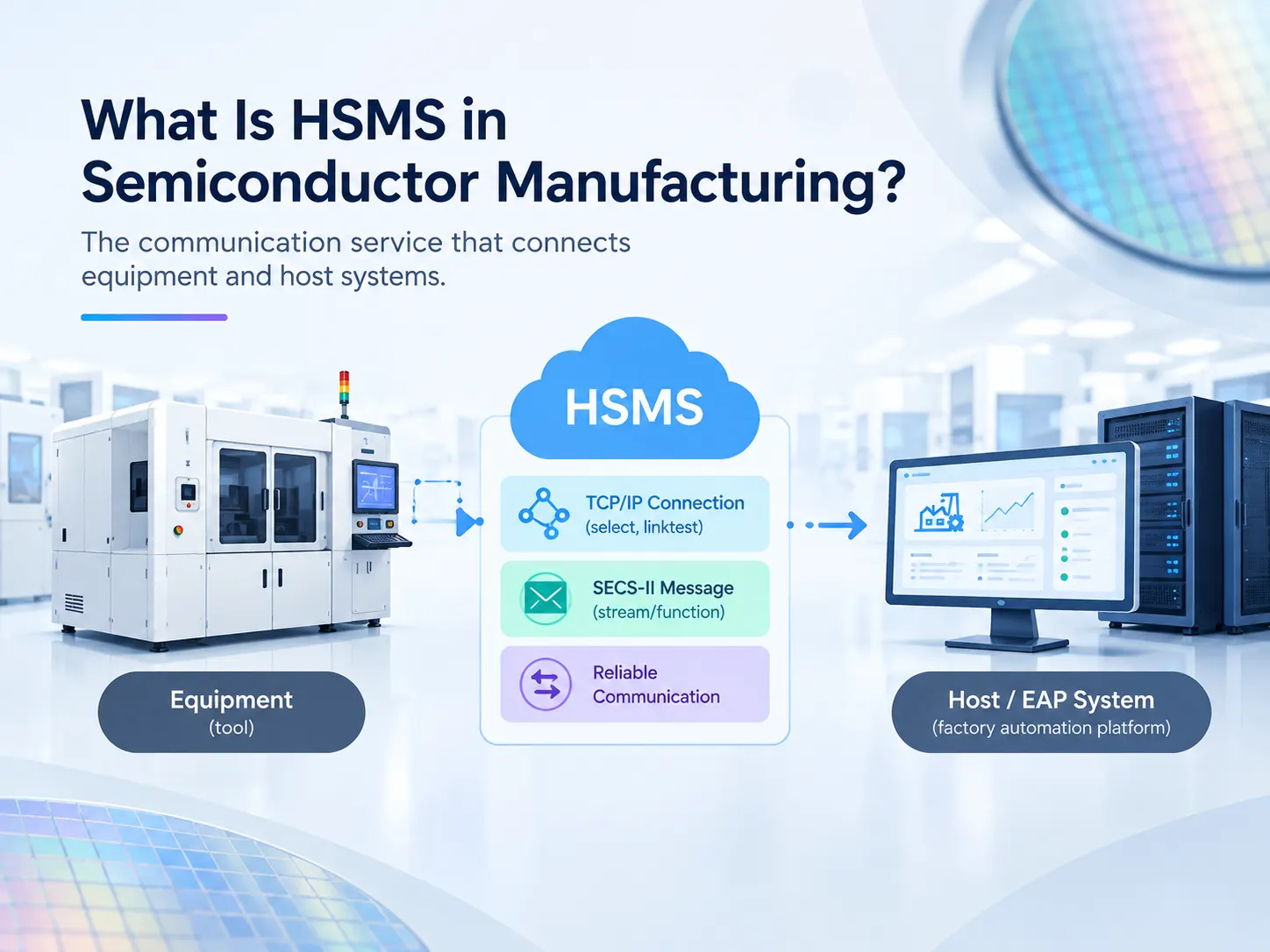
At a high level, HSMS works by establishing a network connection between two entities — typically a piece of equipment and a host system — and then using that connection to exchange messages according to a defined set of rules.
Specifically, the general flow looks like this:
- Equipment and host establish a TCP/IP connection.
- The two sides perform a “select” procedure to confirm the communication session is active.
- Once selected, both sides can exchange SECS-II messages in either direction.
- Periodic checks, called linktests, confirm the connection is still healthy.
- Either side can end the session with a “deselect” or close the connection entirely.
Overall, this flow is intentionally simple and repeatable. It gives equipment and host systems a predictable way to start talking, keep talking, and cleanly stop when needed, without ambiguity about the state of the connection.
HSMS and SECS-II: What Is the Difference?
This is one of the most common points of confusion for people new to semiconductor equipment communication, so it is worth stating plainly:
HSMS is the communication and session service. SECS-II is the message and data format.
HSMS, defined by SEMI E37, handles how a connection is opened, maintained, and closed over TCP/IP. SECS-II, defined by SEMI E5, defines the structure of the actual messages — how data is organized into streams and functions, and what that data represents.
In practice, the two work together. HSMS acts as the transport layer that carries SECS-II messages between equipment and host. Without HSMS, there would be no reliable way to move the messages. Without SECS-II, the messages carried over HSMS would have no agreed-upon structure or meaning.
HSMS and SECS/GEM
SECS/GEM is a broader term that refers to the overall equipment communication standard used in semiconductor manufacturing. It is not a single protocol, but a combination of standards working together:
- HSMS provides the communication and connection service.
- SECS-II defines the message format and data structure.
- GEM (Generic Equipment Model) defines the expected equipment behaviors, states, and standard capabilities that make communication meaningful in a manufacturing context.
HSMS is typically the transport method used beneath a SECS/GEM implementation, though it is important to note that HSMS itself is not the complete SECS/GEM standard. It is one component within it. A tool can support HSMS as its connection method while still needing SECS-II and GEM compliance layered on top to be considered a fully SECS/GEM-compliant piece of equipment.
HSMS Communication Flow in a Semiconductor Fab
A simple way to visualize how HSMS fits into daily fab operations is to follow the path a piece of data takes from equipment to the host or Equipment Automation Program (EAP): For example, when a process tool completes a wafer lot, it can report status and process data through this same path. The equipment formats the information as a SECS-II message, HSMS carries that message reliably over the network connection, and the host or EAP system receives and processes it — updating dashboards, triggering the next step, or logging data for traceability.
This flow repeats constantly across a fab floor, often across hundreds of connected tools at once, which is why the reliability of the underlying HSMS connection matters so much.
HSMS Active and Passive Connections
HSMS connections are established using one of two roles: active or passive. Understanding this distinction does not require deep networking expertise — the core idea is straightforward.
- Passive mode means one side, usually the host, waits and listens for an incoming connection request.
- Active mode means the other side, usually the equipment, initiates the connection to the host.
One entity has to be listening while the other reaches out — this is a normal part of how TCP/IP connections are set up. In most fab environments, the host system is configured as passive, waiting for equipment to connect as the active side, though this can vary depending on the specific integration design.
Common HSMS Terms to Know
Beginners working with HSMS for the first time will encounter a handful of recurring terms. Here is a brief explanation of each:
- Host — the factory system that equipment communicates with, often part of a broader MES or EAP environment.
- Equipment — the semiconductor tool or machine being integrated for communication.
- Session — the logical communication relationship established between equipment and host after a successful connection.
- Connection — the underlying TCP/IP link over which HSMS messages are transmitted.
- Select — the procedure that activates a communication session after the connection is established.
- Deselect — the procedure that ends an active session without necessarily closing the network connection.
- Linktest — a periodic check used to confirm the connection is still alive and responsive.
- SECS-II message — the structured message format carried over the HSMS connection.
- Stream and Function — the numbering system SECS-II uses to categorize message types and their specific purpose.
Benefits of HSMS for Semiconductor Equipment Integration
HSMS offers several practical advantages that explain why it remains widely used across semiconductor fabs:
- Standardized communication across equipment from different vendors, reducing custom integration work.
- TCP/IP-based connectivity, which fits naturally into modern network infrastructure without proprietary hardware.
- Reliable session management, with clear procedures for starting, monitoring, and ending communication.
- Support for real-time equipment monitoring, which factory automation and EAP systems depend on.
- A stable foundation for SECS/GEM implementations, allowing equipment integration teams to build compliant, interoperable tools.
These benefits can vary depending on how an individua
l integration is designed, but the underlying standardization is what allows HSMS to scale across large, multi-vendor fab environments.
Conclusion
HSMS plays an important role in semiconductor equipment communication. It provides the connection and session service that allows SECS-II messages to move between equipment and host systems.
However, HSMS is not the complete SECS/GEM standard. Instead, it works with SECS-II and GEM. SECS-II defines the message structure and data format. GEM defines equipment behavior and communication requirements. Together, these standards create a complete framework for equipment-to-host communication.
For engineers and integration teams, understanding HSMS is a useful first step. It provides a foundation for learning SECS-II and the broader SECS/GEM framework.


