
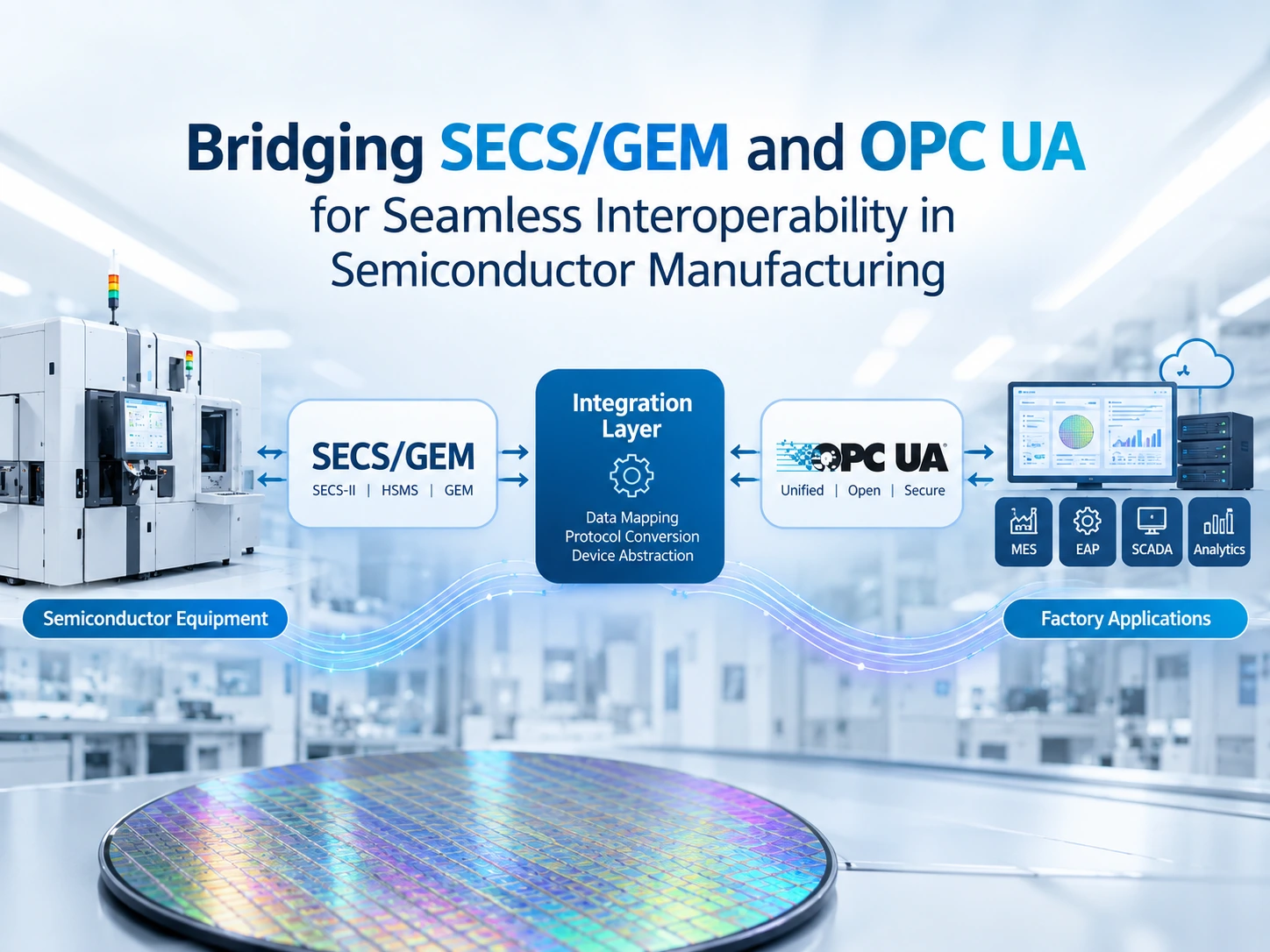
Semiconductor fabs depend on equipment communication standards that have been stable for decades. At the same time, factory teams now expect equipment data to appear in dashboards, analytics platforms, and SCADA systems built around modern industrial protocols. That gap is where SECS/GEM and OPC UA meet.
The two technologies were designed for different purposes, and neither replaces the other. Used together through a well-designed integration layer, they let established equipment feed modern factory applications without being rebuilt. This article explains how each works and how they can be bridged in practice.
What Is SECS/GEM?
SECS/GEM is the long-standing standard family for communication between semiconductor equipment and a factory host. It is made of three parts that are often confused:
- SECS-II (SEMI E5) defines the message format. It describes how data such as events, alarms, and commands are structured into messages.
- HSMS (SEMI E37) defines how those messages travel over a TCP/IP Ethernet connection. It replaced the older serial approach.
- GEM (SEMI E30) defines how equipment should behave from the host’s point of view. It covers state models, event reporting, alarm management, remote commands, equipment constants, and data collection.
The host on the other side of this connection is usually an MES (Manufacturing Execution System) or an EAP (Equipment Automation Program) layer. SECS/GEM itself is a communication standard, not an MES. It is the way equipment reports what it is doing and accepts instructions.
GEM300 extends this for 300 mm fabs with capabilities such as carrier and job management. How much of it a tool supports depends on the equipment vendor’s implementation.
What Is OPC UA?
OPC UA (Open Platform Communications Unified Architecture) is an industrial interoperability standard, published as IEC 62541. It is platform-independent and used across many industries, including manufacturing, energy, and process automation.
Its central idea is the information model. Instead of exposing raw registers or tag numbers, an OPC UA server presents data as structured objects with names, types, units, and relationships. A client can browse this structure and understand what a value means without a separate document.
OPC UA supports both client/server and publish/subscribe communication. It also includes built-in security features such as authentication, certificates, signing, and encryption. Because of this, it is widely used to connect controllers, SCADA systems, historians, and analytics platforms from different vendors.
SECS/GEM and OPC UA: Different Roles, Complementary Technologies
The clearest way to see the difference is to look at what each was built to do. SECS/GEM standardizes how a semiconductor tool talks to a factory host. OPC UA standardizes how industrial systems describe and exchange data in general.
- Purpose: SECS/GEM handles equipment-to-host control and reporting. OPC UA provides general industrial data access and modeling.
- Environment: SECS/GEM is specific to semiconductor and related industries. OPC UA is used across industrial automation.
- Data model: SECS/GEM uses defined messages, data variables, and collection events. OPC UA uses browsable, typed information models.
- Typical consumers: SECS/GEM usually connects to MES and EAP. OPC UA connects to SCADA, historians, dashboards, and analytics tools.
Most fabs already have SECS/GEM in place on their process tools, and most modern industrial software already speaks OPC UA. The practical question is how to connect the two without modifying the equipment.
How to Bridge SECS/GEM and OPC UA
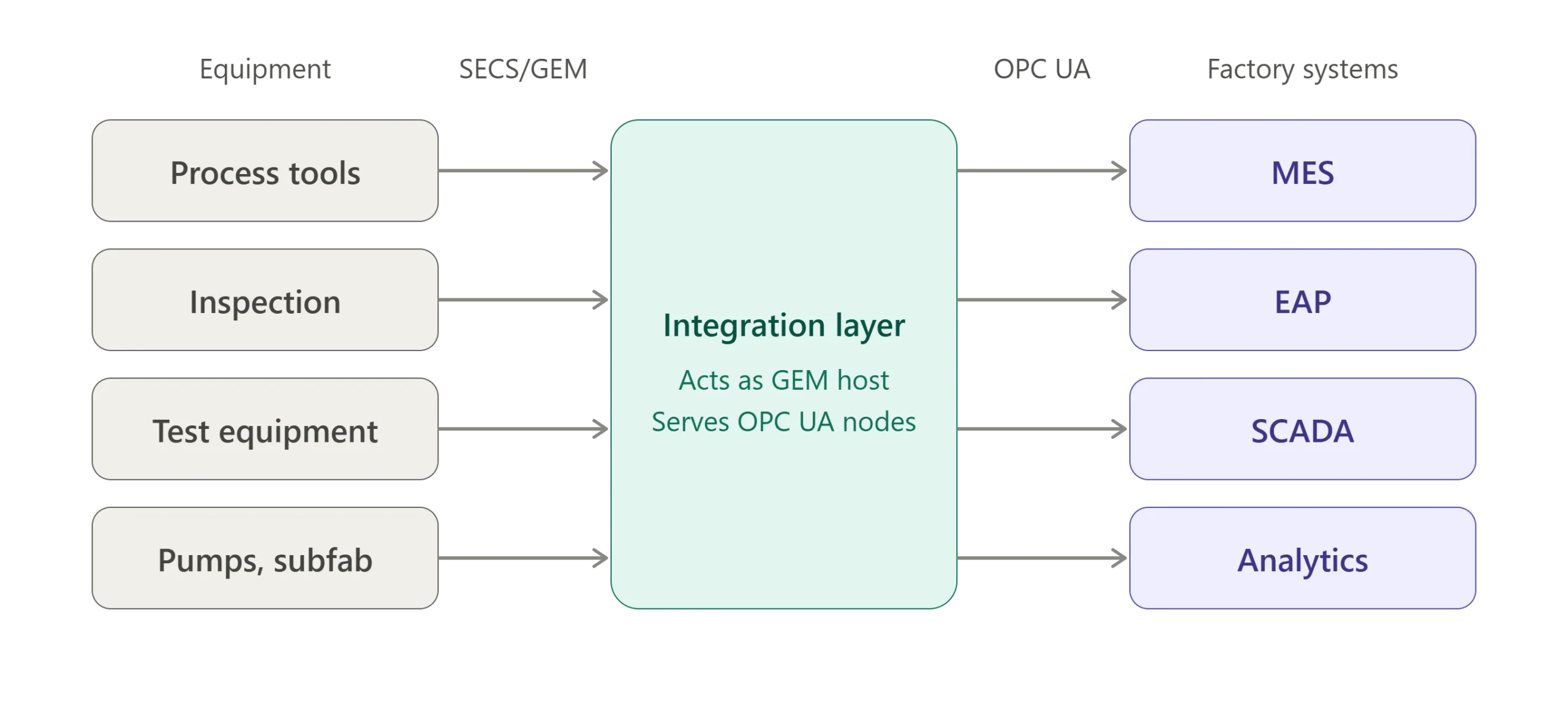
The bridge is an integration layer, sometimes called a gateway or translation layer. It sits between the equipment and the applications that need its data.
On the equipment side, the layer acts as a SECS/GEM host. It establishes the HSMS connection, configures event reports, subscribes to alarms, and reads status variables. On the application side, it acts as an OPC UA server. It exposes the collected data as nodes that OPC UA clients can browse, read, or subscribe to.
In between, the layer maps SECS/GEM concepts to OPC UA structures. Equipment states, collection events, alarms, and process parameters each need a defined place in the OPC UA address space. Where it makes sense, the layer can also pass commands in the other direction, although control paths need extra care and clear rules.
Benefits for Semiconductor Manufacturing
When the bridge is designed carefully, several benefits can follow, depending on the equipment and the applications involved.
- Improved interoperability: Applications that speak OPC UA can consume equipment data without learning SECS-II message details.
- Legacy equipment reuse: Established tools with SECS/GEM interfaces can join newer data initiatives without hardware replacement.
- Better equipment visibility: Status, alarms, and process parameters can be viewed in one place instead of tool by tool.
- Consistent data access: A common OPC UA structure can present similar information from different vendors in a uniform way.
- Integration flexibility: New dashboards or analytics tools can be added by connecting to the OPC UA layer rather than to each tool individually.
For example, a fab might want vacuum pump health data from the subfab shown next to process tool status in a SCADA view. With a shared OPC UA layer, this is an integration task rather than a redevelopment of each system.
Key Considerations for SECS/GEM and OPC UA Integration
A bridge is only as good as its design. These areas deserve attention early.
- Data mapping: Decide which collection events, variables, and alarms map to which OPC UA nodes. Consistent naming and units matter more than the volume of data exposed.
- Equipment compatibility: SECS/GEM implementations vary between vendors. Some tools support only a subset of GEM capabilities, and custom messages or vendor-specific variables are common. Each tool should be verified rather than assumed to behave like the last.
- Communication performance: Data rates, event frequency, and the number of connected tools all affect load. Performance can vary with configuration, so test with realistic conditions.
- Security: Use OPC UA’s authentication and encryption, and segment networks appropriately. Limit any write or command paths and log them.
- Scalability: Plan for growth in tools, data points, and client applications, and decide whether to run one layer per bay or a central service.
- Maintenance: Document mappings, version them, and plan for equipment software updates that may change variables or events.
Ownership matters too. Equipment engineers, automation teams, and IT each hold part of the picture, and the mapping works best when they agree on it together.
Supporting Smart Manufacturing with Connected Equipment
Smart manufacturing depends on reliable, well-structured data from the shop floor. Analytics, predictive maintenance, and factory-wide monitoring all need equipment information in a form that many systems can use.
Bridging SECS/GEM to OPC UA is one practical step toward that. It lets the fab keep the control and reporting behavior that GEM provides while making the same data available to Industry 4.0 applications. Fabs can then extend connectivity gradually, tool by tool, rather than in one large migration.
eInnoSys works in this area of equipment connectivity and factory automation. Its SECS/GEM software and connectivity products, such as EIGEMBox and EIGEMEquipment, are designed to help equipment and fab systems communicate, and the same approach can be extended to OPC UA-based applications. You can read more about our approach to SECS/GEM integration and equipment integration services.
Conclusion
SECS/GEM and OPC UA solve different problems. SECS/GEM gives semiconductor equipment a standardized way to report to and be controlled by a factory host. OPC UA gives industrial systems a common, secure way to describe and share data.
Bridging them through a carefully designed integration layer allows established equipment to support modern applications. The result can be better visibility, easier integration, and a clearer path toward smart manufacturing. If your team is planning this kind of project, our Industry 4.0 solutions and EAP and factory automation pages are a good place to start.


