
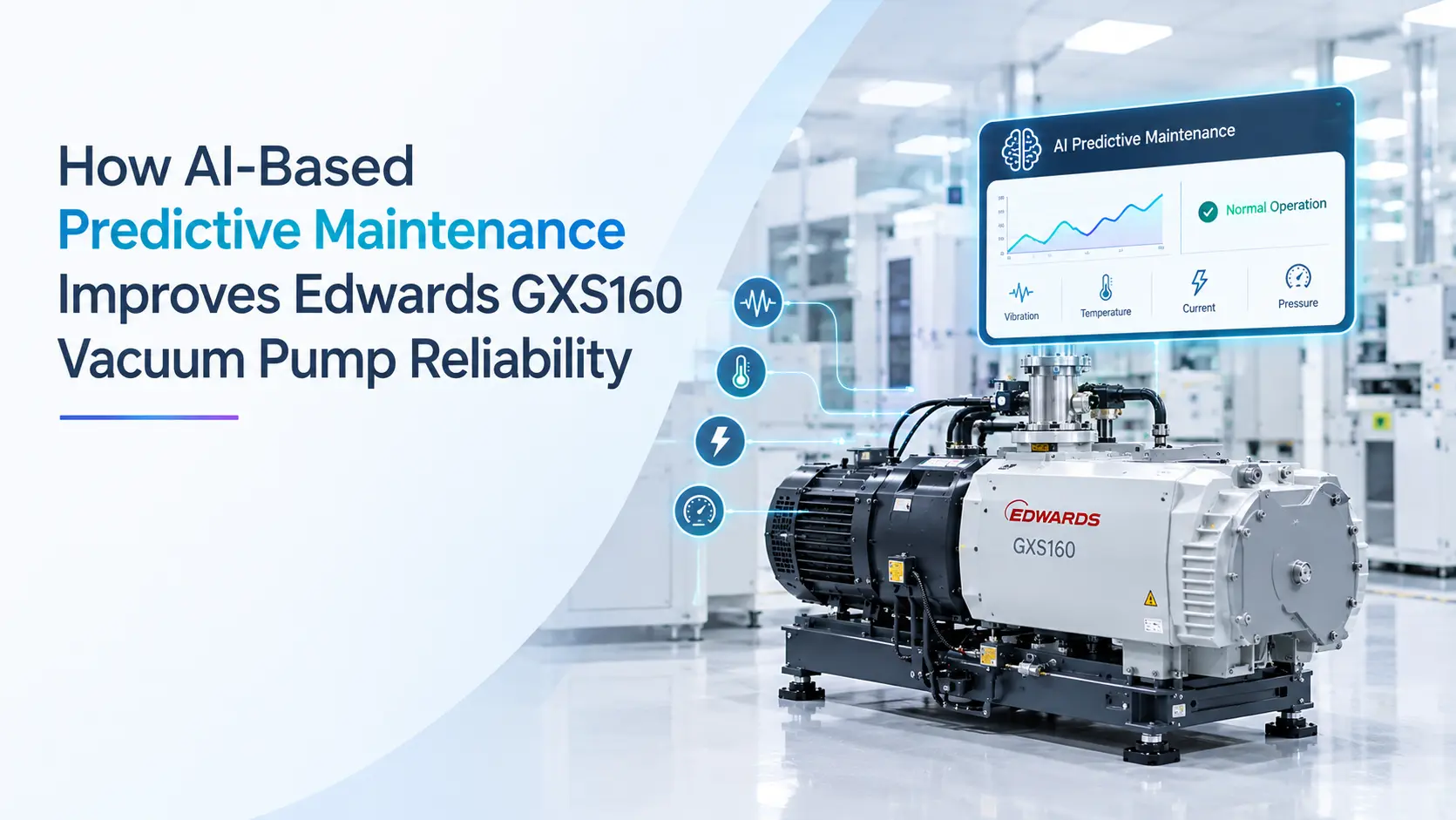
Reliable vacuum performance is a basic requirement for many semiconductor manufacturing processes. Pumps supporting etch, deposition, and load-lock operations often run continuously for extended periods, and any gradual change in their condition can eventually affect equipment availability if it goes unnoticed.
This kind of change rarely happens all at once. A pump can shift slowly — a small rise in temperature here, a subtle change in vibration there — long before it becomes visible to an operator walking the floor. By the time a problem is obvious, the pump may already be close to an unplanned stop.
AI-based predictive maintenance offers a way to address this gap. Instead of relying only on fixed schedules or periodic checks, it uses continuous equipment data and analytics to look for patterns suggesting a pump’s condition is changing. This article focuses on how that approach applies to the Edwards GXS160 dry screw vacuum pump, while being clear about which points are general predictive-maintenance principles and which relate specifically to eInnoSys’s own monitoring approach.
Understanding Vacuum Pump Degradation
Like other continuously operating rotating equipment, dry screw vacuum pumps can experience gradual condition changes over time. Depending on the pump, environment, and process, this may include factors such as:
- Bearing wear from extended runtime
- Gradual temperature changes at various pump locations
- Vibration changes linked to mechanical wear
- Motor load changes
- Seal degradation over time
- Contamination or process byproduct buildup
- General shifts in day-to-day operating behavior
These are common categories of condition change associated with dry screw vacuum pumps in general. The actual failure mechanisms for a specific Edwards GXS160 pump depend on its configuration, operating conditions, process type, and maintenance history, and should be evaluated with reference to manufacturer guidance where needed.
Why Traditional Preventive Maintenance May Not Be Enough
Most maintenance strategies fall along a familiar spectrum:
Reactive maintenance addresses problems only after a failure occurs. It requires no advance planning, but downtime arrives without warning.
Preventive maintenance services equipment on a predefined schedule or operating interval, regardless of the pump’s actual condition. It’s simple to plan around, but it treats every pump the same way, even though wear patterns can differ between units doing similar work.
Predictive maintenance uses equipment-condition data and analytics to help determine when a pump may need attention, based on how it is actually behaving rather than how long it has been running.
Preventive maintenance remains useful and often necessary. But because it isn’t based on a pump’s real-time condition, it may miss an issue developing between service intervals, and can mean maintenance is performed on pumps that don’t yet need it.
How AI-Based Predictive Maintenance Works for the Edwards GXS160
At a general level, AI-based predictive maintenance for a dry screw vacuum pump like the Edwards GXS160 follows a series of steps:
1. Condition data collection. Where sensors are available, data such as vibration, temperature, current, and pressure can be collected continuously rather than checked periodically.
2. Normal baseline development. A monitoring system builds an understanding of what “normal” looks like for a given pump, since behavior varies by installation, process, and duty cycle.
3. Continuous trend monitoring. Ongoing data collection lets trends be tracked over time, which tends to be more informative than any single reading in isolation.
4. AI/ML-based anomaly detection. Machine learning models can identify patterns that differ from the pump’s established baseline behavior.
5. Alerts and maintenance prioritization. When a deviation is detected, maintenance teams can be notified so pumps showing unusual behavior are prioritized over the rest.
6. Maintenance decision support. The resulting condition information can help engineers decide which pumps warrant closer inspection, without replacing the engineering judgment needed to diagnose the underlying cause.
Key Parameters for Vacuum Pump Condition Monitoring
No single measurement typically tells the whole story about a pump’s condition. Depending on the installation, useful parameters for a dry screw vacuum pump may include:
- Vibration
- Temperature
- Current
- Pressure
- Energy consumption, where available
- Runtime and alarm history
- General operating trends
The parameters actually available for a given Edwards GXS160 installation depend on the pump’s configuration, the sensors installed, the equipment interface, and the overall monitoring architecture. Not every installation offers the same level of visibility, so this should be assessed case by case.
How AI Helps Identify Early Signs of Abnormal Pump Behavior
A useful way to think about this process is as a progression:
Normal → Trend Change → Anomaly → Maintenance Investigation.
For example, a pump may typically operate within a stable, well-understood range for vibration and temperature. If vibration gradually increases while other conditions stay comparable, a monitoring system may flag this as a trend outside expected behavior.
This flag does not, by itself, confirm a specific cause such as bearing failure. It gives maintenance engineers an earlier indication that something has changed, so they can investigate further using their own diagnostic expertise and, where appropriate, manufacturer resources.
Benefits of Predictive Maintenance for GXS160 Pump Reliability
When supported by good data and proper implementation, AI-based predictive maintenance can offer several practical advantages for pumps like the Edwards GXS160:
- Earlier visibility into abnormal operating conditions
- Better-informed maintenance planning
- Reduced dependence on purely reactive maintenance
- Improved equipment health visibility
- More effective maintenance prioritization across a pump fleet
- More informed spare-parts planning
- Potential reduction in avoidable unexpected downtime
- Better use of maintenance resources
These are outcomes predictive maintenance can help support, depending on data quality, sensor coverage, and how well it’s integrated into existing maintenance processes. No approach can guarantee specific downtime reductions or cost savings.
How XPump Supports AI-Based Vacuum Pump Monitoring
eInnoSys’s XPump AI/ML-based predictive maintenance platform is designed to support continuous condition monitoring for critical fab equipment, including dry screw vacuum pumps of the type discussed in this article. It brings together sensor data collection with AI/ML-based analysis to help maintenance and process teams gain earlier visibility into pump condition.
In general terms, this kind of platform can support the workflow described above — collecting sensor data, comparing it against a pump-specific baseline, applying anomaly detection, and surfacing alerts for review. The specific capabilities available for a given Edwards GXS160 installation depend on the sensors, data, and integration in place. More detail on eInnoSys’s broader approach for GXS dry screw vacuum pumps is available on the AI Predictive Maintenance for GXS Dry Screw Vacuum Pumps page.
From Pump Monitoring to Smart Factory Maintenance
Pump-level condition monitoring becomes more valuable when connected to a facility’s broader automation and data environment rather than operating as a standalone tool. Condition data from pumps such as the Edwards GXS160 can support:
- Equipment monitoring systems and factory-wide dashboards
- Fault Detection and Classification (FDC)
- Maintenance workflow and work-order systems
- Broader AI/ML analytics initiatives
- Data-driven decision-making across engineering and operations teams
As fabs invest further in smart factory automation, integrating pump-condition data into this larger environment lets maintenance insight sit alongside the equipment connectivity and process data teams already rely on.
Practical Steps for Implementing Predictive Maintenance
Organizations considering predictive maintenance for their vacuum pump fleet, including Edwards GXS160 units, typically benefit from a structured approach:
- Identify the most critical vacuum pumps in the fleet
- Review what equipment data is already available
- Determine what additional sensors, if any, are needed
- Establish normal operating baselines for each pump
- Begin continuous monitoring and configure anomaly detection
- Validate alerts together with maintenance engineers
- Start with a pilot on a limited number of pumps, then expand fleet-wide once validated
Successful predictive maintenance depends on good-quality data, appropriately placed sensors, careful configuration, and close collaboration between automation teams and maintenance engineers.
Conclusion
AI-based predictive maintenance offers a practical way to improve visibility into the condition of Edwards GXS160 vacuum pumps, without relying solely on fixed schedules or manual inspection. It can help maintenance teams move from a purely reactive posture, through scheduled preventive maintenance, toward a more condition-based predictive approach.
Bringing together equipment-condition data, AI/ML analytics, and the experience of maintenance engineers can support more reliable, data-driven operation of semiconductor vacuum equipment — helping teams plan maintenance around what a pump is actually telling them, rather than around the calendar alone.


