
Wafer inspection tools like the KLA Surfscan SP1 DLS Series play a central role in defect detection and process monitoring across semiconductor fabs. As fabs push further into automated, data-driven operations, even well-established inspection platforms are expected to communicate cleanly with host and MES systems, not just perform their core measurement function.
That expectation creates a practical question for many equipment engineering teams: how do you bring a mature inspection tool into a modern automation environment without disrupting the production it already supports? For fabs working with SP1-class systems, achieving reliable KLA Surfscan SP1 SECS/GEM connectivity through a dedicated integration layer is often a more practical path than replacing productive equipment outright.
This is the role EIGEMBox is designed to play — acting as a connectivity bridge that helps establish standardized SECS/GEM communication for tools that were not originally built with modern host interfaces in mind eInnoSys’s SECS/GEM for Old/Legacy Equipment solution set is built around this exact connectivity gap.
Understanding the KLA Surfscan SP1 DLS Series
The KLA Surfscan SP1 DLS Series belongs to a family of wafer inspection systems used to detect surface defects and particles that can affect device yield. DLS configurations are associated with different detection approaches within the broader Surfscan platform, generally applied to unpatterned or bare-wafer inspection tasks.
Tools in this category are typically deployed at points in the process flow where early defect detection helps prevent costly downstream yield loss. Because inspection data feeds directly into process control and quality decisions, the accuracy and availability of that data matter as much as the inspection itself.
This article does not attempt to detail specific SP1 configuration parameters, detection thresholds, or performance specifications, since those depend on the exact tool configuration and should be confirmed through KLA’s own Product documentation. The focus here is on the connectivity layer around the tool, not the inspection technology itself.
The Fab Connectivity Challenge
Inspection tools of this generation were often designed around standalone operation, local user interfaces, and equipment-specific data formats rather than standardized factory communication. Depending on the specific installation, this can create a number of integration challenges:
- Limited or non-standard communication interfaces for host connectivity
- Equipment data that isn’t readily available in a SECS/GEM-compliant format
- Manual or semi-manual data collection between the tool and MES
- Reduced real-time visibility into equipment states, alarms, and events
- Difficulty maintaining consistent data flows across a mixed fleet of newer and older tools
- Friction when trying to fold established equipment into broader Industry 4.0 or smart-factory initiatives
Not every SP1 installation will face all of these issues — the extent depends on the tool’s age, configuration, and how it was originally deployed. But where any of these gaps exist, they tend to limit how effectively an otherwise capable inspection tool can participate in an automated fab environment.
How EIGEMBox Supports Connectivity
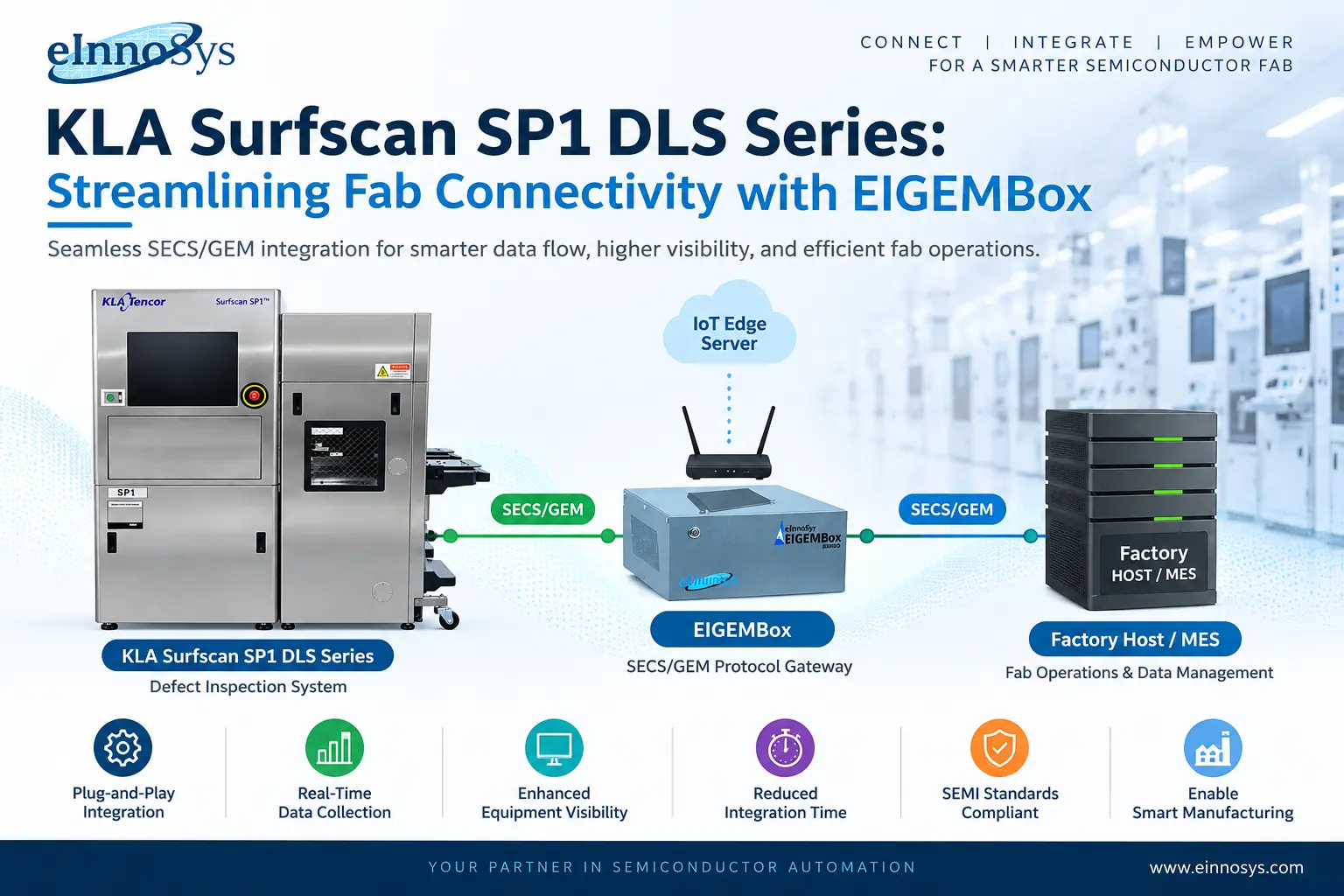
EIGEMBox is designed to function as a communication layer between the equipment and the fab’s host or MES environment, rather than as a replacement for the tool’s native control system. The general integration concept looks like this:
KLA Surfscan SP1 → EIGEMBox → SECS/GEM Communication → Fab Host / MES
In this architecture, EIGEMBox interfaces with the equipment’s available data and control points, then translates and structures that information into standardized SECS/GEM messaging that a host system can consume. This allows a fab to establish consistent, standards-based communication with the SP1 tool without needing to modify or replace the underlying inspection platform.
The intent is to add a connectivity layer on top of a tool that is already doing its job well, rather than to disrupt a system that fabs depend on for daily production.
Key Integration Capabilities
Depending on the specific SP1 configuration and available interfaces, EIGEMBox-based integration can support capabilities such as:
- SECS/GEM communication aligned with common SEMI equipment communication standards
- Equipment status monitoring, giving the host visibility into current tool state
- Event and alarm reporting, so relevant conditions are communicated to the host as they occur
- Host communication, enabling structured data exchange between the tool and MES
- Data collection, supporting more consistent capture of equipment and process data
- Remote command support, where the equipment interface allows it
- Equipment traceability, linking inspection activity to lot, wafer, or process records
- Integration with fab automation workflows, connecting the tool into broader dispatch, scheduling, or monitoring systems
Which of these capabilities apply to a given SP1 deployment depends on the tool’s existing interfaces and the scope of the integration project.
Benefits for Semiconductor Fabs
When a legacy or specialized inspection tool gains standardized SECS/GEM connectivity, fabs can generally expect a set of practical operational improvements:
- Improved visibility into equipment status and performance
- Reduced dependence on manual data logging or transcription
- Better traceability between inspection results and process records
- More consistent, structured communication between the tool and the host
- Easier incorporation of existing equipment into automation and monitoring workflows
- Improved readiness for broader smart manufacturing and Industry 4.0 initiatives
- Better utilization of existing capital equipment rather than early replacement
- Stronger support for data-driven decision-making across engineering and operations
These benefits depend on the quality of the underlying equipment interface and how thoroughly the integration is implemented, rather than being automatic outcomes of adding a connectivity layer.
Integration Approach
A SECS/GEM integration project for an SP1-class tool typically follows a structured, low-disruption sequence:
- Equipment and interface assessment — reviewing the tool’s existing communication capabilities, control points, and data availability.
- Communication and interface analysis — determining how EIGEMBox can interface with the equipment’s control system without affecting normal operation.
- EIGEMBox configuration — setting up the platform to match the specific equipment interface and fab requirements.
- SECS/GEM parameter and event mapping — defining status variables, alarms, events, and data items relevant to the tool.
- Host and MES communication setup — establishing the message flow between EIGEMBox and the fab’s host systems.
- Testing and validation — verifying communication behavior across expected operating scenarios before production use For complex or high-risk cutover scenarios, an SECS/GEM Simulator can help validate host-side handling before connecting to the live tool.
- Production deployment and monitoring — moving the integration into live operation, with ongoing monitoring to confirm stable communication.
This structure keeps the SP1 tool in production throughout most of the process, with validation completed before the connectivity layer goes live.
Why Modernize Existing Equipment?
Replacing a productive inspection tool is rarely the first option fabs consider when automation requirements evolve. Several practical factors typically favor connecting existing equipment instead:
- Capital investment already made in a functioning tool
- Equipment lifecycle considerations, since inspection platforms often remain technically capable well beyond when their native connectivity was designed
- Production continuity, since replacing equipment introduces requalification effort and schedule risk
- Automation requirements that call for host connectivity rather than a new inspection capability
- Data visibility needs that can often be met without touching the core equipment
- Factory standardization goals that benefit from bringing more of the fleet onto consistent communication standards
Where a tool like the SP1 continues to meet its inspection requirements, connecting it into the fab’s automation environment is often a more efficient use of engineering effort than a full equipment replacement.
EIGEMBox for Legacy Equipment Connectivity
EIGEMBox is part of eInnoSys’s broader set of solutions for SECS/GEM connectivity on legacy and non-SECS/GEM equipment, spanning inspection, metrology, and process tools across different equipment generations. The underlying approach — interfacing with existing equipment data and translating it into standardized SECS/GEM communication — applies across a range of tool types.
For a specific KLA Surfscan SP1 DLS deployment, the exact scope of integration depends on the tool’s configuration and available interfaces, and should be assessed on a case-by-case basis rather than assumed from general capability.
Conclusion
Bringing an established inspection platform like the KLA Surfscan SP1 DLS Series into a modern, connected fab environment doesn’t require replacing the tool. A structured SECS/GEM integration approach, supported by a connectivity layer such as EIGEMBox, can help fabs gain equipment visibility, traceability, and host communication while keeping proven inspection equipment in production.
If your team is evaluating SECS/GEM connectivity, legacy equipment integration, or broader fab automation requirements for inspection or metrology tools, eInnoSys is available to discuss your specific equipment environment and integration needs. You can also browse related SECS/GEM integration success stories for other equipment types eInnoSys has worked with.


