
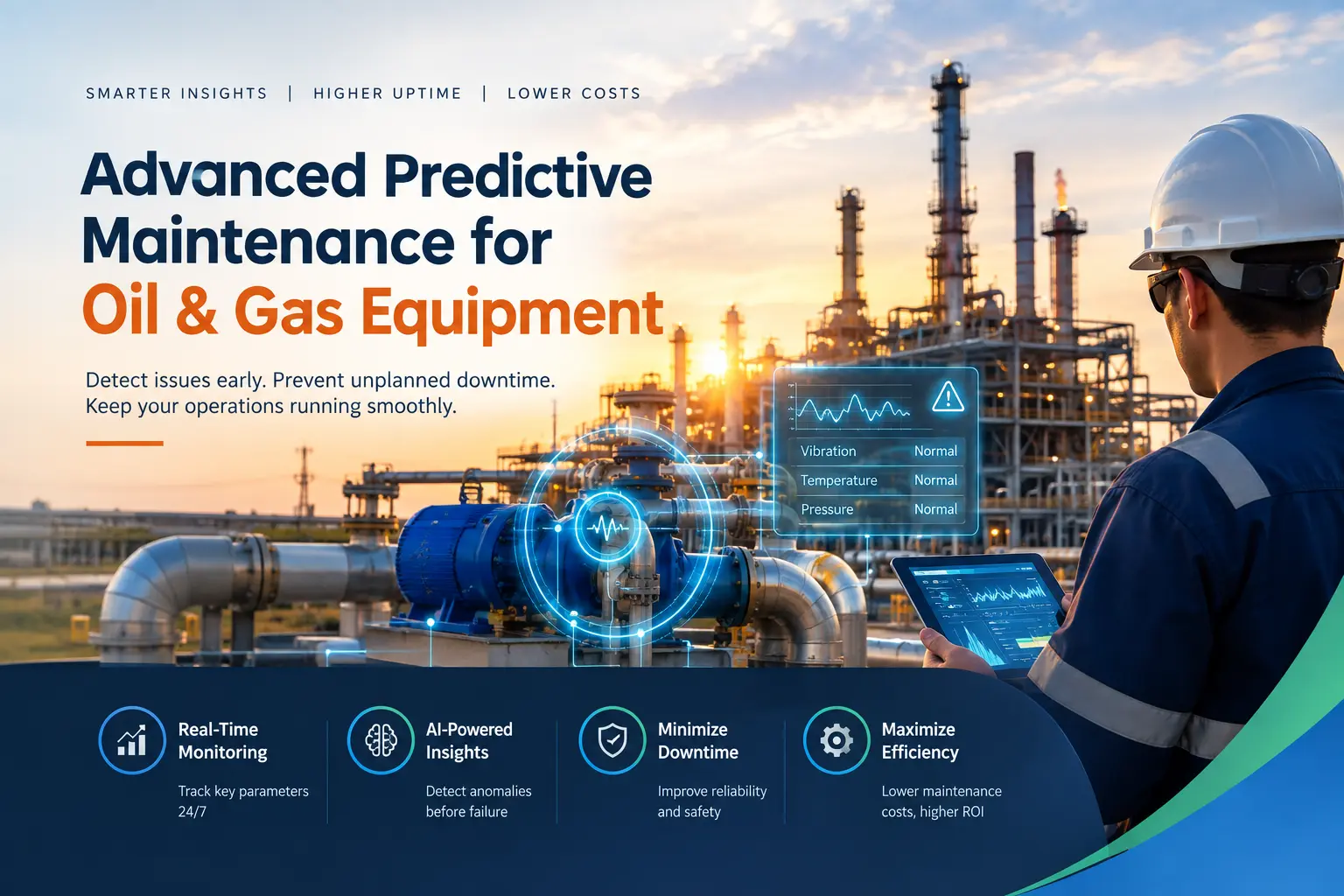
Unplanned equipment failure is one of the most expensive problems in the oil and gas industry. A single unexpected shutdown on a pump, compressor, or turbine can halt production, delay operations, and cost thousands of dollars per hour. This is why more operators are turning to predictive maintenance for oil and gas equipment — a data-driven approach that catches problems before they become failures.
In this guide, we’ll break down what predictive maintenance really means, which equipment benefits most, the technologies that make it possible, and how to build a strategy that actually works in the field.
What Is Predictive Maintenance for Oil & Gas Equipment?
Predictive maintenance is a maintenance strategy that uses real-time data, sensors, and analytics to monitor the actual condition of equipment and predict when a failure is likely to occur. Instead of servicing machinery on a fixed schedule or waiting for it to break down, technicians act only when data signals that something is genuinely wrong.
For oil and gas facilities, this means continuously tracking parameters like vibration, temperature, pressure, and energy consumption across critical rotating and stationary assets. When readings drift outside of normal operating ranges, the system flags the anomaly, giving maintenance teams time to intervene before a small issue turns into an expensive failure.
Why Predictive Maintenance Matters in the Oil & Gas Industry
Oil and gas operations run in some of the harshest environments imaginable — high pressure, extreme temperatures, corrosive chemicals, and remote locations. Equipment is pushed hard, and downtime is rarely convenient.
Predictive maintenance matters because it directly addresses the industry’s biggest operational risks:
- Reduced unplanned downtime by catching early warning signs of failure
- Lower maintenance costs by avoiding unnecessary part replacements and labor
- Improved safety by identifying hazardous conditions like overheating or excessive vibration before they escalate
- Extended asset life through better-informed maintenance decisions
- Regulatory and environmental compliance, since equipment failures in this sector can lead to spills, leaks, or emissions
With margins tightening and assets aging across many facilities, predictive maintenance has shifted from a “nice to have” to a core operational requirement.
Key Oil & Gas Equipment That Benefits from Predictive Maintenance
Not all equipment needs the same level of monitoring, but certain asset classes see the biggest return on investment from predictive maintenance programs.
| Equipment | Key Monitoring Parameters | Common Issues Detected | Benefit |
|---|---|---|---|
| Pumps | Vibration, temperature, pressure | Bearing wear, cavitation, misalignment | Prevents costly downtime and unexpected failures |
| Compressors | Vibration, temperature, pressure | Valve wear, lubrication failure, mechanical degradation | Enables early fault detection and improves reliability |
| Turbines | Vibration, temperature, speed, performance | Imbalance, bearing issues, efficiency loss | Protects high-value assets and prevents major failures |
| Motors | Current, vibration, temperature | Electrical faults, overheating, bearing wear | Detects electrical and mechanical degradation early |
| Valves | Position, pressure, flow, actuator condition | Leakage, sticking, actuator failure | Maintains process control and operational reliability |
| Fans & Blowers | Vibration, temperature, speed | Imbalance, bearing wear, overheating | Reduces unexpected failures and process-line disruptions |
Advanced Technologies Used in Oil & Gas Predictive Maintenance
A modern predictive maintenance program relies on a combination of sensing technologies and analytics working together.
Vibration monitoring is one of the most reliable indicators of mechanical health, capable of detecting imbalance, misalignment, and bearing degradation long before a failure occurs.
Temperature monitoring tracks heat buildup in motors, bearings, and other components, often the earliest sign of friction or lubrication problems.
Pressure monitoring helps identify blockages, leaks, or inefficiencies in fluid and gas systems.
Acoustic monitoring picks up on abnormal sounds — such as cavitation in pumps or air leaks — that aren’t always visible through other sensor data.
Energy and current monitoring detects unusual power draw patterns that often point to mechanical strain or electrical faults.
IoT sensors collect this data continuously and transmit it to centralized platforms, enabling remote monitoring across multiple sites without manual inspections.
AI and machine learning tie everything together, analyzing patterns across historical and real-time data to flag anomalies and forecast failures with far greater accuracy than manual analysis alone.
How AI Predictive Maintenance Detects Equipment Failures
AI-driven predictive maintenance works by continuously learning what “normal” looks like for each piece of equipment. Machine learning models are trained on historical sensor data, operating conditions, and known failure patterns.
Once deployed, the AI compares live sensor readings against these learned baselines in real time. When it detects a deviation — a slight rise in vibration frequency, an unusual temperature curve, or an irregular current spike — it generates an alert well before the issue is visible to a human inspector.
Over time, these models improve as they process more data, becoming increasingly precise at distinguishing between normal operational variation and genuine early-stage faults. This reduces false alarms while improving the accuracy of failure predictions.
Predictive Maintenance vs. Preventive Maintenance vs. Reactive Maintenance
Understanding how predictive maintenance differs from other strategies helps clarify its value.
- Reactive maintenance means fixing equipment only after it fails. It’s the lowest-cost approach upfront but the most expensive in terms of downtime, emergency repairs, and safety risk.
- Preventive maintenance follows a fixed schedule — servicing equipment at set intervals regardless of its actual condition. This reduces failures compared to reactive maintenance but often leads to unnecessary maintenance on healthy equipment and doesn’t fully prevent unexpected breakdowns.
- Predictive maintenance relies on real condition data to determine exactly when service is needed. It minimizes both unnecessary maintenance and unplanned failures, offering the best balance of cost, reliability, and asset longevity.
Common Equipment Failures Detected by Predictive Maintenance
Predictive maintenance systems are particularly effective at catching:
- Bearing wear and failure
- Misalignment and imbalance in rotating equipment
- Cavitation in pumps
- Lubrication breakdown
- Overheating in motors and electrical components
- Seal and gasket degradation
- Abnormal vibration patterns indicating structural fatigue
Catching these issues early allows maintenance teams to schedule repairs during planned downtime instead of dealing with emergency shutdowns.
Benefits of Predictive Maintenance for Oil & Gas Operations
The return on investment for predictive maintenance goes well beyond avoiding breakdowns. Facilities that adopt it typically see measurable improvements in operational efficiency, maintenance spend, and equipment reliability.
Key benefits include fewer emergency repairs, lower parts and labor costs, better allocation of maintenance staff, improved safety outcomes, and more accurate long-term asset planning. Because maintenance decisions are backed by real data rather than guesswork, teams can prioritize the equipment that actually needs attention.
How to Implement a Predictive Maintenance Strategy
Building an effective predictive maintenance program doesn’t happen overnight, but a structured approach makes the transition manageable.
Start by identifying your most critical and failure-prone assets — the equipment where downtime would cause the biggest operational or safety impact. From there, install the appropriate sensors for vibration, temperature, pressure, or current monitoring based on each asset’s failure risks.
Next, establish baseline performance data so the system understands what “normal” looks like for each machine. Integrate this data into a centralized monitoring platform, ideally one with AI-based analytics that can flag anomalies automatically rather than relying on manual review.
Finally, train maintenance teams to act on the alerts and continuously refine thresholds as more data is collected. A predictive maintenance program becomes more accurate and valuable the longer it runs, so treating it as an ongoing process — not a one-time installation — is key to long-term success.
For a deeper look at building this kind of program, explore eInnoSys’ Predictive Maintenance Solutions, which are designed specifically for industrial and oil and gas environments.
How XPump Supports AI-Based Equipment Monitoring
XPump is eInnoSys’ AI/ML-based monitoring solution built for pumps, motors, exhausts, HVAC systems, furnaces, ovens, and other motor-driven equipment commonly found in oil and gas facilities.
XPump continuously tracks vibration, temperature, and other key health indicators, using machine learning to detect early signs of wear or malfunction. It supports both cloud and on-premise deployment, giving facilities the flexibility to fit the system into their existing infrastructure and security requirements.
Instead of relying on periodic manual inspections, teams get real-time visibility into equipment condition and actionable alerts — allowing maintenance to be planned around actual need rather than guesswork or fixed schedules.
Conclusion
Predictive maintenance is no longer just an efficiency upgrade — it’s becoming essential for oil and gas operations that want to reduce downtime, control costs, and keep equipment running safely under demanding conditions. By combining vibration, temperature, and pressure monitoring with AI-driven analytics, facilities can move from reactive firefighting to proactive, data-backed decision-making.
eInnoSys helps oil and gas operators make this shift with AI/ML-powered monitoring solutions like XPump, built to detect early warning signs across pumps, motors, and other critical equipment. To see how this approach could work for your facility, visit eInnoSys and explore their predictive maintenance offerings, or request a demo of XPump to see AI-based equipment monitoring in action.


