
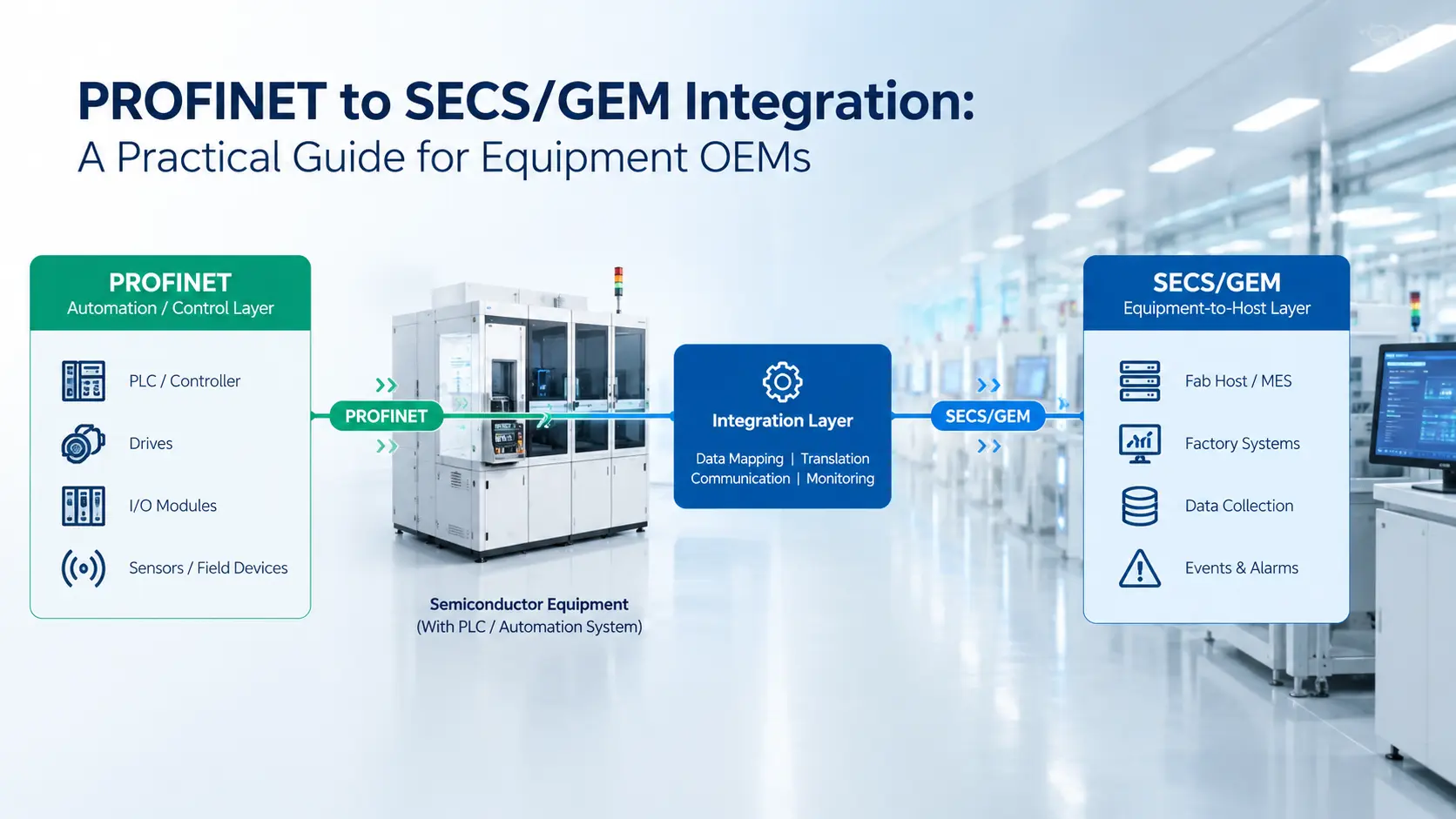
Semiconductor equipment builders face a recurring engineering reality: the control system inside the tool speaks one language, and the fab expects another. PLCs, drives, I/O modules, and motion controllers inside the equipment often communicate over PROFINET, while the fab’s host and factory systems require standardized SECS/GEM communication. These are not competing choices — they operate at different layers of the automation stack, and equipment OEMs need a clear way to connect them without redesigning the equipment’s core control architecture.
This guide looks at what PROFINET and SECS/GEM each do, why they are not interchangeable, and how equipment OEMs can approach the integration between them in a practical, engineering-driven way.
What Is PROFINET?
PROFINET is an industrial Ethernet communication standard widely used in automation environments to connect PLCs, controllers, I/O devices, drives, sensors, and other equipment-level components. Within a piece of semiconductor equipment, PROFINET typically handles the real-time exchange of control signals — moving axes, reading sensor states, coordinating drives, and managing I/O at the automation-control level.
Equipment builders choose PROFINET because it is well suited to deterministic, high-speed communication between controllers and field devices. It is not designed to communicate equipment status, events, or recipe information to a factory host system — that is a separate communication requirement, and one that PROFINET was never intended to solve.
What Is SECS/GEM?
SECS/GEM is the industry-standard framework for communication between semiconductor equipment and factory host systems, and it forms the foundation of eInnoSys’s SECS/GEM and GEM300 solutions. It is made up of SECS-II, which defines the structure and content of messages exchanged between equipment and host, and GEM, which defines standardized equipment behavior — how a tool reports status, manages its communication state, and responds to host requests.
Through SECS/GEM, equipment can report status changes, generate events tied to specific process conditions, communicate alarms, expose data variables for monitoring, and in many implementations, accept remote commands from the host. Recipe-related information may also be exchanged where the GEM implementation supports it. None of this activity replaces the equipment’s internal control logic — SECS/GEM operates at the equipment-to-host layer, communicating what the equipment is doing and what condition it is in, rather than how its internal automation components are wired together.
PROFINET vs. SECS/GEM: What Is the Difference?
| Aspect | PROFINET | SECS/GEM |
|---|---|---|
| Purpose | Equipment-level automation and control | Equipment-to-host communication |
| Layer | Automation/control layer | Fab integration layer |
| Connects | PLCs, drives, I/O, field devices | Equipment and fab host |
| Data | Control, sensor, and device data | Status, events, alarms, variables, commands |
| Main Role | Controls equipment operations | Enables fab-level monitoring and control |
Why Equipment OEMs Need PROFINET to SECS/GEM Integration
Many equipment OEMs already have a working, validated control architecture built around PLCs and PROFINET. When a fab requires SECS/GEM connectivity, the practical question is not whether to abandon that architecture, but how to expose the right equipment information to the host without disrupting proven control logic.
This is where an integration layer becomes necessary. Equipment data collected at the PROFINET/PLC level needs a defined path to reach the fab host in SECS/GEM form. Host-issued commands, where supported, need to be translated back into actions the equipment-control system can execute. Events, alarms, and variables need to be mapped consistently so that what the host sees accurately reflects what the equipment is actually doing. Handling this translation directly inside the PLC application, without a defined integration layer, tends to increase complexity and long-term maintenance burden — particularly as SECS/GEM requirements evolve across different fabs and customers.
How PROFINET to SECS/GEM Integration Works
A typical integration architecture follows this general flow:
PROFINET Devices / PLC → Integration Layer → SECS/GEM Interface → Fab Host / Factory Automation System
Within this architecture, the integration layer generally handles a few core responsibilities:
- Collects relevant equipment data from the PROFINET/PLC side.
- Maps equipment variables to the appropriate SECS/GEM data structures.
- Translates equipment states into the events and status changes the host expects to see.
- Generates SECS/GEM alarms based on defined equipment conditions.
- Handles host commands where the GEM implementation supports remote control.
- Sends corresponding instructions or values back toward the equipment-control system.
- Maintains ongoing communication status and error handling.
It’s worth noting that this architecture does not assume every PROFINET device communicates with SECS/GEM directly. The integration layer is what bridges the two environments — the underlying PROFINET devices continue operating exactly as they did before.
Key Data That Can Be Integrated
Depending on the equipment and the fab’s requirements, integrated data commonly includes:
- Equipment status and process states.
- Sensor readings such as pressure or temperature.
- Motor and drive information.
- Machine-state transitions.
- Alarms and events.
- Production and lot-related information.
- General equipment parameters.
- Remote commands, where supported.
These are illustrative examples rather than a fixed or universal SECS/GEM data set — the actual scope depends on the equipment type, the GEM implementation, and what the specific fab host requires.
Practical Integration Challenges for Equipment OEMs
Connecting PROFINET-based equipment to a SECS/GEM environment involves genuine engineering work:
- Data mapping — Differences in how each protocol structures information can complicate mapping between PLC tags and SECS/GEM variables.
- PLC architecture — Existing program structure influences how easily relevant data can be extracted.
- State-model design — Designing an accurate GEM state model that reflects real equipment behavior takes deliberate effort.
- Alarm and event mapping — Equipment conditions need to be mapped to the correct alarms and events.
- Communication reliability — Error handling needs attention on both sides of the integration layer.
- Timing and synchronization — Issues can surface when equipment-level automation and host-level communication operate on different cycles.
- Host command validation — Adds complexity when remote control is part of the scope.
- Testing and factory acceptance — Integration testing and factory acceptance testing take dedicated planning.
- SEMI compliance requirements — Applicable standards need to be confirmed for the target fab.
- Maintaining existing functionality — The added connectivity should not compromise the equipment’s proven control behavior.
A Practical PROFINET to SECS/GEM Integration Approach
A structured integration process helps ensure reliable equipment-to-host communication:
- Review Equipment Architecture – Understand the PLC, PROFINET network, and control system.
- Identify Required Data – Select relevant tags, states, alarms, and process data.
- Define SECS/GEM Requirements – Determine the host communication requirements.
- Map Data and Events – Map PLC data to SECS/GEM variables, events, and alarms.
- Implement the Integration Layer – Connect the PROFINET/PLC environment with the SECS/GEM interface.
- Test and Validate – Verify connectivity, data, alarms, events, and remote commands.
- Perform Fab Integration Testing – Test with the target host before deployment.
Where EIGEMBox Can Fit
For equipment OEMs working with existing or legacy control architectures, solutions such as EIGEMBox can serve as a plug-n-play SECS/GEM solution that helps address the equipment-to-host side of this architecture. For OEMs building SECS/GEM support directly into new equipment, the SECS/GEM SDK offers an alternative starting point. Where the integration spans multiple industrial protocols, a gateway approach such as EIGEMLink, which is designed to convert between protocols including PROFINET and SECS/GEM, may also be relevant depending on the architecture.
The specific way any of these fit into a PROFINET-based equipment environment depends on the equipment’s PLC, available interfaces, data-access methods, and integration requirements — these details vary by project and should be evaluated against the actual equipment architecture rather than assumed in advance.
Benefits of a Well-Designed Integration Architecture
When implemented thoughtfully, a PROFINET to SECS/GEM integration layer can offer several advantages:
Reduced overall integration complexity.
Better factory connectivity.
Standardized host communication.
Reuse of existing, validated automation architecture rather than redesigning equipment-level control from scratch.
Improved equipment visibility for the fab.
Simplified data collection.
Reduced need for major equipment redesign.
Better readiness for fab automation requirements going forward.
These outcomes depend heavily on implementation quality and the specific requirements of the target system.
What Equipment OEMs Should Consider Before Integration
Before starting a PROFINET to SECS/GEM integration project, it helps to review the following:
- PLC and controller architecture currently in use.
- What PROFINET data is actually available and accessible.
- The fab’s specific SECS/GEM requirements.
- Required equipment variables, events, and alarms.
- Whether remote commands are in scope.
- The GEM state model the equipment will follow.
- Host communication requirements.
- Applicable SEMI compliance requirements.
- Testing requirements and realistic timelines.
- Cybersecurity and network architecture implications of adding a new communication layer.
- Long-term maintainability, including how the integration will be supported as equipment models evolve.
Conclusion
PROFINET and SECS/GEM solve different communication requirements within semiconductor equipment: one manages automation-level control, the other manages equipment-to-host communication. Treating them as complementary layers, connected through a well-designed integration architecture, allows equipment OEMs to meet fab connectivity requirements without disrupting proven control systems. eInnoSys works with semiconductor equipment OEMs on SECS/GEM equipment integration to help address these SECS/GEM and factory-connectivity requirements as part of a broader equipment integration strategy.


