
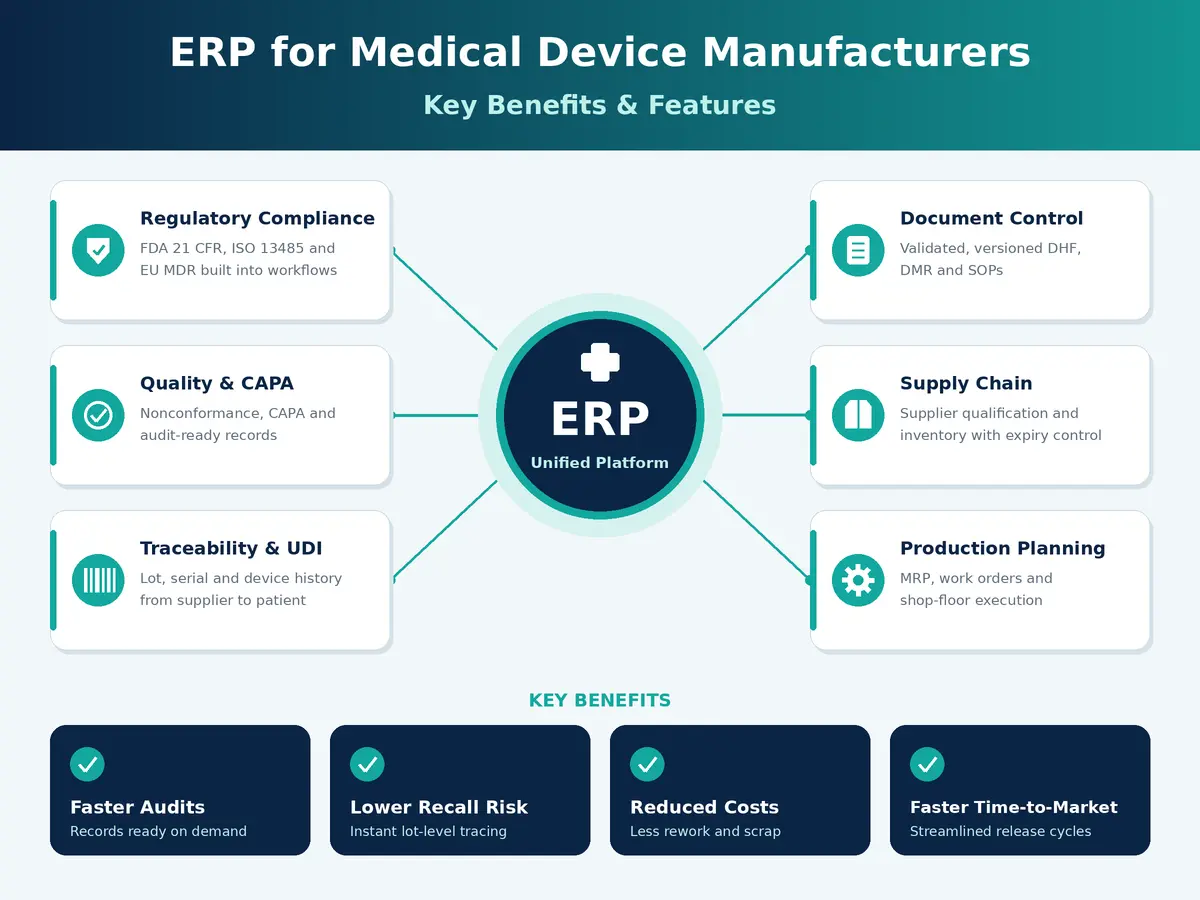
Medical device companies work under tight rules and thin margins for error. Every part, batch, and process needs a record. That is why ERP for medical device manufacturers has become a core business system rather than an optional upgrade.
A well-chosen ERP connects production, inventory, quality, and compliance in one place. As a result, teams stop chasing spreadsheets and start acting on live data. This guide explains why ERP matters, which benefits and features count most, and when custom software makes sense.
Why Medical Device Manufacturers Need ERP
Medical device manufacturing is different from general manufacturing. Products affect patient safety, so regulators expect full documentation. Standards such as FDA 21 CFR Part 820 and ISO 13485 require controlled processes and complete records.
Many manufacturers still rely on disconnected tools. Production uses one system, quality uses another, and purchasing uses a third. Consequently, data gets duplicated, and errors slip through. Audits also become stressful because records live in many places.
An ERP solves this by creating a single source of truth. Moreover, it supports faster decisions, since every department sees the same information.
Key Benefits of ERP for Medical Device Manufacturers
- Better Production Planning:-
An ERP aligns demand, materials, and capacity. Planners can see what to build, when, and with which resources. Therefore, delays drop and delivery dates become more reliable. - Accurate Inventory Management:-
Medical components often have expiry dates, strict storage rules, and long lead times. An ERP tracks stock levels, locations, and expiry in real time. Because of this, shortages and waste both decrease. - Stronger Quality Management:-
Quality cannot be an afterthought. ERP quality modules manage inspections, non-conformances, and corrective actions (CAPA). In addition, they link quality events to the exact batch and process involved. - Regulatory Compliance and Traceability:-
Regulators expect you to trace a finished device back to its raw materials. ERP makes this possible through lot tracking and electronic records. If a recall happens, you can find affected units within minutes instead of days. - Smarter Supply Chain Management:-
Supplier performance directly affects product quality. An ERP tracks supplier certifications, delivery history, and incoming inspection results. Consequently, you can spot risky suppliers early. - Real-Time Reporting:-
Dashboards turn raw data into clear insight. Managers can monitor yield, scrap, and on-time delivery without waiting for manual reports.
Key ERP Features for Medical Device Manufacturers
Not every ERP fits this industry. Look for the following capabilities when you evaluate medical device manufacturing software.
| ERP Feature | Purpose |
|---|---|
| Batch & Lot Tracking | Enables forward and backward traceability. |
| Quality Control | Manages inspections, CAPA, deviations, and audits. |
| Document Management | Controls SOPs, work instructions, and device records. |
| Production Scheduling | Balances machines, labor, and materials. |
| Inventory & Procurement | Automates purchasing and tracks expiry/storage conditions. |
| Data Analytics | Identifies trends in defects, downtime, and suppliers. |
| Equipment Integration | Collects machine data automatically. |
ERP vs. MES for Medical Device Manufacturing
| ERP | MES |
|---|---|
| Manages business operations | Manages shop-floor operations |
| Handles orders, finance, purchasing, and inventory | Manages work orders and production processes |
| Supports planning and costing | Captures real-time production data |
| Provides business-level reporting | Provides process-level traceability |
| Sends work orders to production | Guides operators and records results |
How Equipment Integration Improves ERP Performance
An ERP is only as good as its data. If operators enter results by hand, mistakes and delays are almost certain. Equipment integration removes that weakness.
When machines connect to your ERP or MES, they send data automatically. This includes cycle counts, process parameters, alarms, and test results. Therefore, records become more accurate, and compliance evidence builds itself.
Integration also enables faster response. If a machine drifts out of tolerance, the system can flag it immediately. In turn, you avoid producing a whole batch of non-conforming devices.
eInnoSys offers a range of connectivity tools for this purpose. For example, EIGEMBox helps connect equipment to higher-level systems. Operators can use EIGEMHMI as a clear interface for equipment data. Meanwhile, EIGEMEquipment and EIGEM300Equipment support standards-based equipment communication. On the host side, EIGEMLink manages that communication. For automated material handling, EIGEM84 supports E84 handoff. Finally, EIGEMSim lets teams test integrations before touching live equipment.
When to Consider Custom Medical Device Manufacturing Software
Off-the-shelf ERP works well for many companies. Still, some situations call for custom medical device manufacturing software.
Consider a custom approach if:
- Your processes are unique and do not fit standard workflows.
- You run specialized or legacy equipment that standard tools cannot connect to.
- You need tight links between ERP, MES, and machine data.
- Your compliance needs go beyond what a generic package covers.
A reliable medical device software development company will start by studying your workflow. Then it will design a solution that fits your processes instead of forcing you to change them. Good medical device software development services also include validation support, which saves time during audits.
Custom work also supports medical device product development. Connecting design, testing, and production data helps teams move from prototype to scale with fewer surprises.
How eInnoSys Supports Medical Device Manufacturing Automation
eInnoSys helps manufacturers connect machines, data, and business systems. Its expertise in equipment automation makes it a strong partner for any medical device software solution that depends on reliable shop-floor data.
To see how this applies to your plant, visit the medical device industry page. There you can explore how integration and automation support compliant, efficient production.
Conclusion: Key Takeaways
ERP for medical device manufacturers brings production, inventory, quality, and traceability together. It reduces errors, simplifies audits, and gives leaders real-time visibility.
Remember these points:
- Choose an ERP built for regulated manufacturing.
- Prioritize lot tracking, quality control, and document management.
- Pair ERP with MES as your operations grow.
- Use equipment integration to improve data accuracy.
- Consider custom software when standard tools fall short.
If you want expert help, eInnoSys can guide you from equipment connectivity to full manufacturing automation. Contact eInnoSys today to build a smarter, more compliant production environment.


