
Medical device production leaves little room for error. A single missed record or untraceable component can trigger a recall, a failed audit, or a risk to patient safety. This is why MES for medical device manufacturers has moved from a nice-to-have to a core system on the shop floor.
A manufacturing execution system (MES) connects planning, production, quality, and equipment in real time. In this guide, you will learn what MES software does, which features matter most, and how to choose the right system. You will also see why equipment connectivity, including SECS/GEM, decides how well an MES performs.
What Is MES for Medical Device Manufacturers?
A manufacturing execution system for medical devices manages and monitors production as it happens. It sits between your ERP, which handles orders and inventory, and your shop-floor equipment, which does the actual work.
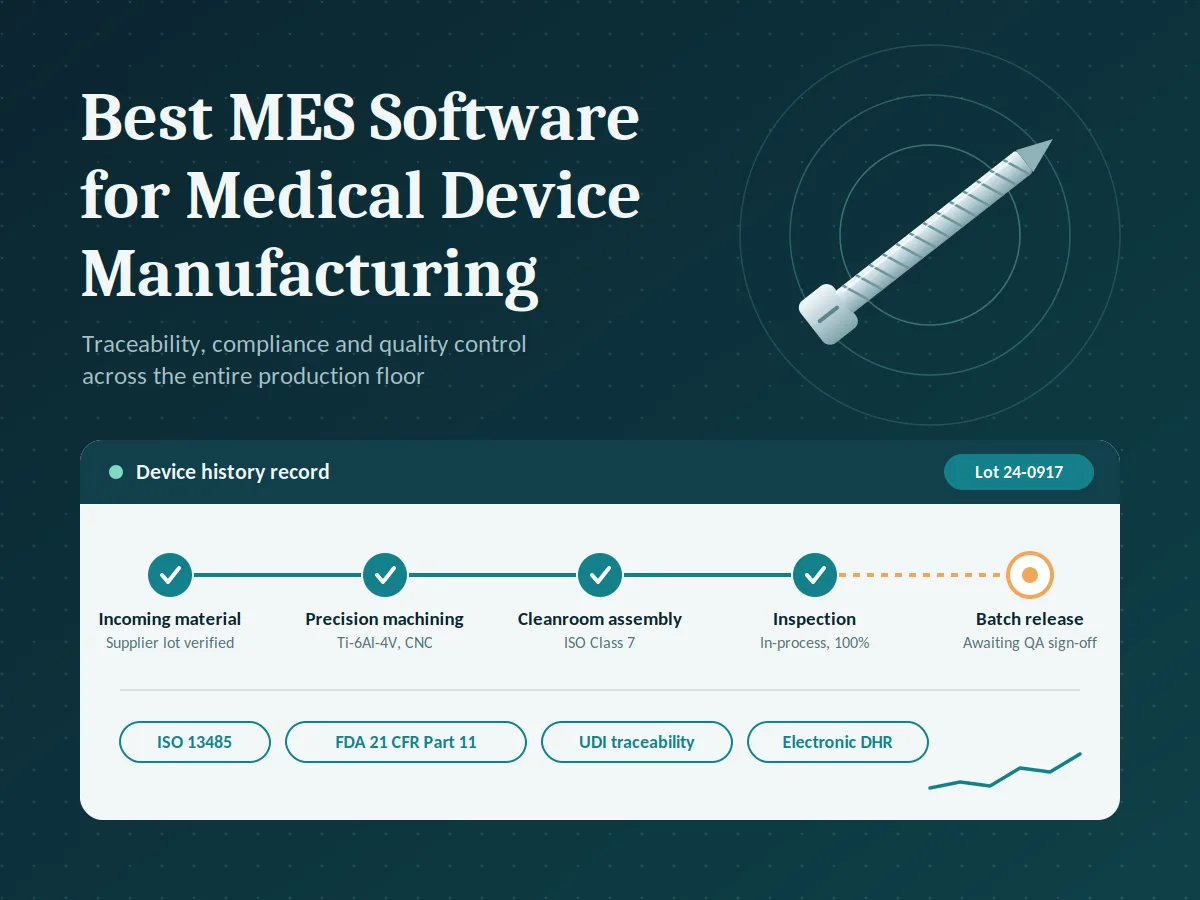
An MES tells operators what to build and which materials to use. It records what actually happened and flags deviations immediately. It also builds the electronic device history record (DHR) automatically.
Generic manufacturing software for medical devices often stops at scheduling or inventory. A true MES goes further. It enforces process steps, captures machine data, and keeps every unit traceable from raw material to finished device.
Key Features of Medical Device MES Software
Not every MES fits a regulated environment. When you evaluate MES software for medical device manufacturers, look for these capabilities.
- Full traceability and genealogy. The system should link every finished device to its components, lots, operators, equipment, and process parameters. This supports UDI requirements and speeds up recall investigations.
- Electronic device history records. Automated DHR generation replaces paper travelers. It reduces transcription errors and shortens batch review time.
- Compliance support. Look for audit trails, electronic signatures, and role-based access. These features help you meet FDA 21 CFR Part 11, the FDA Quality Management System Regulation, and ISO 13485 expectations.
- Quality management integration. Nonconformance handling, CAPA links, and in-process inspections should sit inside the workflow, not in a separate silo.
- Real-time equipment data. Automated data collection from machines removes manual entry. It also gives quality teams evidence they can trust.
- Work instruction and process enforcement. The MES should block a step if a prerequisite is missing, such as an uncalibrated tool or an expired material lot.
- Scalability and open architecture. Your product mix will change. Therefore, the system must adapt without a full re-implementation.
Benefits of MES Integration for Medical Devices
MES integration for medical devices delivers the most value when the MES connects with both business systems and equipment. Here is what that typically brings.
- Faster audit readiness. Records are complete, timestamped, and searchable, so you spend less time gathering evidence.
- Fewer errors and less rework. Enforced workflows and automatic data capture reduce human mistakes.
- Better production visibility. Managers see order status, downtime, and yield as they happen.
- Quicker release decisions. Electronic batch review lets quality teams release products sooner.
- Lower compliance risk. Consistent, tamper-evident records protect you during inspections.
- Continuous improvement. Reliable machine data shows where bottlenecks and quality drift begin.
In short, integration turns scattered data into one dependable source of truth.
How to Choose the Right MES Software
Selecting an MES is a long-term decision. Use this checklist to keep the process focused.
- Define your compliance needs first. List the regulations, customer requirements, and internal procedures the system must support.
- Map your equipment landscape. Note which machines are new, which are legacy, and which communication protocols they use.
- Check integration depth. Ask how the MES connects to ERP, PLM, QMS, and shop-floor equipment. Weak integration creates manual workarounds.
- Review validation support. A vendor should provide documentation that eases your IQ/OQ/PQ effort.
- Test usability. Operators will use it daily. A cluttered interface leads to workarounds and bad data.
- Plan for growth. Confirm that the system handles new lines, new sites, and new products.
- Evaluate the vendor. Look at domain experience, implementation approach, and long-term support.
Involve production, quality, and IT early. Each group sees different risks, and all three will live with the decision.
MES Integration With Medical Device Equipment
Even the best MES fails if it cannot talk to your machines. Many medical device plants run a mix of equipment: molding machines, laser markers, cleanroom tools, automated assembly cells, inspection systems, and test stations. Some are modern. Others are decades old.
Without equipment integration, operators type in values by hand. That is slow, and it introduces the very errors an MES is meant to prevent. With integration, the MES can:
- Send recipes and parameters to the machine
- Receive process data, alarms, and status updates automatically
- Confirm that the right settings were used for each lot
- Record events with accurate timestamps for the device history record
The challenge is that machines speak different languages. A standard, well-supported communication layer solves much of this problem, which leads to SECS/GEM.
Role of SECS/GEM and Equipment Connectivity
SECS/GEM is a set of SEMI standards for equipment-to-host communication. It comes from semiconductor manufacturing, but its value carries over to any environment that needs reliable, structured machine data. This includes precision medical device production.
The standard defines how a machine reports its state, sends event and alarm data, and accepts remote commands and recipe changes. Because the messages follow a common structure, connecting new equipment to an MES becomes faster and more predictable. You also avoid building a custom interface for every machine.
Equipment connectivity matters for three reasons:
- Data quality. Machine-generated data is more accurate than manual entry.
- Speed. Standard interfaces shorten integration projects.
- Consistency. The same approach works across different machines and vendors.
For older equipment without native communication, gateway hardware and software can add connectivity without replacing the machine. This helps plants modernize gradually and protect their existing investment.
How eInnoSys Supports Medical Device Manufacturing
eInnoSys specializes in equipment connectivity and factory automation software. Its solutions help manufacturers connect shop-floor machines to MES and host systems. The medical device industry solutions page explains how this applies to regulated production.
Here is how the EIGEM product family fits into an MES integration project:
- EIGEMBox helps connect equipment, including older machines, to host systems without heavy modification.
- EIGEM-HMI provides an operator interface for viewing and interacting with equipment data.
- EIGEMEquipment supports SECS/GEM communication on the equipment side.
- EIGEM300Equipment extends that capability to GEM300 requirements.
- EIGEMLink helps link equipment and host applications so data flows between them.
- EIGEM84 addresses automated material handling interfaces based on the E84 standard.
- EIGEMSim simulates equipment or host behavior so teams can test integrations before going live.
Testing with a simulator reduces risk. Teams can validate communication early, before touching production equipment. That saves time and protects uptime.
Conclusion
Choosing the right MES for medical device manufacturers comes down to compliance, traceability, and integration. A strong system gives you accurate records, faster releases, and real-time visibility. It only works at full strength when it connects reliably to your equipment.
That is where eInnoSys can help. Its EIGEM product family supports SECS/GEM-based equipment connectivity, so your MES receives trusted data directly from the shop floor. To see how it fits your production environment, visit eInnoSys or explore the medical device industry solutions page.


