
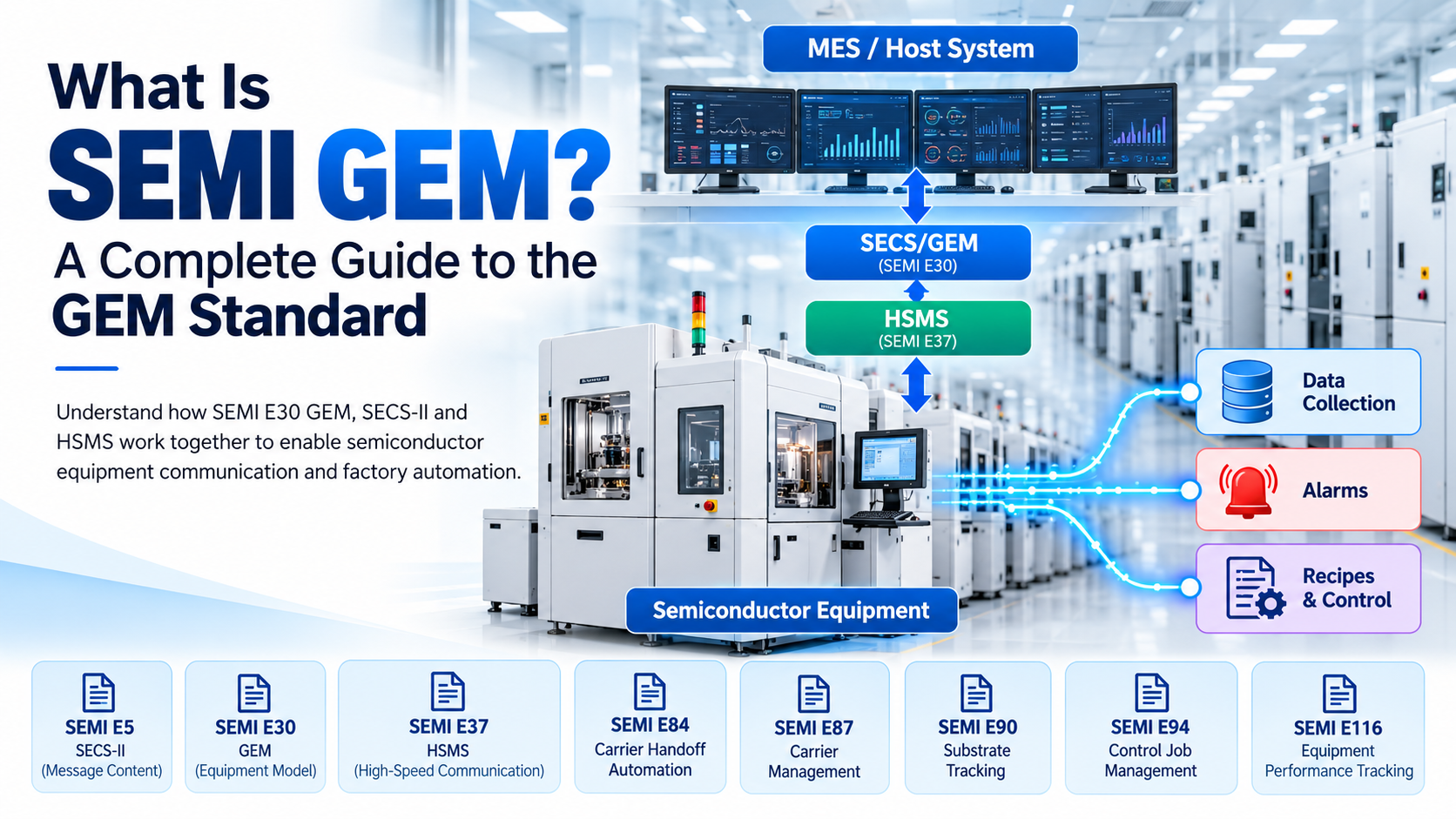
GEM (Generic Equipment Model) is a semiconductor manufacturing equipment communication and control standard defined by SEMI E30. It provides a common framework for communication between semiconductor manufacturing equipment and host systems such as MES, factory automation systems, and other manufacturing applications.
GEM helps semiconductor manufacturers standardize how equipment communicates with factory systems, reports equipment data, handles alarms, responds to remote commands, manages recipes, and supports automated manufacturing processes.
For equipment manufacturers and semiconductor fabs, implementing SEMI E30 GEM together with SECS-II and HSMS provides a structured approach to equipment connectivity and factory automation.
What Does GEM Stand For?
GEM stands for:
Generic Equipment Model
It is defined in:
SEMI E30 – Specification for the Generic Model for Communications and Control of Manufacturing Equipment
SEMI describes GEM as a standard implementation of SECS-II for semiconductor manufacturing equipment. It defines common equipment behavior and communication capabilities that can be used by semiconductor device manufacturers for factory automation.
GEM does not replace SECS-II. Instead, the standards work together:
| Standard | Purpose |
|---|---|
| SEMI E30 – GEM | Defines the equipment communication and control model |
| SEMI E5 – SECS-II | Defines the messages and message content |
| SEMI E37 – HSMS | Provides high-speed communication services, typically over TCP/IP |
| SEMI E84 | Supports carrier handoff automation |
| SEMI E87 | Carrier management |
| SEMI E90 | Substrate tracking |
| SEMI E94 | Control job management |
SEMI lists E5, E30, E37 and related standards within its Information & Control standards family.
How Does SEMI GEM Work?
A simplified GEM communication architecture looks like this:
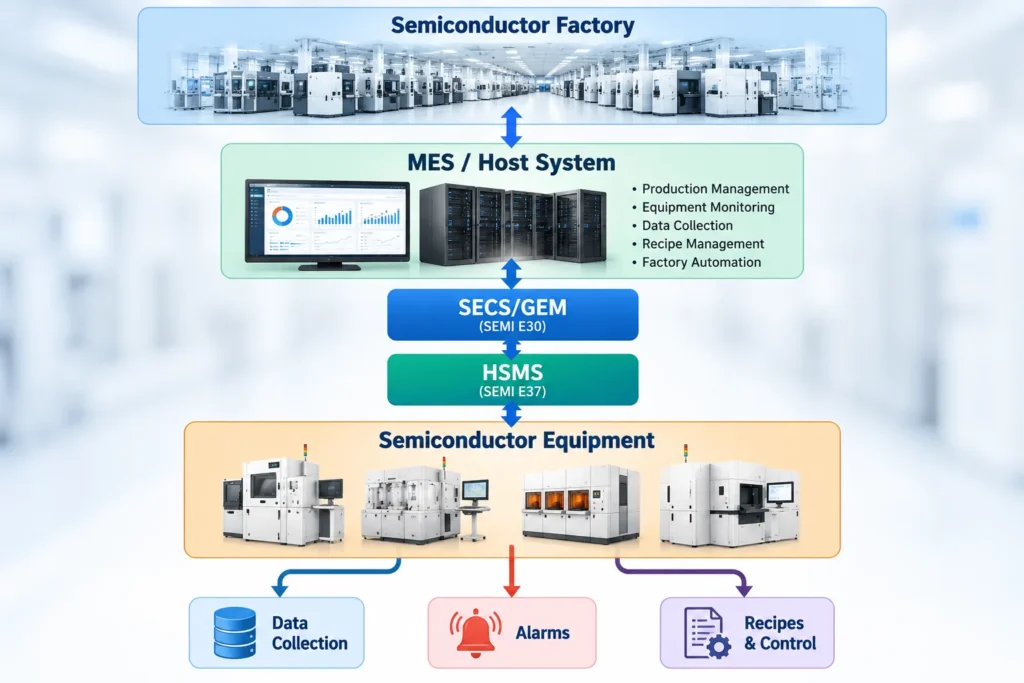
The equipment can provide information such as:
- Equipment status
- Process information
- Equipment variables
- Collection events
- Alarms
- Production data
- Equipment state
- Process results
The host can also send commands to equipment where the implemented GEM functionality supports those operations.
SEMI’s GEM definition specifies how SECS-II messages are used and what equipment behavior should result from them.
What Can GEM Do?
A GEM implementation can support several important manufacturing automation functions.
1. Equipment Data Collection
GEM enables equipment to report manufacturing and equipment information to host systems.
Examples include:
- Status variables
- Equipment parameters
- Process data
- Event reports
- Production information
This allows fabs to obtain greater visibility into equipment operation.
2. Alarm Management
Equipment can communicate alarm conditions to the host system.
This helps factory automation systems identify and respond to equipment conditions.
3. Remote Equipment Control
Where supported by the equipment implementation, host systems can issue remote commands through the GEM interface.
4. Recipe / Process Program Management
GEM implementations can support communication related to process programs and recipe management, allowing factory systems to interact with equipment recipes according to the applicable implementation.
5. Equipment Status Monitoring
GEM provides standardized equipment communication behavior that allows host systems to monitor equipment states and events.
SEMI notes that modern fabs collect large amounts of equipment information for process monitoring, equipment health, performance monitoring, and manufacturing optimization.
What Is the Difference Between SECS, GEM and HSMS?
This is one of the most common questions in semiconductor equipment automation.
SECS-II
It defines the message content used for communication between equipment and host systems.
GEM
It defines the generic equipment communication and control model and explains how SECS-II messages are applied to equipment behavior.
HSMS
It provides the high-speed message service used to transport SECS messages, commonly over TCP/IP. SEMI describes HSMS as an alternative to SECS-I for applications where higher-speed communication or TCP/IP is preferred.
In simple terms:
- SECS-II = What messages are exchanged
- GEM = How equipment behaves and uses those messages
- HSMS = How the messages are transported
Together, these technologies form the foundation of many modern SECS/GEM equipment communication implementations.
Why Is SEMI GEM Important for Semiconductor Equipment?
Semiconductor fabs operate equipment from many equipment manufacturers and technology generations. A standardized communication model helps integrate equipment into factory automation systems.
GEM can help manufacturers establish consistent interfaces for:
- Equipment data collection
- Factory automationEquipment monitoring
- Alarm reporting
- Remote commands
- Process program management
- MES integration
- Manufacturing data integration
SEMI’s standards program describes SECS and GEM as foundational standards for smart manufacturing across the microelectronics industry.
GEM for Legacy Semiconductor Equipment
Many semiconductor manufacturing facilities continue to operate equipment that was developed before modern factory automation requirements were implemented.
Adding a SECS/GEM interface can provide a path to connect such equipment with modern factory systems without necessarily replacing the entire equipment control system.
This can enable capabilities such as:
- Real-time equipment data collection
- Host communication
- Alarm reporting
- Equipment status monitoring
- Recipe/process-program communication
- MES connectivity
- Factory automation integration
For legacy equipment modernization, eInnoSys provides SECS/GEM solutions designed to connect equipment with host and factory systems. Its EIGEMBox solution is positioned for adding SECS/GEM connectivity to legacy equipment.
SEMI GEM and GEM300
GEM300 extends the GEM-based automation framework for 300 mm semiconductor manufacturing environments.
Related SEMI standards include areas such as:
- Carrier Management – E87
- Substrate Tracking – E90
- Control Job Management – E94
- Processing Management – E40
- Equipment Performance Tracking – E116
SEMI identifies these standards within its equipment-control and related automation standards.
For fabs requiring advanced material and job automation, GEM300 provides additional standards beyond basic GEM communication.
Get Expert Guidance for GEM-Based Equipment Communication


