
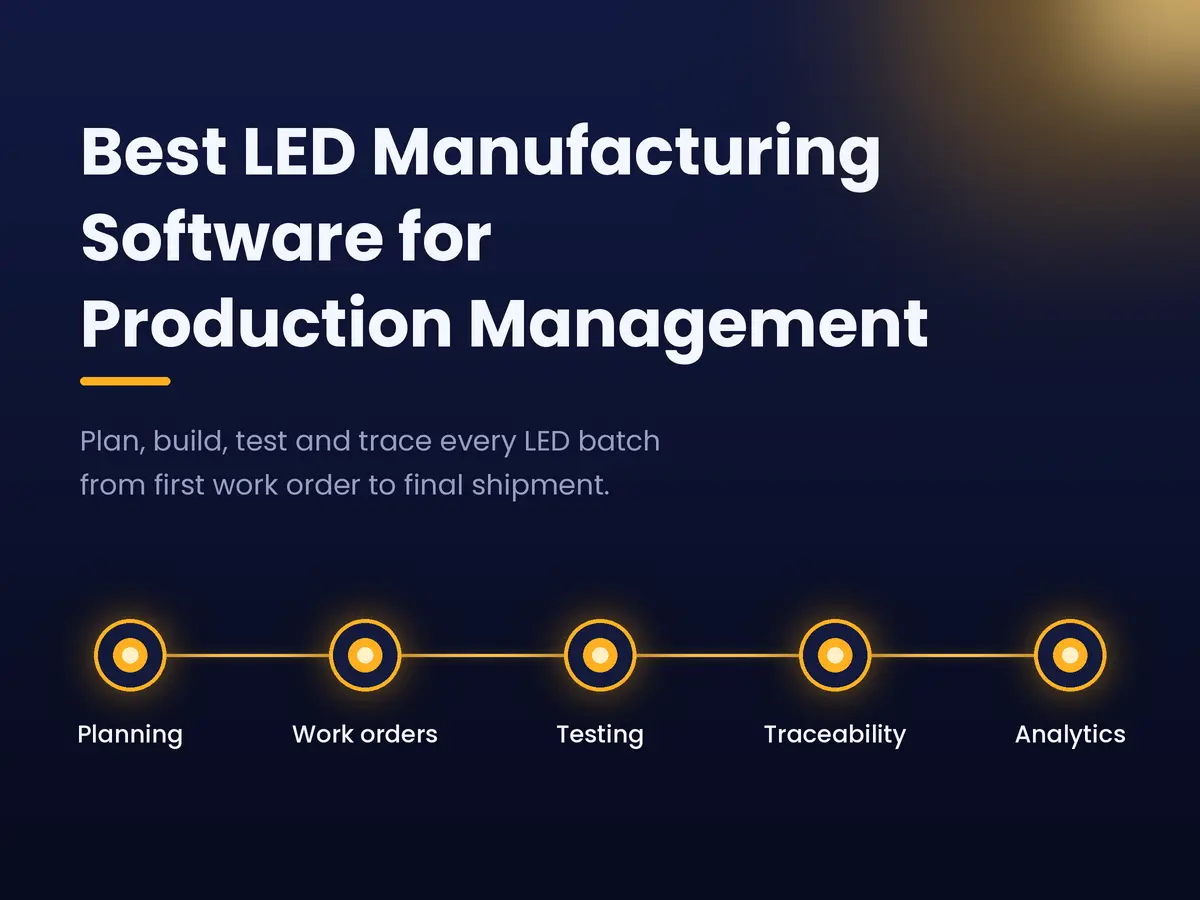
LED production runs on tight tolerances, fast cycles, and complex equipment. A small process drift can lower yield, waste materials, and delay shipments. That is why LED manufacturing software has become a core part of modern factories.
The right software connects machines, collects data, and gives teams clear visibility into every step of production. This guide explains what it is, which features matter, and how to choose the right solution for your plant.
What Is LED Manufacturing Software?
LED manufacturing software is a set of digital tools that control, monitor, and optimize LED production. It links equipment, production lines, and factory systems into one connected environment.
In practice, this software does several jobs:
- Communicates with production equipment
- Collects process and machine data in real time
- Tracks production status and equipment performance
- Supports traceability and quality control
- Helps teams make faster, data-based decisions
Without it, factories depend on manual logs, isolated machines, and delayed reports. With it, every tool and process feeds a single source of truth.
Why LED Manufacturers Need Production Management Software
LED manufacturing involves many sensitive stages, such as wafer processing, die bonding, wire bonding, encapsulation, testing, and packaging. Each stage uses specialized equipment, and each machine generates its own data.
Consequently, manual management creates real problems:
| Challenge | Impact on LED Manufacturing |
|---|---|
| Limited visibility | Managers cannot monitor production activities on the shop floor in real time. |
| Slow issue detection | Defects may be identified late, increasing material waste and production losses. |
| Data silos | Equipment from different vendors may operate independently without sharing production data. |
| Inconsistent quality | Different operator practices across shifts can lead to variations in product quality. |
| Compliance pressure | Customers increasingly require complete traceability and well-documented production processes. |
Production management software solves these problems. It replaces guesswork with accurate, timely information. As a result, teams can reduce downtime, improve yield, and respond to problems quickly.
Key Features of LED Manufacturing Software
Not every platform fits every factory. However, strong LED production software usually includes the following capabilities.
- Real-Time Equipment Connectivity:-
The software should connect to machines using industry standards such as SECS/GEM. This allows it to control equipment, receive events, and gather data without manual input. - Production Monitoring:-
Live dashboards show equipment status, throughput, alarms, and process results. Therefore, supervisors can act before small issues become major stoppages. - Data Collection and Analysis:-
Accurate data is the foundation of improvement. The software should capture process parameters, recipes, and event logs, then store them for analysis. - Recipe and Process Management:-
Centralized recipe control keeps settings consistent across machines and shifts. It also reduces human error during changeovers. - Traceability and Reporting:-
Every lot, wafer, and batch should be traceable. Detailed reports help with audits, root-cause analysis, and customer requirements. - Scalability:-
Your factory will grow. The software should handle new lines, new equipment, and higher data volumes without a complete rebuild.
LED Manufacturing Automation and Factory Automation
LED manufacturing automation reduces manual work and makes processes repeatable. LED factory automation goes further by connecting the entire plant, not just individual machines.
Here is what automation delivers in practice:
- Machines receive recipes and instructions automatically.
- Material moves through the line with fewer manual handoffs.
- Alarms and events trigger immediate responses.
- Production data flows to the host system without operator entry.
In addition, automation supports consistency. Every lot is processed the same way, which improves yield and product quality. It also frees skilled engineers from repetitive tasks, so they can focus on process improvement.
Automation does not happen in one step, though. Most factories start by connecting equipment and collecting data. Then they add host-level control and advanced analytics. This staged approach lowers risk and delivers value early.
LED Equipment Integration
- EIGEMBox: Connects existing and legacy LED equipment with factory systems using SECS/GEM, helping modernize machines without major hardware changes.
- EIGEMEquipment: Enables equipment manufacturers to add SECS/GEM connectivity to new machines and make them automation-ready.
- EIGEMHost: Provides centralized monitoring and control of SECS/GEM-enabled equipment from a host system.
- EIGEMLink: Enables reliable communication between LED equipment, host applications, and factory systems, simplifying equipment integration.
For plants focused on display and lighting products, Einnosys also offers solutions tailored to the LED and flat panel industry.
Production Monitoring and Data Collection
You cannot improve what you cannot see. Production monitoring turns raw machine signals into useful insight.
Good monitoring systems track:
- Equipment states, such as running, idle, or down
- Throughput and cycle times
- Process parameters and recipe usage
- Alarms and fault history
- Lot and batch progress
Data collection runs in the background and requires no operator effort. Over time, the stored data reveals patterns. For example, you may find that one machine drifts after a certain number of cycles. Or you may learn that a specific recipe causes more rework than others.
Teams can then act on facts instead of assumptions. This is where LED production software delivers some of its biggest returns.
How LED Production Software Improves Efficiency
When connected equipment, live monitoring, and automation work together, the benefits add up quickly.
- Less downtime: Real-time alerts shorten response times. Historical data also supports predictive maintenance.
- Higher yield: Consistent recipes and tighter process control reduce defects.
- Faster decisions: Managers see current data instead of waiting for end-of-shift reports.
- Lower labor effort: Automated data capture removes manual logging and errors.
- Better traceability: Quick access to lot history simplifies audits and customer reporting.
- Improved equipment utilization: Visibility into idle time helps teams schedule better and use assets fully.
Overall, these gains lead to lower cost per unit and more reliable delivery. In a competitive LED market, that advantage matters.
Conclusion: Building a Smarter LED Manufacturing Process
LED manufacturing demands precision, speed, and reliable data. The right software connects machines, monitors production in real time, and turns information into action. It supports automation, improves yield, and gives teams the visibility they need to run efficient factories.
Einnosys helps LED manufacturers build this foundation with proven equipment integration and factory automation solutions. From equipment-side connectivity to host-level control, Einnosys supports every stage of the journey toward a smarter plant. To learn more, visit Einnosys and explore how its solutions can streamline your LED production.


