
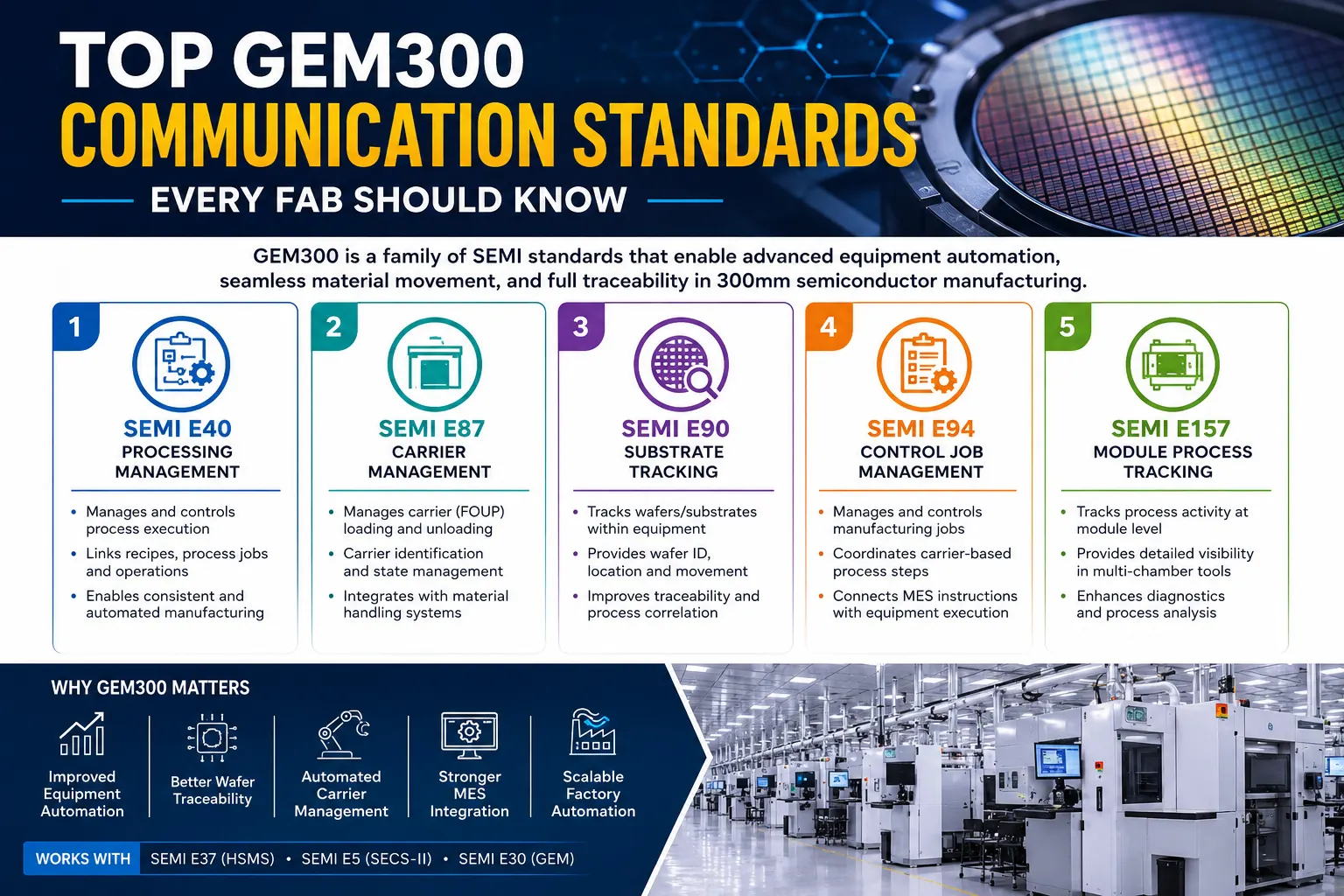
If you work anywhere near equipment integration in a semiconductor fab, you’ve heard the term GEM300 thrown around in meetings about host connectivity, MES rollouts, or new tool qualification. But GEM300 isn’t a single standard — it’s a family of SEMI standards built on top of SECS/GEM, purpose-built for 300mm fabs where automation, throughput, and data visibility aren’t optional extras. They’re the baseline.
For engineers evaluating a new SECS/GEM driver or auditing an existing equipment integration, knowing which GEM300 standards matter — and what each one actually does — makes the difference between a smooth host connection and months of troubleshooting. This guide breaks down the GEM300 communication standards every fab team should have on their radar.
What Is GEM300, and Why Does It Matter?
GEM300 refers to the set of SEMI E30 (GEM) extensions that SEMI introduced specifically for 300mm wafer fabs. While SECS/GEM defines the base communication protocol between equipment and host, GEM300 standards add the specific behaviors 300mm automation requires: carrier tracking, job management, equipment self-diagnosis, and enhanced remote control.
In short, SECS/GEM is the language. GEM300 is the vocabulary a 300mm fab actually needs to speak fluently — tracking FOUPs, managing recipes remotely, and giving the host real-time visibility into equipment health without a human walking the floor.
Any fab running (or planning to run) 300mm wafers with a modern MES will need equipment that complies with most, if not all, of these standards.
1. SEMI E37 — High-Speed SECS Message Services (HSMS)
E37 replaced the older serial-based SECS-I protocol with TCP/IP-based communication. This is the transport layer that makes everything else possible — faster message exchange, more reliable connections, and the ability to support the message volume that carrier tracking and data collection demand in a 300mm environment.
Why it matters: Without HSMS, none of the higher-level GEM300 standards can perform at the speed a modern fab needs. It’s the foundation every other standard on this list runs on top of.
2. SEMI E40 — Processing Job Management
E40 defines how a host system creates, controls, and monitors processing jobs on equipment — essentially, the standardized way to tell a tool what to process and in what order, then track that job through to completion.
Why it matters: For fabs running lights-out or near-lights-out operations, E40 is what lets the host schedule and sequence work without an operator manually keying in job parameters at each tool.
3. SEMI E39/E90 — Substrate Tracking
E39 defines the object model for substrates (wafers), and E90 builds on it to track substrate location and history as material moves through a tool. Together, they give the host a continuous, standardized record of where every wafer is and what’s happened to it.
Why it matters: Traceability is non-negotiable in semiconductor manufacturing. If a wafer needs to be pulled for a quality investigation, E90 compliance is what makes that lookup fast instead of a multi-hour archaeology project.
4. SEMI E87 — Carrier Management (CMS)
E87 standardizes how equipment tracks and reports on carriers (FOUPs) — load port status, carrier IDs, slot mapping, and the events tied to carrier movement.
Why it matters: 300mm fabs run on automated material handling, and FOUPs are constantly moving between stockers, tools, and load ports. E87 is what lets the host and the AMHS agree on carrier state without manual reconciliation.
5. SEMI E94 — Control Job Management
Where E40 manages processing jobs at the equipment level, E94 governs control jobs — the higher-level construct that links carriers to processing jobs and coordinates multi-step sequences across a tool.
Why it matters: E94 is what allows a host to say “run this carrier through this recipe sequence” as a single coordinated instruction, rather than issuing separate commands at every step.
6. SEMI E116 — Equipment Performance Tracking (EPT)
E116 standardizes how equipment reports its operational state — productive, idle, down, engineering, and the reason codes behind each state change.
Why it matters: Fabs live and die by OEE (Overall Equipment Effectiveness). E116 gives the host a standardized feed of equipment states, which is the raw data behind every OEE dashboard and utilization report.
7. SEMI E120/E125 — Equipment Self-Description and Equipment Reporting
E120 defines a standard structure for equipment to describe its own capabilities to the host (component IDs, subsystems, configuration), while E125 extends this into standardized status reporting on those components.
Why it matters: These standards reduce the custom engineering work needed every time a new tool type comes online. A host system built around E120/E125 can pull structured equipment data without a bespoke integration project for each tool.
8. SEMI E164 — EDA Common Metadata (Equipment Data Acquisition)
E164, part of the broader Interface A / EDA framework, standardizes the metadata around high-speed data collection — freeze events, data variables, and how equipment-level data maps back to context like lot, carrier, and process step.
Why it matters: As fabs lean harder into predictive maintenance and yield analytics, E164 (alongside the rest of the Interface A family) is what makes high-volume equipment data usable rather than just noise flowing into a data lake.
Bringing It All Together: Why Standards Compliance Beats Custom Integration
Every one of these standards exists to solve the same underlying problem: getting equipment and host systems to agree on a shared language, without a custom integration project for every tool, every vendor, and every fab. When equipment is genuinely GEM300-compliant across E37, E40, E90, E87, E94, E116, and the rest, fab teams spend less time debugging one-off protocol mismatches and more time actually running production.
This is precisely where a mature SECS/GEM driver earns its keep. Rather than building compliance into each tool’s control software from scratch, fabs and equipment makers can integrate a driver that already handles the GEM300 standard set — HSMS transport, carrier management, job control, equipment reporting — out of the box.
eInnoSys’s EIGEM300Equipment SECS/GEM driver is built around exactly this need: full GEM300 standard compliance for 300mm fab equipment, so integration teams can connect to host and MES systems without reinventing the protocol stack for every tool.
Final Thoughts
GEM300 isn’t one standard to check off a list — it’s a coordinated set of SEMI standards that, together, make automated 300mm fab operation possible. Understanding what each one covers, from HSMS transport up through equipment self-description and EDA metadata, helps engineering and integration teams ask the right questions when evaluating new equipment or a new SECS/GEM driver.
If your team is scoping a new tool integration or auditing existing GEM300 compliance, it’s worth starting with the standards above as a checklist — and looking at how much of that compliance a driver can hand you before you write a single line of custom code.


