
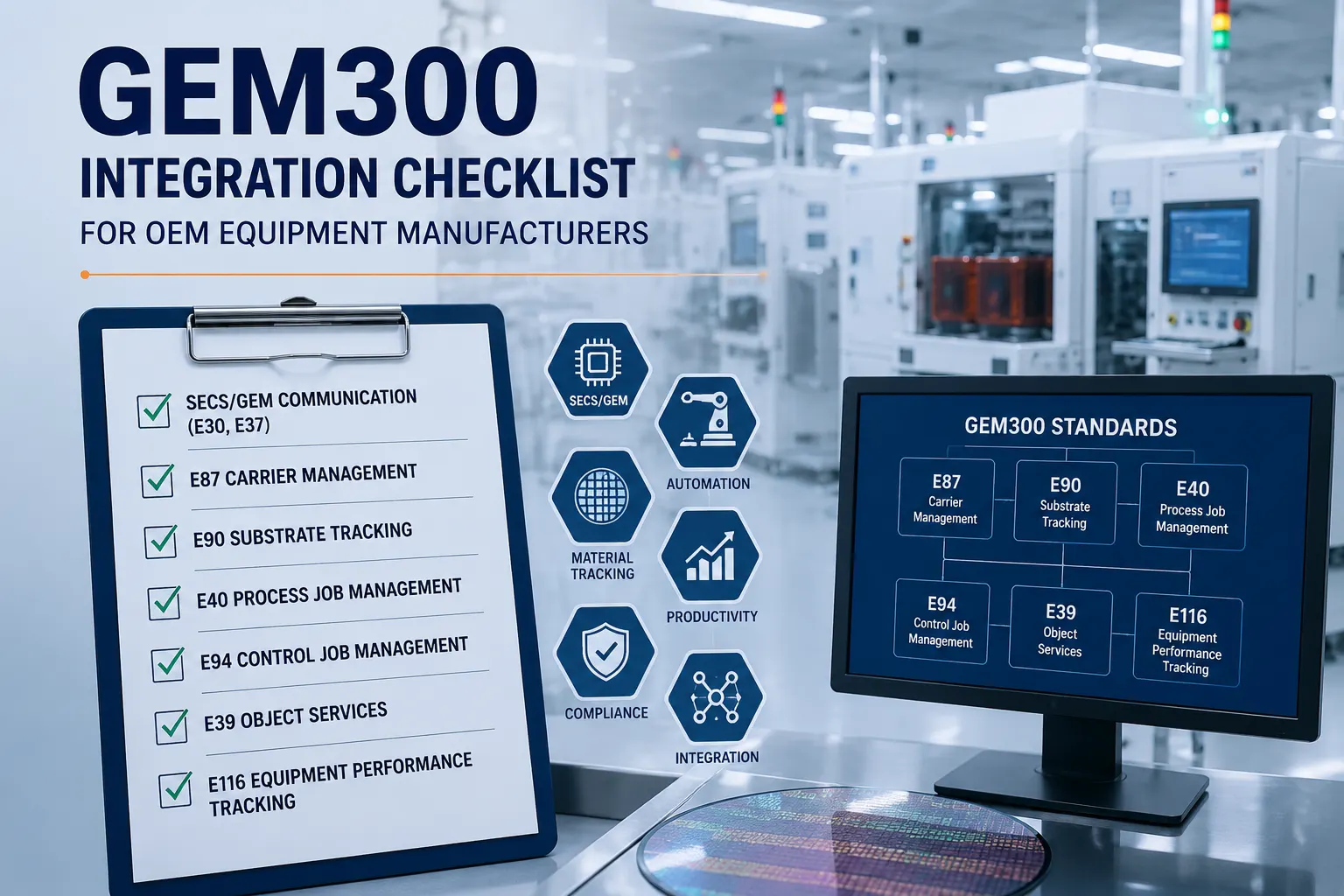
Understanding the GEM300 Framework Before You Build
GEM300 compliance is built on a family of SEMI standards that define how 300mm semiconductor equipment communicates with a fab’s host system. The core specifications — E30 (GEM), E37 (HSMS), E39 (Object Services), E40 (Process Jobs), E87 (Carrier Management), E90 (Substrate Tracking), E94 (Control Job Management), and E116 (Equipment Performance Tracking) — work together to create a unified model for semiconductor factory automation. Understanding how these standards interlock is the first obligation in any serious GEM300 implementation. Before writing a single line of driver code, your team should audit the target fab’s host requirements. Different fabs implement varying subsets of the SEMI standards, and some carry proprietary extensions. Confirming the exact compliance profile early prevents costly rework later. Document the required SECS-II variable list, event report configuration, and alarm table during this phase, since these outputs directly feed your equipment’s ECS (Equipment Communication Software) design.GEM300 Integration Checklist: Communication Layer and Core GEM
The foundation of any SECS/GEM integration is a stable, low-latency communication link. Use this section of the GEM300 integration checklist to verify your communication layer is production-ready.Connectivity and Transport
- Confirm HSMS (E37) Session Management is implemented: T-Connect, T-Linktests, and T-Separate procedures must complete without timeout under simulated load.
- Verify TCP/IP configuration supports both active and passive connection modes.
- Test link survivability: the equipment must re-establish the HSMS session automatically after a network interruption without operator intervention.
Core GEM (E30) Capabilities
- Equipment Constants (EC) are fully enumerable via S2F29/S2F30 exchanges.
- Status Variables (SV) return correct values under all equipment states.
- Collection Events (CE) fire accurately for every state transition and process event — this is a frequent gap in early GEM300 implementations.
- Remote Commands are validated end-to-end: the host must be able to transition the equipment through all defined states.
- Alarms are categorized correctly (personal safety, equipment safety, process), and the alarm table is synchronized with the SECSII alarm list submitted to the fab.
E87 Carrier Management and E90 Substrate Tracking
E87 Carrier Management and E90 Substrate Tracking represent the highest-stakes portion of GEM300 compliance for most OEMs, because errors here directly affect material traceability and fab yield accounting. Treat this section of the GEM300 integration checklist with particular rigor. E87 Carrier Management E87 defines how the equipment manages FOUPs and cassettes at load ports. Your implementation must support:- Complete Carrier ID Verification (CIV) workflow, including the NoRead and IDVerificationFailed states.
- Load port state machine transitions: Out-of-Service, Transfer Blocked, ReadyToLoad, ReadyToUnload, and all intermediate states.
- SlotMap reporting that accurately reflects wafer presence at each position, with correct handling of crossed/double-slotted wafers returned as fault states.
- Proper binding of carrier objects to process jobs so the host can track material at the carrier level throughout the equipment’s process sequence.
E90 Substrate Tracking
Where E87 manages the container, E90 tracks the individual substrate. The substrate state model — NoState, NeedsProcessing, InProcess, ProcessingComplete, Rejected, Lost — must be maintained accurately throughout the equipment’s workflow. Any substrate state that cannot be reconciled must trigger an exception event that the host system can act upon. Combined, E87 and E90 form the backbone of semiconductor factory automation data integrity. Fabs running advanced process nodes increasingly require real-time substrate state feeds, making a robust E90 implementation non-negotiable for competitive OEMs.Process Management: E40 and E94
GEM300 compliance extends to how equipment receives and executes process instructions. E40 (Process Jobs) and E94 (Control Jobs) define the recipe and job management model that allows the host to drive equipment behavior without operator intervention — a prerequisite for lights-out factory automation. Verify that your GEM300 implementation handles:- Process Job creation, queuing, start, pause, resume, stop, and abort from host commands.
- Recipe management via S7 message streams, including recipe upload, download, and verification using checksums.
- Control Job (E94) binding of multiple Process Jobs into a single logical work order, with correct precedence and dependency handling.
- Exception handling for mid-job process alarms that require job suspension and host notification rather than silent continuation.
GEM300 Integration Checklist: Pre-FAT Validation Steps
Before shipping equipment for factory acceptance testing, run through this final section of the GEM300 integration checklist internally. It mirrors what most fab process engineers will verify on arrival.- Run a full SEMI E30 compliance test suite against a simulated host — commercial SECS/GEM simulators (such as those from Cimetrics or Aegis) are standard tools for this.
- Confirm E87 load port state machines against the full decision tree specified in the standard, not just the happy path.
- Verify E90 substrate state transitions for every process outcome, including partial lots and aborted jobs.
- Validate that all required SEMI E116 equipment performance tracking metrics are populated correctly, since OEE data feeds are increasingly mandatory in advanced fabs.
- Review the ECS log output: the fab’s integration team will request communication logs early in the qualification process, and they must be parseable without ambiguity.
Conclusion
GEM300 compliance is not a feature you add at the end of a development program — it is an architectural commitment that shapes how your equipment communicates, manages material, and reports its state from the moment it powers on. OEM equipment manufacturers who treat this GEM300 integration checklist as a living engineering document rather than a one-time audit tool consistently achieve faster fab qualifications and fewer post-installation escalations. The standards that govern SECS/GEM integration — E30, E37, E87, E90, E40, E94, and the broader GEM300 family — are mature and well-documented, but their correct implementation still demands disciplined engineering, rigorous internal testing, and close collaboration with the fab’s equipment integration team. Invest in that discipline early, and your equipment will be ready to perform from the first wafer in.Ready for GEM300 Compliance?


