
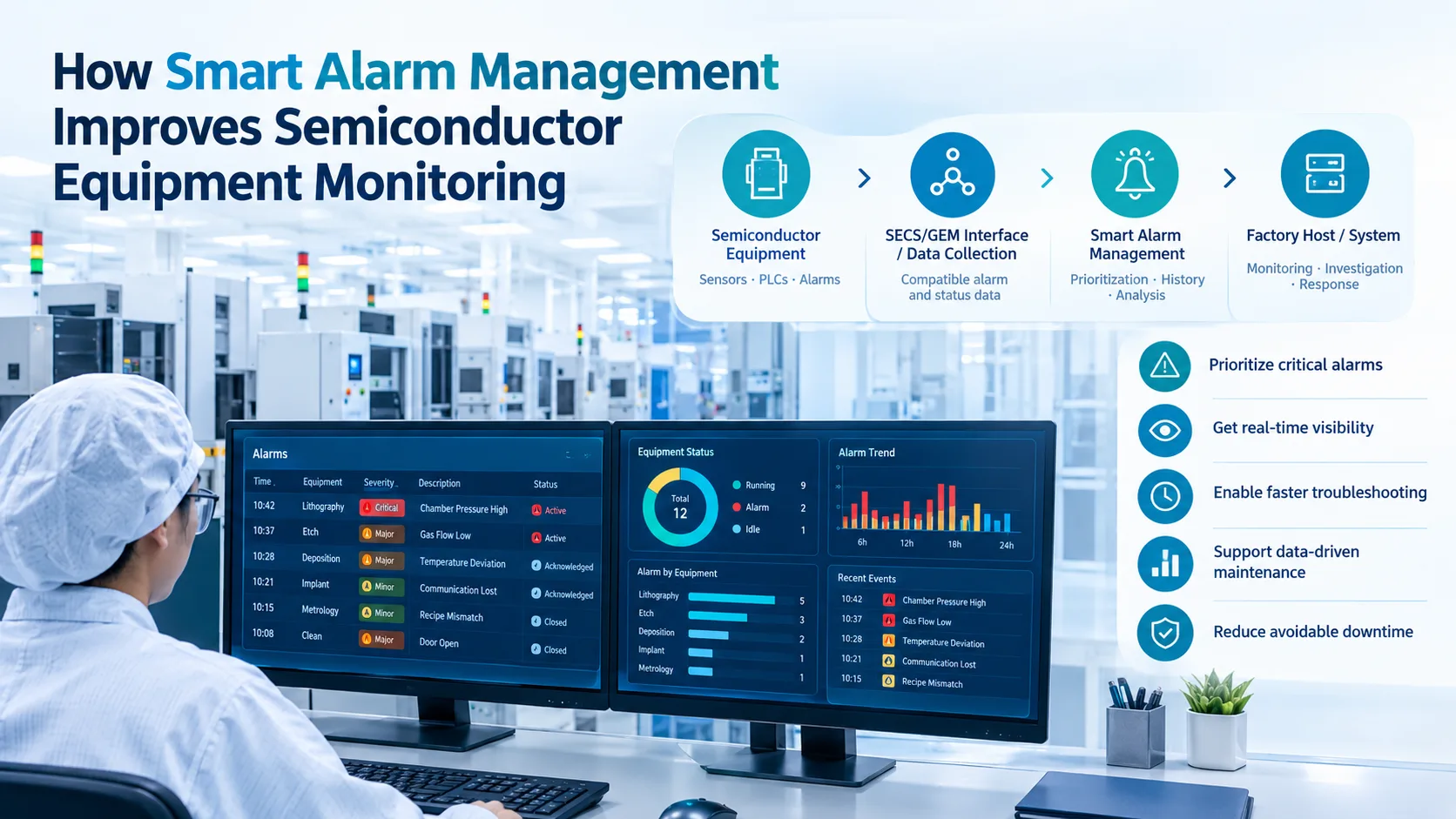
Every semiconductor tool talks to its operators through alarms. A vacuum fault, a temperature deviation, or a communication loss all arrive as an alarm. In a busy fab, those messages come from dozens or hundreds of tools at once.
The challenge is not the alarms themselves. The challenge is making sense of them quickly. When alarms repeat, overlap, or lack context, engineers spend more time sorting messages than fixing problems. Smart alarm management addresses this by collecting, organizing, and analyzing alarms so teams can see what matters and act on it.
This article explains how smart alarm management works, where it helps, and how to introduce it into a semiconductor factory automation environment.
What Is Smart Alarm Management in Semiconductor Manufacturing?
Smart alarm management is a software approach that turns raw equipment alarms into organized, actionable information. Instead of treating every alarm as an isolated message, it manages alarms across their full lifecycle.
In simple terms, it covers four functions:
- Alarm collection: Software gathers alarms from equipment, typically through a standard interface such as SECS/GEM (the SEMI standard protocol for equipment-to-host communication).
- Prioritization: Alarms are classified by severity and impact, so critical events stand out from informational ones.
- Monitoring: Teams view current alarm status across tools in one place rather than checking each tool separately.
- Historical analysis: Stored alarm data shows which alarms recur, which tools generate them, and how they trend over time.
Together, these functions give engineers context. An alarm becomes part of a pattern rather than a single, disconnected event.
Common Equipment Alarm Challenges in Semiconductor Fabs
Most fabs already receive equipment alarms. The difficulty lies in how those alarms are handled.
Too Many Alarms and Repeated Notifications
A single fault can trigger several related alarms. Some alarms also repeat until someone clears the condition. Over time, operators may see so many notifications that important ones blend into the background.
This is often called alarm flooding. It slows response because staff must first decide which messages deserve attention. Unclear alarm text adds to the problem, especially when the same message means different things on different tools.
Delayed Fault Identification and Limited Equipment Visibility
When alarms stay on individual tool screens, engineers must walk to the tool or log in to find the cause. Alarm information may sit in separate logs, and no one sees a combined view.
As a result, recurring problems are harder to spot. A tool may raise the same alarm every week, yet without historical records the pattern goes unnoticed. Limited visibility makes troubleshooting reactive instead of informed.
How Smart Alarm Management Improves Equipment Monitoring
Alarm Prioritization and Real-Time Visibility
Prioritization separates urgent alarms from routine ones. Teams define severity levels and decide which alarms need immediate attention. Operators then see the most important events first.
Real-time visibility adds to this. A shared view of alarm status across equipment lets engineers notice problems as they appear. They no longer rely on someone reporting an issue from the floor.
Faster Troubleshooting and Historical Alarm Analysis
Troubleshooting is faster when engineers can see what happened and how often. Historical alarm records show recurring faults and which tools raise them most. A Pareto chart, which ranks alarms by how often they occur, helps teams focus on the few alarms behind most of the noise.
Comparing alarms across tools of the same type can also reveal whether a problem belongs to one machine or to the process. That insight supports better maintenance planning.
Integration with SECS/GEM and Factory Systems
SECS/GEM is the common language between semiconductor equipment and factory host systems. Equipment that supports it can report alarms to the host in a standard way. This gives alarm management software a consistent data source across tools and vendors.
Once alarm data reaches the host layer, it can feed MES and other factory systems. This is why SECS/GEM equipment monitoring and alarm management work well together. Reliable connectivity provides the data, and alarm management makes the data useful.
Challenges, Approaches, and Benefits at a Glance
| Equipment Monitoring Challenge | Smart Alarm Management Approach | Business Benefit |
|---|---|---|
| Too many alarms and repeated notifications | Classify alarms and assign priority levels | Helps teams focus on critical events first |
| Alarms scattered across individual tools | Centralize alarm data through compatible SECS/GEM integration | Provides a unified view of equipment status |
| Slow root-cause identification | Maintain alarm history and relevant event context | Supports faster fault investigation |
| Recurring alarms go unnoticed | Analyze alarm frequency using Pareto-style reports | Supports better-informed maintenance decisions |
| Inconsistent responses to critical alarms | Define response procedures and notification rules | Encourages consistent handling of alarm events |
Key Benefits for Semiconductor Manufacturers
Smart alarm management supports several practical outcomes:
- Improved equipment visibility: Staff see alarm status across tools without visiting each one.
- More organized alarm handling: Classification and priority rules bring order to a noisy stream of messages.
- Faster fault investigation: Alarm context and history shorten the path from symptom to cause.
- Better maintenance decisions: Frequency data shows which issues deserve engineering time.
- Potential downtime reduction: Quicker response and fewer recurring faults can help limit avoidable downtime. Actual results depend on the fab, the equipment, and how the system is configured.
How to Implement Smart Alarm Management
A phased approach keeps the project manageable.
- Classify alarms. List the alarms your equipment generates. Group them by type, such as safety, process, hardware, or informational.
- Configure priorities. Assign severity levels and decide who should be notified for each class. Involve both engineering and maintenance teams.
- Establish equipment connectivity. Confirm each tool can report alarms to the host. Many tools support SECS/GEM natively. Others need an interface layer.
- Set up dashboards and reports. Give operators a live alarm view and give engineers reporting tools for analysis.
- Review alarms periodically. Revisit priorities and recurring alarms on a regular schedule. Alarm settings that fit today may not fit after a process change.
Start with a few high-value tools. Then expand once the workflow proves useful.
How eInnoSys Supports Semiconductor Equipment Monitoring
eInnoSys offers products and services for equipment connectivity and monitoring. The following solutions relate to alarm-focused monitoring.
Alarm Management System (EIAMS). EIAMS tracks alarms generated by semiconductor equipment and compares them against other tools of the same type. It includes Pareto-style alarm reports and downtime tracking by alarm. Users can also define automatic actions in response to an alarm, such as notifying personnel, stopping wafer input, switching equipment to maintenance mode, or holding wafers for engineering review. For a real-world example, see the eInnoSys alarm management case study.
EIGEMBox. EIGEMBox adds SECS/GEM capability to existing equipment. It helps connect compatible legacy tools so that their data, including alarms, can reach factory systems. Compatibility depends on the equipment, so confirm it during assessment.
EIGEMEquipment. EIGEMEquipment is a SECS/GEM SDK for equipment manufacturers. eInnoSys also provides SECS/GEM implementation services for OEMs that want to build host communication into their tools.
Smart FDC. Fault Detection and Classification monitors equipment sensor data and applies user-defined limits to detect process excursions. It supports fault detection and process monitoring alongside alarm-based monitoring. Learn more on the SeerSight page.
Conclusion
Smart alarm management gives semiconductor teams a clearer view of equipment behavior. It reduces alarm confusion, supports faster troubleshooting, and turns historical alarm data into better maintenance decisions. It depends on reliable equipment connectivity, because alarms must reach the host before anyone can organize them.
For fabs, OSAT/ATMP facilities, and equipment manufacturers, the path often starts with connectivity, then moves to structured alarm handling and broader factory visibility.


