

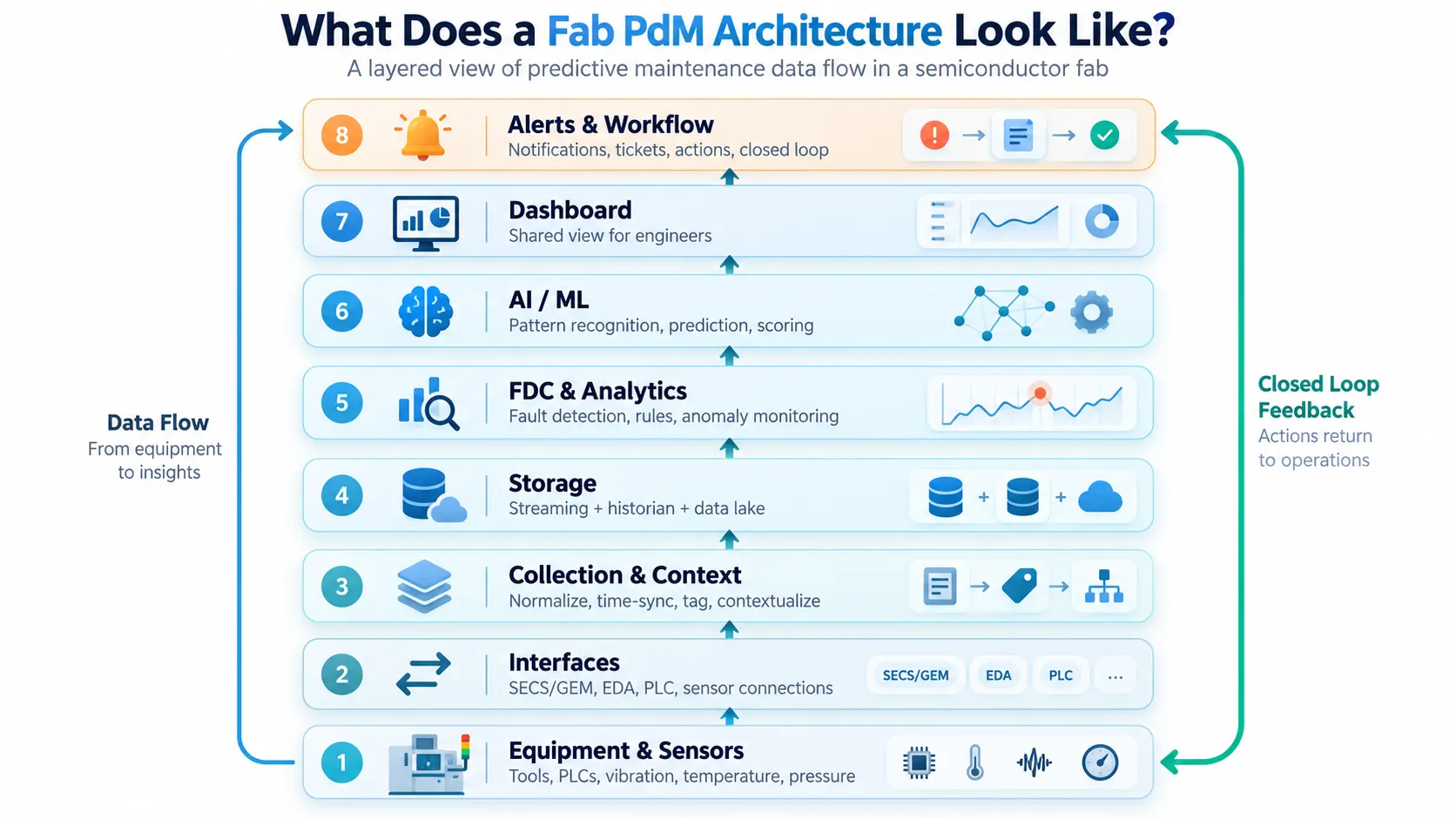
A predictive maintenance pipeline for fab equipment collects data from tools and sensors, cleans and contextualizes it, converts it into equipment health indicators, applies FDC and anomaly detection, adds AI/ML where the data supports it, and sends alerts into a maintenance workflow. The pipeline works only when every stage is reliable, from data collection through the maintenance action.
Unplanned downtime, unexpected component failures, and aging equipment put constant pressure on semiconductor fabs. Fixed-interval maintenance and alarm-driven repairs often miss gradual degradation, while large volumes of equipment data go unused.
Predictive maintenance (PdM) uses that data to estimate equipment health and failure risk before a breakdown. This guide explains how to build a predictive maintenance pipeline for fab equipment, step by step.
Key takeaways
- PdM needs more than an AI model; it needs reliable data, equipment connectivity, FDC, analytics, and an actionable maintenance workflow.
- Define failure modes before choosing sensors or models.
- Rules and thresholds suit known failure modes; AI/ML helps with complex patterns.
- An alert without a response workflow has limited value.
- Start with one equipment class, prove value, then scale.
What Is a Predictive Maintenance Pipeline for Fab Equipment?
A predictive maintenance pipeline for fab equipment is the end-to-end flow that turns raw equipment and sensor data into maintenance decisions. It moves data from the tool through collection, processing, analysis, and alerting to a planned maintenance action.
| Term | Meaning | Role in PdM |
|---|---|---|
| SECS/GEM | Equipment communication standard for data collection and host interaction | Provides equipment data |
| FDC | Fault Detection and Classification | Detects and classifies abnormal behavior |
| PdM | Predictive Maintenance | Estimates equipment health and failure risk |
| AI/ML | Artificial Intelligence / Machine Learning analytical methods | Supports prediction and anomaly detection |
SECS/GEM is not a predictive maintenance system. It supplies data that monitoring, FDC, and analytics can use.
Why Does Predictive Maintenance Matter in Semiconductor Fabs?
Semiconductor equipment predictive maintenance supports several practical goals:
- Equipment availability: early detection gives teams time to act before a tool goes down.
- Production continuity: planned work disrupts flow less than emergency repairs.
- Maintenance planning: teams can schedule around production windows and spare parts.
- Equipment health visibility: engineers see ongoing behavior, not just inspection snapshots.
- Resource use: effort goes to tools showing signs of trouble.
Results depend on the equipment, the data, and how well the organization acts on findings. PdM improves decisions; it does not eliminate failures.
Step 1: Which Fab Equipment Should You Monitor First?
Start with equipment where failure hurts most. Rank candidates by production impact, failure frequency, repair cost, and detection difficulty. Define failure modes before choosing sensors or models, because the failure mode determines which signals matter.
| Equipment | Example Failure Modes |
|---|---|
| Vacuum Pumps | Bearing wear, rising motor load, overheating, degraded pump-down |
| Etch & Deposition Equipment | Chamber drift, component wear, unstable process conditions |
| Furnaces | Heater degradation, temperature uniformity drift |
| Cleaning Equipment | Pump or flow problems, supply instability |
| Wafer Handling Systems | Motor stalls, positioning errors, longer cycle times |
| Motors | Rising current, vibration changes, overheating |
| Temperature-Control Systems | Slow response, unstable setpoint tracking |
Step 2: What Data Do You Need for Semiconductor Equipment Monitoring?
| Source | What It Provides |
|---|---|
| SECS/GEM | Standard equipment-to-host communication: events, alarms, and status variables |
| EDA | Higher-volume equipment data, where the tool supports it |
| PLCs & Controllers | States, counters, and process values |
| Equipment Logs | Events, errors, and operating history |
| Vibration, Temperature & Pressure Sensors | Mechanical, thermal, and process behavior |
| Current & Energy Measurements | Motor load and power behavior |
SECS-II defines message content, HSMS carries those messages over Ethernet, and GEM defines standard equipment behavior and data. Legacy tools may expose limited data. External semiconductor equipment sensors can fill the gap, though installation and approval rules vary by fab.
Step 3: How Do You Build the Data Collection Pipeline?
The basic architecture is:
Equipment/Sensors → Communication Layer → Data Collection → Storage → Analytics
Get these elements right:
- Sampling rates that match the failure mode
- Reliable transmission with buffering
- Synchronized timestamps across sources
- Storage that supports real-time and historical analysis
- Consistent units and naming
- Equipment identification at tool, chamber, and component level
Reliable collection is the foundation; every later step inherits its flaws.
Step 4: How Do You Clean and Contextualize Equipment Data?
Raw data contains missing values, noise, duplicates, and timestamp errors. Context matters just as much: the same sensor value can mean different things in different equipment states. A motor current that is normal during production may signal a problem at idle.
Useful context includes equipment state, recipe or process step, maintenance events, part replacements, and lot or wafer information where available. Without it, models may flag normal recipe changes or miss real faults.
Step 5: What Are Equipment Health Indicators?
Equipment health indicators are values derived from raw data that reflect the condition of a tool or component. Feature engineering creates them.
Health indicators help predictive maintenance systems identify gradual changes in equipment behavior before they become serious failures. A moving average smooths signal fluctuations over time, while the rate of change shows how quickly a parameter is drifting. Vibration and temperature trends can reveal developing wear or overheating, and current consumption can indicate rising motor load under similar operating conditions. Pressure behavior can also help identify process or vacuum changes during specific equipment steps.
Other indicators provide additional context about equipment health and performance. An increase in alarm frequency may indicate growing equipment instability, while cycle-time changes can reveal slower mechanical or process performance. Operating hours show how much the equipment has been used since the last maintenance activity. When these indicators are analyzed together, they can help maintenance teams detect abnormal patterns earlier and make more informed maintenance decisions.
Step 6: How Do FDC and Anomaly Detection Fit into Predictive Maintenance?
FDC monitors equipment and process data to detect abnormal conditions and identify fault types. It extends naturally into maintenance:
Equipment Monitoring → FDC → Anomaly Detection → Predictive Maintenance
| Method | Best Suited For | Limitation |
|---|---|---|
| Thresholds & Rules | Known failure modes; transparent and easy to trust | May miss complex patterns |
| Statistical Analysis | Tracking drift and variation | Requires stable baselines |
| AI/ML | Detecting multi-signal or subtle patterns | Requires good-quality data and validation |
AI is not automatically better than traditional FDC. Effective FDC predictive maintenance usually combines all three.
Step 7: Can AI Predict Fab Equipment Failures?
AI/ML can support semiconductor equipment failure prediction, but not every failure and not without good data. Common applications include:
- Anomaly detection: learn normal behavior and flag deviations.
- Failure prediction: estimate likelihood within a defined window.
- Equipment health scoring: combine indicators into one score.
- Fault classification: identify the type of developing problem.
- Remaining useful life (RUL) estimation: forecast remaining operating time.
- Pattern recognition: find signatures that precede known issues.
These methods need reliable historical data and clear objectives. Failures are often rare, so anomaly detection and health scoring may be more realistic starting points than precise forecasts. Validate results against real maintenance outcomes.
Step 8: How Do You Turn Predictions into Maintenance Actions?
An alert nobody acts on has little value. Build a workflow:
Sensor Change → Anomaly → Risk Assessment → Alert → Engineer Investigation → Maintenance Planning
Define who receives alerts, their urgency, what information they include, and the expected response. Link alerts to existing maintenance processes and feed outcomes back so confirmed faults and false alarms improve future results.
What Are the Common Challenges When Implementing PdM?
| Challenge | Why It Matters | What Helps |
|---|---|---|
| Legacy Equipment | Older tools may lack modern data interfaces | Retrofit sensors and use protocol conversion |
| Data Quality | Poor-quality data weakens every model | Fix data collection problems first |
| Too Much Data | More data does not guarantee better predictions | Focus on signals linked to failure modes |
| False Alarms | Excessive alerts can reduce engineer trust | Tune thresholds and add operating context |
| Integration | Standalone PdM can become another data silo | Integrate with existing automation and FDC systems |
| Model Maintenance | Equipment behavior can change after repairs or recipe changes | Monitor model performance and retrain as needed
|
How Does eInnoSys Support Fab Equipment Predictive Maintenance?
eInnoSys works in semiconductor equipment connectivity and factory automation, covering several layers of the pipeline.
XPump is aimed at equipment health and predictive maintenance for pumps and motors, using signals such as vibration, temperature, current, and other health parameters to support monitoring and early detection of abnormal behavior.
SeerSight Smart FDC supports equipment monitoring, fault detection, anomaly detection, predictive analytics, dashboards, and alerts.
EIGEMBox and SECS/GEM connectivity address data collection by helping collect and integrate equipment data for monitoring, FDC, and analytics, including on tools where data would otherwise be hard to reach.
Actual results depend on the equipment, available data, and deployment.
Conclusion
Successful predictive maintenance for semiconductor fabs depends on more than an AI model. It depends on data, equipment connectivity, FDC, analytics, AI/ML where it adds value, and actionable maintenance.


