
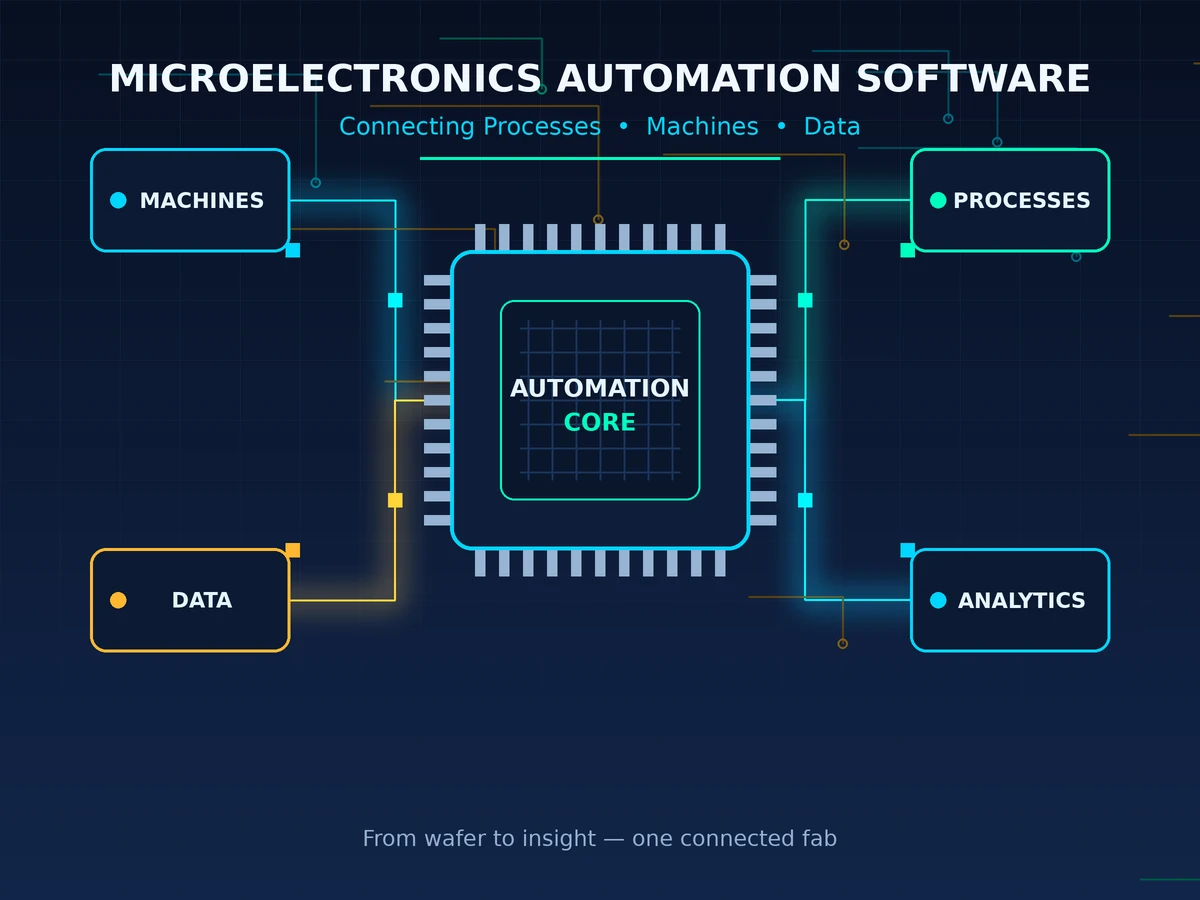
Microelectronics automation software connects production equipment, MES, and factory data into one coordinated system. It uses standards such as SECS/GEM to give manufacturers real-time visibility, tighter process control, and fewer unplanned stops. Fabs, MEMS manufacturers, and equipment OEMs use it to raise yield and throughput.
Introduction to Microelectronics Automation Software
A modern microelectronics fab runs hundreds of tools from different vendors, built in different decades. Each tool produces valuable data, but that data is often trapped inside the machine.
Microelectronics automation software solves this problem. It acts as the connective layer between equipment, factory systems, and people. It collects data, sends recipes, controls material flow, and reports status in real time.
For production engineers and factory automation managers, this software is now a basic requirement. It is how a fab moves from isolated machines to a connected, data-driven operation
Challenges in Microelectronics Manufacturing
Microelectronics production leaves very little room for error. Several challenges make automation harder than in most industries:
- Mixed equipment generations. Legacy tools sit next to modern 300mm systems, and they often speak different protocols.
- Data silos. Process data stays inside individual tools instead of reaching the MES or analytics platforms.
- Tight process windows. Small deviations in temperature, pressure, or timing can scrap an entire lot.
- Manual intervention. Manual recipe downloads and paper-based tracking cause errors and slow down operations.
- Unplanned downtime. One failed tool can stall the whole line.
Manufacturers need a structured way to connect every tool and every data point. Standards-based automation provides that.
Key Features of Microelectronics Automation Software
Strong microelectronics manufacturing automation software offers these core capabilities:
- Standards-based connectivity using SECS/GEM, GEM300, and SEMI E84.
- Recipe and parameter management with version control.
- Real-time data collection from equipment sensors and process events.
- Operator interfaces for clear tool control and alarm handling.
- Simulation and testing to validate integrations before go-live.
- Scalability from a single tool to a full factory.
These features work together. Connectivity supplies the data, interfaces make it usable, and simulation keeps deployments safe.
Connecting Manufacturing Equipment Through Equipment Integration
Microelectronics equipment integration is the process of making each machine communicate with the factory host in a standard way. It is the foundation of every automation project.
For newer tools, the equipment software can implement the required protocols directly. For older tools without native communication, a hardware gateway can add connectivity without major modification.
Good integration delivers three things:
- Equipment that reports its state, alarms, and events automatically.
- Hosts that can send commands and recipes without manual steps.
- A consistent data format across tools from many vendors.
Equipment OEMs benefit as well. Building standard connectivity into a tool shortens customer integration time and makes the product easier to sell to fabs.
Role of MES and SECS/GEM in Factory Automation
Two elements sit at the center of microelectronics factory automation: the MES and the SECS/GEM standard.
What is SECS/GEM?
SECS/GEM is the SEMI standard that defines how equipment and a host computer communicate. It covers status reporting, event collection, alarm management, remote control, and recipe handling. For 300mm fabs, GEM300 extends this with carrier management, process job control, and control job handling. Automated material handling relies on SEMI E84 for the physical handoff between transport systems and tools.
Why MES matters
Microelectronics MES software manages work-in-process. It tracks lots, enforces routes, dispatches work, and records genealogy. But an MES is only as good as its equipment connection. Without reliable SECS/GEM links, the MES works from delayed or manual data.
When both layers are connected, the factory gains:
- Accurate lot tracking from start to finish
- Automatic recipe verification before processing
- Full traceability for quality audits
- Faster response to process excursions
Real-Time Production Monitoring and Data Collection
You cannot improve what you cannot see. Automation software turns raw equipment signals into live production insight.
With real-time monitoring, teams can:
- View tool states (running, idle, down) across the whole factory.
- Capture process parameters at every step.
- Trigger alerts when readings drift outside limits.
- Feed clean, time-stamped data into analytics and reporting tools.
This matters for MEMS manufacturing software as well. MEMS processes often involve unique steps such as deep etching, bonding, and wafer-level packaging. Detailed process data is needed to keep these steps repeatable. Strong MEMS manufacturing automation depends on the same connected foundation as a traditional fab.
Better data also shortens root-cause analysis. Engineers can trace a yield problem to a specific tool, recipe, or time window in minutes rather than days
Predictive Maintenance and Equipment Performance
Reactive maintenance is costly. A tool that fails mid-lot can scrap product and idle expensive capacity.
Microelectronics predictive maintenance uses collected equipment data to spot early warning signs. Examples include rising vibration, slowly drifting pressure, or growing cycle times. The software flags these patterns so maintenance can be scheduled before a failure.
The practical benefits are clear:
- Fewer unplanned stops
- Longer component life
- Better planning of spare parts and technician time
- Higher overall equipment effectiveness (OEE)
Predictive maintenance is only possible when data flows reliably from the tool. That is another reason equipment integration comes first.
Benefits of Microelectronics Manufacturing Automation
When integration, MES connectivity, monitoring, and maintenance work together, the results are measurable:
- Higher yield through tighter process control and fewer manual errors.
- Greater throughput from faster dispatching and reduced idle time.
- Lower cost by cutting rework, scrap, and unplanned downtime.
- Full traceability that supports customer and regulatory audits.
- Faster tool onboarding for new equipment and new product lines.
- Scalability so you can grow without rebuilding your systems.
Together these benefits make a fab more competitive and more resilient.
How eInnoSys Supports Microelectronics Automation
eInnoSys provides semiconductor manufacturing equipment software and connectivity products for the full automation stack. Each product addresses a specific need:
- EIGEMBox adds SECS/GEM connectivity to legacy equipment through a ready-to-deploy gateway.
- EIGEM-HMI gives operators a clear interface for tool control, alarms, and status.
- EIGEMEquipment embeds SECS/GEM capability directly in equipment software.
- EIGEM300Equipment supports GEM300 requirements for 300mm tools.
- EIGEMLink links equipment and host systems for smooth data exchange.
- EIGEM84 supports SEMI E84 handoff for automated material handling.
- EIGEMSim simulates equipment and host behavior so teams can test before deployment.
Explore our full range of Microelectronics Industry Solutions to see how these products fit your factory.
Conclusion
Microelectronics automation software turns scattered machines into one connected, visible, and controllable operation. Standards such as SECS/GEM and GEM300, combined with MES integration, real-time monitoring, and predictive maintenance, help manufacturers raise yield, protect uptime, and scale with confidence.
eInnoSys helps fabs, MEMS manufacturers, and equipment OEMs build this foundation with proven connectivity and automation products. Whether you are upgrading legacy tools or launching a new line, eInnoSys can support each step
Related Blogs:-
- Microelectronics Manufacturing Software: How Digital Tools Improve Production Control
- How Semiconductor Manufacturing Software Supports End-to-End Production Management
- Semiconductor Manufacturing Automation: Key Technologies Transforming Wafer Production


