
A single faulty LED batch can trigger returns, rework, and lost customer trust. When that happens, one question matters most: where did the problem start? Without reliable records, finding the answer can take days. With MES for LED manufacturing, it can take minutes.
Production traceability means knowing what went into every product, which machine processed it, and what the test results were. This guide explains how a manufacturing execution system (MES) delivers that visibility, from raw material tracking to finished product inspection. It also shows how equipment connectivity and automation keep the data accurate.
What Is MES for LED Manufacturing?
A manufacturing execution system is the software layer that manages and records what happens on the shop floor in real time. It sits between your ERP, which handles orders and inventory, and your machines, which do the physical work.
In an LED factory, an MES manages work orders, tracks every lot through each process step, and enforces process rules. It also stores quality data against each unit or batch. As a result, LED manufacturing MES platforms create a complete digital history for every product
Compared with spreadsheets or paper travelers, an MES offers three clear advantages:
- Real-time visibility into work in progress
- Enforced workflows that stop wrong materials or skipped steps
- Searchable records for audits and root cause analysis
Modern LED manufacturing software also connects equipment, dashboards, and analytics. This turns raw machine signals into useful production intelligence.
Key Production Traceability Challenges in LED Factories
LED production is complex. It involves many materials, sensitive processes, and tight quality requirements. Consequently, traceability gaps appear easily.
Common challenges include:
- Material variation: LED chips, phosphors, and adhesives often differ from lot to lot. Small differences can change brightness and color.
- Manual data entry: Operators who write or type data make mistakes. Records may also be late or incomplete.
- Disconnected machines: Die bonders, wire bonders, dispensers, and testers often store data separately.
- Binning complexity: LEDs are sorted by color and brightness. Therefore, losing track of a bin can mix grades.
- Legacy equipment: Older machines may lack modern communication interfaces.
- Slow recalls: If a defect reaches customers, teams must quickly identify every affected unit.
Because of these gaps, many plants cannot connect a field failure to its original cause. An MES closes those gaps by linking each record to a unique lot or serial number.
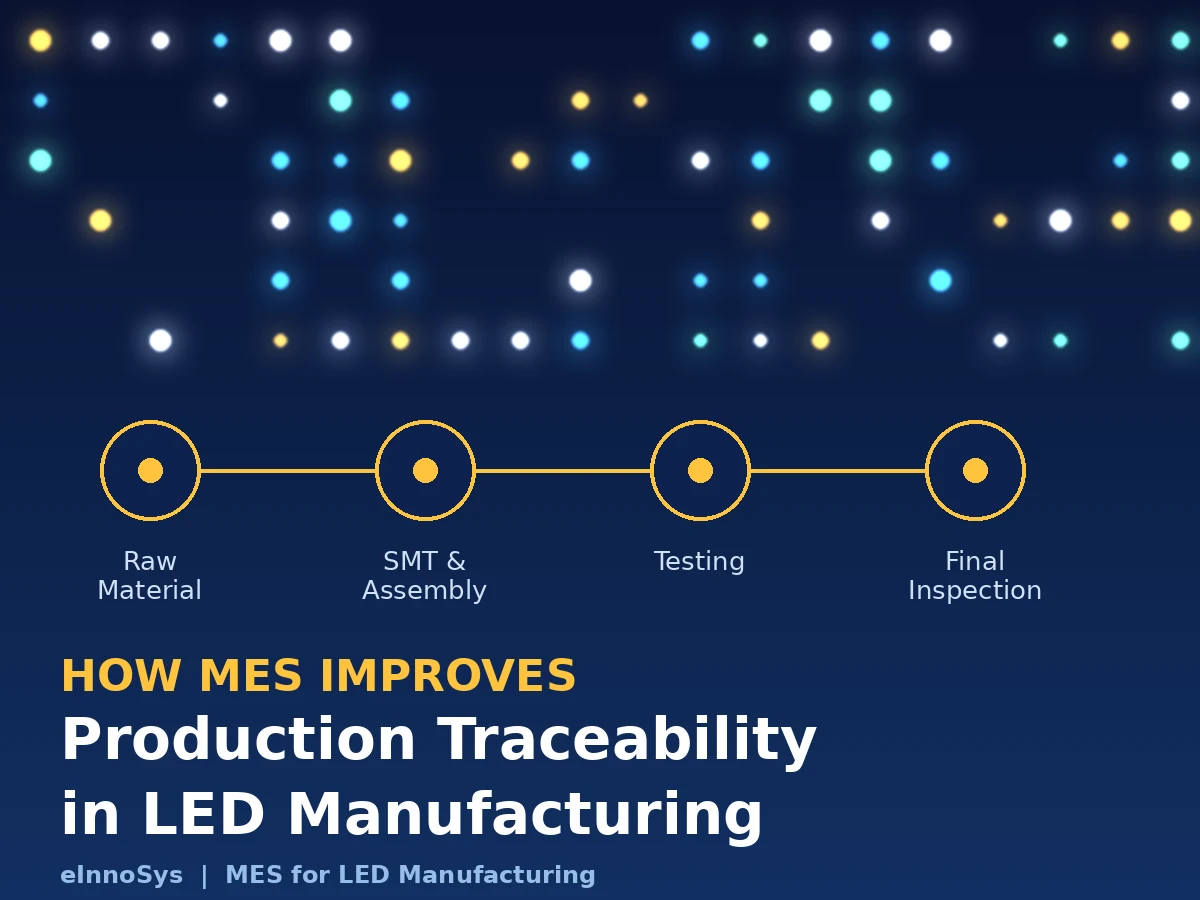
How MES Tracks Materials, Batches, and Production Processes
An MES builds traceability step by step. Each stage adds data to the product’s digital record, often called its genealogy.
- Raw material and incoming inspection:-
Traceability starts at the dock. The MES records supplier, lot number, receiving date, and inspection results for each material. Barcode or QR scanning links materials to specific containers. In addition, the system can block expired or quarantined materials from reaching the line. - Material issue and line loading:-
When operators load materials, the MES verifies them against the work order. If the wrong reel or compound is scanned, the system raises an alert. This prevents errors before they become defects. - Lot and batch genealogy:-
As lots move through assembly, the MES links finished units to their inputs. For example, you can see which chip lot, phosphor batch, and encapsulant lot went into a given product. Splits and merges, which are common in LED production, remain fully tracked. - Process step tracking:-
At each station, the MES logs the machine, recipe, operator, time, and key parameters. These may include bonding force, dispensing volume, and curing temperature. This data shows exactly how each lot was built. - Testing, binning, and final inspection:-
Finally, test results and bin assignments are saved against each unit or lot. Visual inspection results and pass or fail decisions are recorded too. With this record, a customer complaint can be traced back through every step.
Benefits of MES for Quality Control and Defect Identification
Traceability is not only about compliance. It directly improves quality and yield.
- Faster root cause analysis. When a defect appears, you can filter by material lot, machine, shift, or recipe. Patterns show up quickly. For instance, a color shift might trace back to one phosphor batch.
- Targeted containment. Instead of scrapping or recalling everything, you isolate only the affected lots. This saves cost and protects customer relationships.
- Better process control. Real-time data lets engineers spot drift before it causes rejects. Statistical process control (SPC) charts and alarms support this.
- Audit readiness. Complete records make customer and regulatory audits far easier. Reports can be generated on demand.
- Less rework and scrap. Enforced workflows and early alerts reduce human error. Over time, yield improves.
Overall, a good LED production software setup converts quality from a reactive task into a proactive one.
The Role of Equipment Connectivity and Manufacturing Automation
An MES is only as good as the data it receives. If operators key in values by hand, traceability stays fragile. Therefore, equipment connectivity is the foundation of reliable LED manufacturing automation.
When machines send data automatically, the MES gets accurate timestamps, parameters, alarms, and results. This also removes the delays and typing errors of manual entry.
Here is how different connectivity options support LED factory automation:
- Legacy machines: EIGEMBox adds SECS/GEM capability to existing equipment, so older tools can report to your MES without a full replacement.
- PLC and HMI-based equipment: EIGEMHMI is a SECS/GEM solution designed for PLC and HMI-based machines.
- New equipment builds: Tool makers can embed the SECS/GEM SDK or the GEM300 SDK to deliver standards-compliant communication.
- System integration: EIGEMLink helps link equipment and factory systems for smoother data exchange.
- Material handoff: The E84 SDK supports automated load port and transport interactions, which helps keep material movement tracked.
- Testing before go-live: The SECS/GEM simulator lets teams validate host-equipment communication without tying up production tools.
Together, these tools connect machines, MES, and analytics. The result is a continuous, automatic flow of traceability data.
How to Implement MES for Better LED Production Traceability
A phased approach lowers risk and speeds up results. Follow these steps:
- Map your process. Document every step from receiving to shipping. Identify where traceability breaks today.
- Define what to trace. Decide your traceability unit: lot, panel, or serial number. Then list the data points you need at each step.
- Assess your equipment. Check which machines can already communicate and which need connectivity upgrades.
- Connect the machines first. Automate data capture before adding complexity. Clean data makes everything else easier.
- Pilot on one line. Start small, test thoroughly, and fix issues early.
- Train your team. Operators and engineers must trust and use the system.
- Scale and improve. Roll out to other lines. Then use the data for analytics, SPC, and continuous improvement.
Throughout the project, involve production, quality, IT, and maintenance teams. Shared ownership leads to better adoption.
Conclusion: Build Reliable Traceability with eInnoSys
Traceability is a competitive advantage in LED production. It shortens investigations, limits recalls, and protects quality. Most importantly, it gives managers confidence in their data.
The right MES for LED manufacturing depends on accurate, automatic data from your equipment. That is where eInnoSys helps. Its solutions cover legacy equipment upgrades, PLC and HMI connectivity, SDKs for equipment makers, simulation, and integration. Combined with your MES, they support stronger traceability across the factory. To see how this applies to your plant, explore eInnoSys’s LED flat panel manufacturing solutions.


