
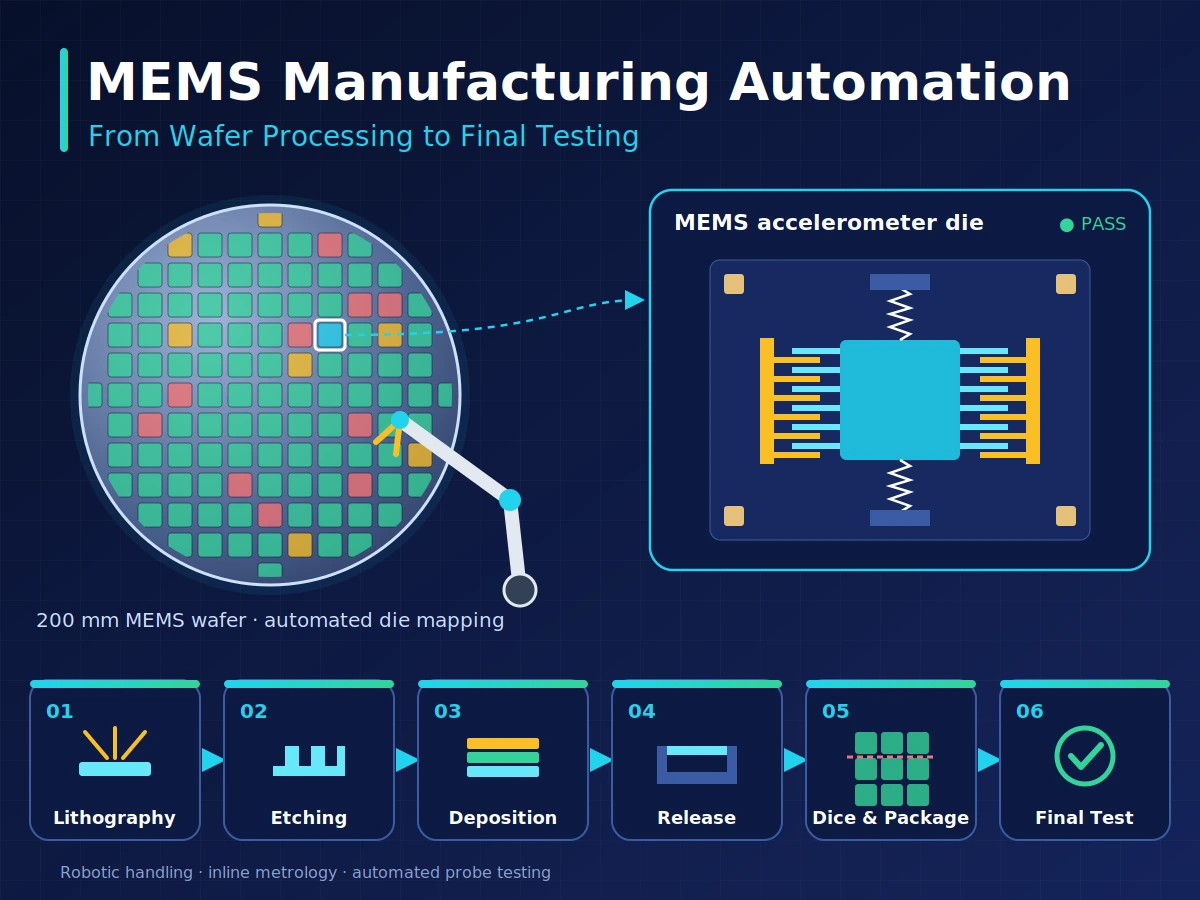
MEMS devices now sit inside phones, cars, medical tools and industrial sensors. Every accelerometer, microphone and pressure sensor passes through dozens of tightly controlled steps before it ships. MEMS semiconductor manufacturing automation is what keeps those steps consistent, traceable and fast enough to meet demand.
This guide walks through the full MEMS process flow, from wafer processing to final testing. It explains where automation adds the most value and how SECS/GEM and MES integration connect equipment to the factory floor. It is written for MEMS manufacturers, fabs, OEMs, OSATs and automation managers.
Why MEMS Semiconductor Manufacturing Automation Matters
MEMS production is different from standard IC manufacturing. Devices combine mechanical and electrical structures, so small process drifts can change device behavior. A slight variation in etch depth or bond pressure can shift sensitivity or yield.
Manual data collection cannot keep up with this level of sensitivity. Automation gives engineers three things:
- Consistency: Recipes run the same way on every lot and every tool.
- Traceability: Each wafer, die and package carries a full process history.
- Speed: Equipment data reaches the right system in seconds, not shifts.
When these three are in place, yield problems are caught earlier and root-cause analysis takes hours instead of days.
Common Challenges in MEMS Factory Automation
Most MEMS facilities run a mix of old and new equipment. This mix creates predictable obstacles.
- Legacy tools without host communication. Many deep reactive ion etchers, bonders and testers were built before connectivity standards were common.
- Mixed wafer sizes. MEMS lines often run 150 mm and 200 mm wafers, and some now run 300 mm.
- Proprietary interfaces. Each vendor exposes data differently, which slows integration projects.
- Disconnected data. Process, inspection and test results sit in separate systems.
- Slow validation. Teams wait for physical tools to test host software, which delays go-live dates.
Solving these problems starts with a clear view of the process flow.
Automation Across the MEMS Process Flow
- Wafer Processing
Wafer processing includes lithography, deposition, etching and cleaning. These tools generate the most process data in the fab. Automation here means collecting recipe parameters, sensor traces and alarms, then confirming that the right recipe runs on the right lot.
Automated recipe management reduces setup errors. Real-time data collection supports statistical process control, so drift is flagged before it becomes scrap. - MEMS-Specific Processing
Steps such as deep silicon etching, wafer bonding and release etching are unique to MEMS. They are sensitive to timing, temperature and pressure. Equipment connectivity lets engineers monitor these variables continuously and trigger holds when limits are exceeded. - Wafer Probe and Dicing
After fabrication, wafers move to probing and dicing. Automation links probe results to wafer maps and passes die-level data downstream. This keeps good and bad die correctly identified through assembly. - Assembly and Packaging
MEMS packaging, including die attach, wire bonding, capping and sealing, directly affects device performance. OSATs gain the most here from automated lot tracking and genealogy. Each package can be tied back to its wafer, lot and process history. - Final Testing and Calibration
Final test often includes calibration, since MEMS sensors need trimming to meet specifications. Automated test cells report results to the MES, which supports binning, quality records and customer traceability.
SECS/GEM for MEMS Manufacturing
SECS/GEM is the standard that lets factory host systems communicate with semiconductor equipment. SECS/GEM for MEMS manufacturing gives teams a common language across tools from different vendors.
A GEM-capable tool can:
- Report equipment status and alarms
- Send process data and event notifications
- Accept remote commands such as start, pause and hold
- Download and upload recipes
- Support host-controlled lot processing
For SECS/GEM MEMS equipment, this means the same host software can talk to an etcher, a bonder and a tester without custom drivers for each. For 300 mm lines, GEM300 adds standards for carrier handling, job control and process management.
MEMS MES Integration
A Manufacturing Execution System (MES) manages work in progress, routing, quality and traceability. MEMS MES integration depends on reliable data from equipment. Without it, the MES works from manual entries and incomplete records.
Strong integration lets the MES:
- Verify that a lot is cleared to run on a specific tool
- Track lot movement automatically
- Collect process and test results in one place
- Enforce recipe and material checks
- Generate genealogy reports for audits and customers
The equipment layer, not the MES itself, is usually where integration projects stall. Getting tools to speak a standard protocol removes that bottleneck.
Best Practices for MEMS Equipment Integration
- Start with an equipment audit. List each tool, its age, its available interfaces and the data you need from it.
- Use a standard protocol wherever possible. SECS/GEM reduces custom code and shortens project timelines.
- Bridge legacy tools with a gateway. Older equipment can be connected with a hardware layer instead of costly retrofits.
- Test before you touch production. Simulating equipment and host behavior lets teams validate logic early. This lowers risk on live lines.
- Give operators a clear interface. A local HMI helps operators see status, alarms and recipes without switching systems.
- Plan for growth. Choose MEMS manufacturing automation software that supports both 200 mm and 300 mm environments.
How Einnosys Supports MEMS Equipment Connectivity
Einnosys offers a connected set of tools for MEMS equipment integration, covering equipment, host and test layers:
- EIGEMBox: A gateway that adds SECS/GEM connectivity to legacy equipment without deep tool changes.
- EIGEMEquipment: Equipment-side SECS/GEM software for tools that need standard host communication.
- EIGEM300Equipment: GEM300 capabilities for 300 mm equipment.
- EIGEMLink: Host-side connectivity that links equipment to MES and factory systems.
- EIGEM-HMI: An operator interface for equipment status, alarms and control.
- EIGEM84: Additional connectivity support for equipment integration projects.
- EIGEMSim: A simulator for testing host and equipment behavior before deployment.
Together, these support MEMS factory automation from the first wafer step to final test. Explore the full approach on the MEMS Manufacturing Automation page.
Key Benefits of Automating MEMS Manufacturing
- Higher yield through earlier detection of process drift
- Faster integration by using standard interfaces
- Full traceability from wafer to packaged device
- Lower downtime through real-time alarms and remote control
- Easier audits with complete, automatic records
- Scalability as volumes and wafer sizes grow
Conclusion
MEMS semiconductor manufacturing automation is no longer optional for teams that want stable yields and reliable traceability. It links wafer processing, packaging and final testing into one connected flow. Standards such as SECS/GEM, combined with solid MES integration, give manufacturers the data they need to act quickly.
Einnosys helps MEMS manufacturers, fabs, OEMs and OSATs connect legacy and modern equipment through proven SECS/GEM solutions. With the right equipment connectivity in place, your factory can move from manual tracking to real-time, data-driven production.


