
Semiconductor fabs depend on precise communication to keep production running smoothly. Every wafer that moves through a fab generates important data, including process parameters, equipment status, recipe execution, and alarms. Factory systems need this data in real time to monitor production and make timely decisions.
However, connecting factory systems with individual semiconductor tools can be complex. MES-to-equipment connectivity software provides the communication layer between Manufacturing Execution Systems (MES) and equipment on the fab floor. It helps the factory host send commands to equipment and collects equipment data in a format that factory systems can use.
As a result, fabs can improve equipment communication, automate data collection, and reduce the need for manual checks. In addition, standards such as SECS/GEM, HSMS, and SECS-II help create a consistent communication framework between factory systems and semiconductor equipment.
What Is MES to Equipment Connectivity Software?
MES to equipment connectivity software is the layer that allows a factory host system to exchange information with semiconductor manufacturing equipment. It does not replace either system — it sits between them and handles translation, message formatting, and communication logistics.
The relationship generally looks like this:
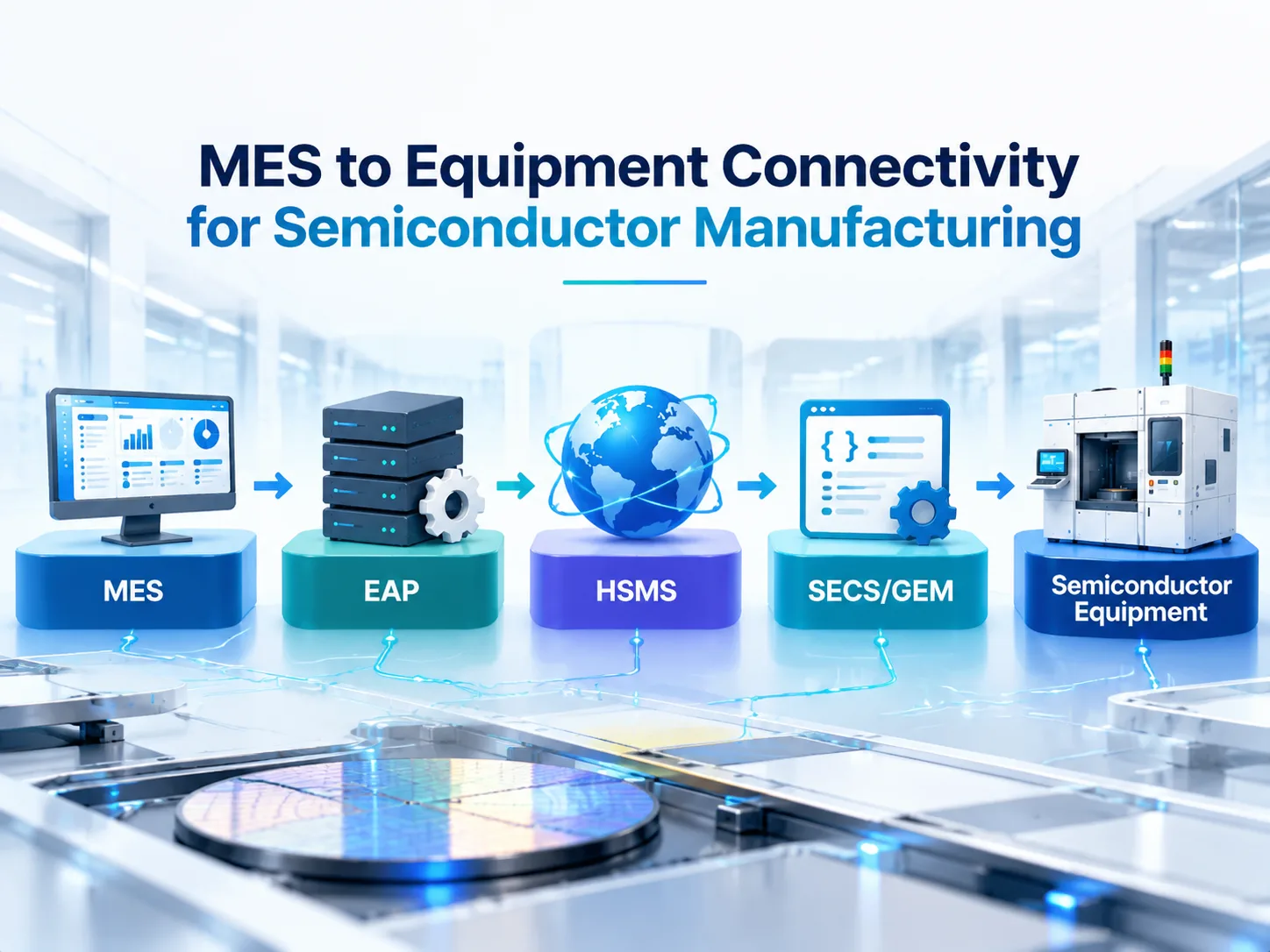
MES / Factory Host → EAP / Connectivity Layer → Semiconductor Equipment
The MES manages scheduling, work orders, and factory-wide production logic. The Equipment Automation Programs (EAP) or connectivity layer handles the equipment-facing communication details. The equipment itself executes recipes, reports status, and generates process data. Connectivity software is what keeps these three layers synchronized without requiring custom point-to-point integration for every tool.
How MES and Semiconductor Equipment Communicate
Communication between MES and semiconductor equipment follows a layered structure defined largely by SEMI standards. Each layer has a distinct job.
A simplified flow looks like this:

SECS-II defines the structure and content of the messages exchanged. HSMS (High-Speed SECS Message Services) is the transport protocol that carries those messages over TCP/IP. GEM (Generic Equipment Model) defines the standard behaviors equipment must support — how it reports state changes, handles alarms, and responds to remote commands. Where applicable, GEM300 extends these behaviors for 300mm equipment with additional requirements around carrier handling and automation.
The EAP or connectivity layer is what actually implements these standards on behalf of the MES, so the MES does not need to speak SECS/GEM directly to every tool.
Why Equipment Connectivity Is Important in Semiconductor Fabs
Reliable equipment connectivity supports several operational needs at once.
Automated equipment communication reduces the need for operators to manually enter status updates or process results. Production data collection happens continuously, giving engineering and quality teams a real-time record of what each tool is doing. Equipment status monitoring allows the fab to track tool availability, idle time, and utilization without physical checks.
Recipe and process control depend on connectivity to push the correct parameters to equipment and confirm they were applied correctly. Alarm and event reporting lets connectivity software flag issues as they occur rather than after a batch is already affected. Remote monitoring extends this visibility to engineers who are not physically on the fab floor.
Traceability is another significant benefit — connectivity software helps maintain a record of what equipment processed which lot, under what conditions, which supports quality investigations and yield analysis. Together, these capabilities are foundational to broader semiconductor factory automation, and they reduce manual intervention across the production line.
Key Features of Semiconductor MES Equipment Connectivity Software
Different vendors implement connectivity software differently, but most solutions in this space share a common feature set.
SECS/GEM communication support is the baseline requirement, along with HSMS support for the underlying transport. Equipment data collection covers variables, events, and alarms defined by the tool’s GEM interface. Remote command capability allows the MES or EAP layer to issue instructions such as recipe selection or process start/stop.
Recipe management features help synchronize recipe versions between the factory system and the equipment, reducing the risk of running an outdated or incorrect recipe. EAP and MES integration capabilities determine how easily the connectivity software fits into an existing factory automation stack. GEM300 support matters specifically for 300mm fabs with carrier and load port automation requirements.
Data logging and monitoring tools give engineers visibility into communication health, not just process data. Configurable communication interfaces allow the software to adapt to different equipment models without custom development for each one. Support for legacy equipment is particularly valuable, since many fabs run a mix of newer and older tools side by side.
Challenges in Connecting MES with Semiconductor Equipment
Equipment connectivity projects rarely go exactly as planned, and a few recurring challenges show up across fabs.
Legacy equipment often predates modern SECS/GEM implementations or supports only partial functionality, which limits what data can be exchanged. Different equipment interfaces across vendors mean that even standards-compliant tools can behave differently in practice. Some older or specialized tools rely on proprietary protocols that require additional translation work.
Missing or inconsistent communication interfaces on certain equipment models can force engineering teams to build workarounds. Complex SECS/GEM configuration — particularly around equipment-specific variable definitions and event mapping — takes real engineering effort to get right. Integration testing is time-consuming because equipment behavior must be validated under real production conditions, not just in a lab setting.
Maintaining communication reliability over time is an ongoing concern, since equipment firmware updates or configuration changes can affect existing connectivity setups. Fabs also differ in their automation requirements, which means a connectivity approach that works well in one facility may need adjustment in another.
How SECS/GEM Helps Connect MES with Equipment
SECS/GEM is a set of SEMI standards that gives equipment connectivity a common technical foundation, but the three components play different roles.
SECS-II defines the message structure — the format and content of the data exchanged between equipment and host systems. HSMS defines the communication protocol — how those messages are actually transmitted over a network connection. GEM defines equipment communication and behavior requirements — the standard set of capabilities a piece of equipment must support to be considered GEM-compliant.
| Standard | Role | What It Defines |
|---|---|---|
| SECS-II | Message Structure | Defines the format and content of data exchanged between equipment and host systems. |
| HSMS | Communication Protocol | Defines how messages are transmitted over a TCP/IP network connection. |
| GEM | Equipment Behavior Model | Defines standard capabilities equipment must support, such as state reporting, alarms, and remote commands. |
| GEM300 | 300mm Extension | Defines additional behaviors for carrier handling and automation; implementation depends on equipment requirements. |
It’s worth being precise here: MES does not typically communicate directly with equipment using SECS/GEM. An intermediate connectivity or EAP layer implements the SECS/GEM interface on the equipment side and exposes a more MES-friendly interface upstream. This layered architecture is what makes standards-based connectivity scalable across many different tools and vendors.
MES-to-Equipment Connectivity for Legacy Semiconductor Equipment
Many fabs operate equipment that is years or decades old, and replacing it purely for connectivity reasons is rarely practical. Connectivity software and gateway solutions offer a way to bring these tools into a modern factory automation environment without a full equipment replacement.
This typically involves adding or upgrading a communication interface on the equipment side, then using connectivity software to translate its output into standard SECS/GEM messaging that the MES or EAP layer can consume. The equipment’s core process capability stays the same; only the communication layer is modernized. This approach extends the useful life of existing capital equipment while still supporting factory-wide data collection and monitoring goals.
What to Consider When Selecting MES-to-Equipment Connectivity Software
Choosing a connectivity solution involves weighing several practical factors against the specific needs of a fab.
SEMI standards support is a starting point — the software should have solid SECS/GEM and HSMS capability, since these are the foundation for most semiconductor equipment communication. Equipment compatibility matters just as much: it’s worth confirming the software has been used successfully with equipment types similar to what the fab operates, including legacy equipment support where relevant.
Configuration flexibility affects how much custom engineering work will be needed per tool. Scalability determines whether the solution can grow from a handful of tools to a full fab deployment without a redesign. Diagnostics and monitoring features help engineering teams troubleshoot communication issues without extended downtime.
Integration with existing MES/EAP systems should be evaluated early, since poor integration can undermine an otherwise solid connectivity layer. Deployment and maintenance requirements — including how updates and configuration changes are managed over time — affect the total cost of ownership. Security and reliability considerations are increasingly relevant as fabs connect more systems to shared networks.
How eInnoSys Supports Semiconductor Equipment Connectivity
eInnoSys works in the semiconductor equipment connectivity space, with solutions built around SECS/GEM communication and equipment integration. Products such as EIGEMBox and EIGEMEquipment are designed to help equipment and integration teams implement SECS/GEM and HSMS communication without building an interface from the ground up.
These tools are intended to support equipment connectivity within a broader factory automation strategy, including scenarios involving legacy equipment that need a standards-based communication path to MES and EAP systems. As with any connectivity implementation, the right fit depends on the specific equipment, fab requirements, and existing automation infrastructure.
Conclusion
Reliable MES to equipment connectivity software is a practical necessity for semiconductor manufacturing, not just a technical nicety. It gives fabs the automated communication, data visibility, and process control needed to run efficiently, while standards like SECS/GEM, HSMS, and GEM300 provide a common technical language across equipment vendors. Whether connecting new tools or bringing legacy equipment into a modern automation environment, a standards-based, scalable connectivity approach supports long-term factory automation goals without locking a fab into a single equipment generation.


