
Introduction
Modern factories are more connected than ever. Equipment, sensors, and software systems exchange data every day. This data helps teams improve production, detect issues early, and make faster decisions.
As factories add more connected machines, they need a simple and reliable way to move data. This is especially important for Industry 4.0 and Industrial IoT applications.
MQTT protocol for smart factory automation can help solve this challenge. MQTT is a lightweight messaging protocol designed for efficient data exchange. Today, manufacturers use MQTT in many Industrial IoT and Industry 4.0 applications.
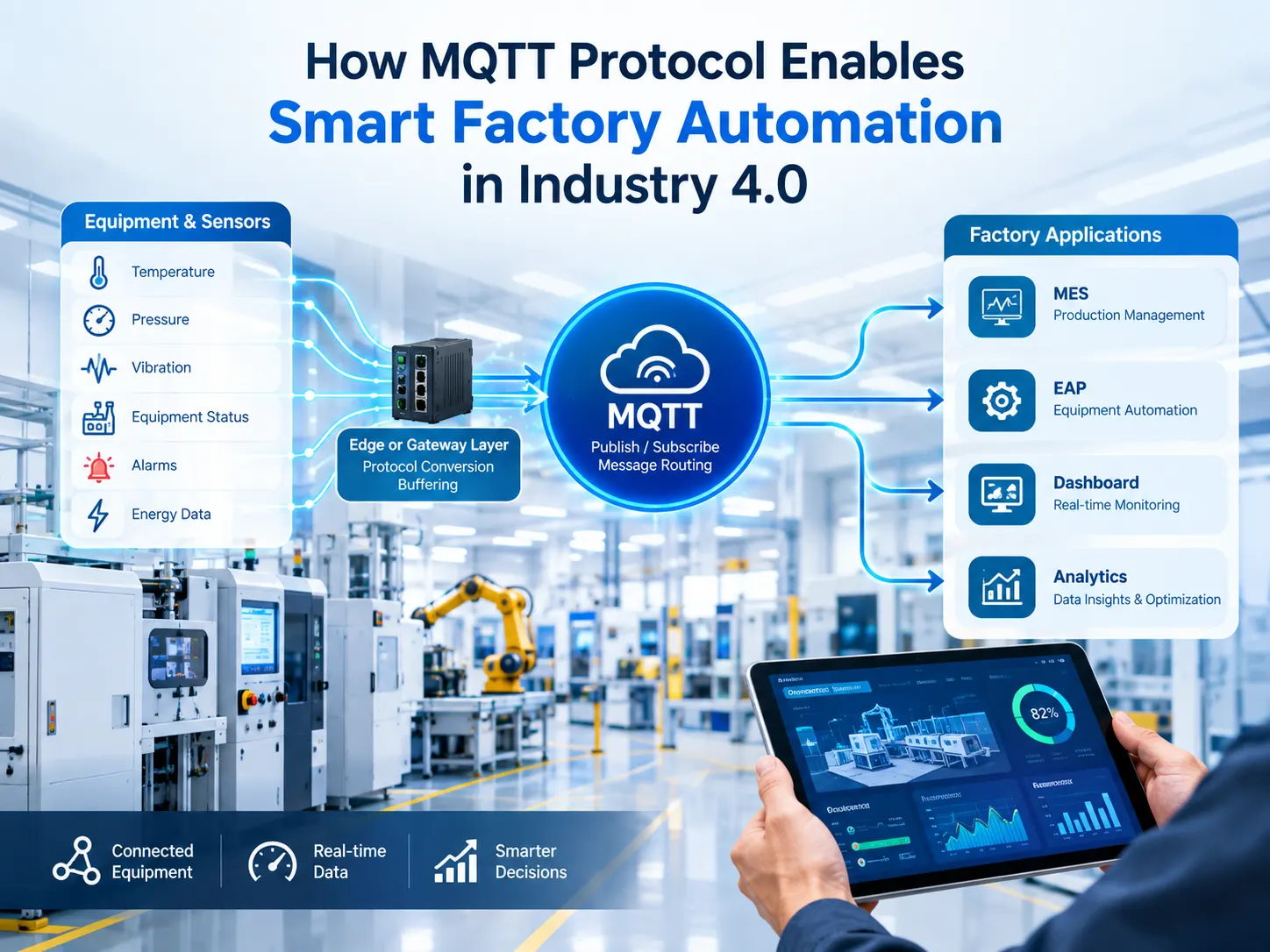
For example, equipment can send sensor readings, status updates, and alarm data through MQTT. A central MQTT broker then routes this information to the systems that need it. As a result, factories can connect equipment, monitoring tools, MES, EAP, and analytics platforms without creating a separate direct connection between every system.
What Is MQTT Protocol?
MQTT (Message Queuing Telemetry Transport) is a lightweight messaging protocol built around a publish/subscribe model rather than direct point-to-point communication.
In simple terms, MQTT involves three components:
- Publishers — devices or systems that send out data, such as a sensor publishing a temperature reading
- Subscribers — applications or systems that receive that data, such as a monitoring dashboard
- Broker — a central server that receives messages from publishers and routes them to the correct subscribers
Publishers and subscribers don’t need to know about each other directly. They communicate through topics, which act like labeled channels. A sensor might publish to a topic like factory/line1/machine3/temperature, and any application subscribed to that topic receives the message automatically.
This structure is why MQTT is described as lightweight: messages are small, the protocol overhead is minimal, and it’s designed to work reliably even over limited or unstable network connections — a common condition in industrial settings.
How MQTT Works in a Smart Factory
In a factory, MQTT follows a simple communication flow:
Equipment/Sensors → MQTT Publisher → MQTT Broker → Factory Applications
Equipment and sensors generate different types of data. For example, they can report temperature, pressure, vibration, equipment status, production counts, alarms, and energy use.
The MQTT publisher sends this data to the broker. It organizes the data under specific topics. For example, a factory may use separate topics for equipment status, temperature, or alarms.
Next, different factory applications can subscribe to the topics they need. A predictive maintenance system can receive vibration data. At the same time, a production dashboard can receive output data. An alert system can monitor alarm topics.
As a result, several applications can use the same equipment data without creating separate connections to the machine.
This approach also makes factory systems easier to expand. For example, when a new application needs equipment data, engineers can connect it to the MQTT broker and subscribe to the required topics. They do not need to change the equipment’s main communication interface.
Therefore, MQTT helps factories share equipment data in a simple and flexible way. It can support monitoring, analytics, predictive maintenance, and other smart factory applications.
Why MQTT Is Important for Industry 4.0
Industry 4.0 depends on connected, data-driven operations, and MQTT Industry 4.0 adoption has grown because the protocol fits well with several core requirements of modern manufacturing:
- Industrial IoT connectivity — MQTT is a common backbone for connecting distributed sensors and devices across a facility
- Real-time data collection — messages are delivered with minimal delay, supporting near-real-time visibility into equipment behavior
- Remote monitoring — because MQTT works over standard network infrastructure, equipment data can be monitored from centralized or even off-site locations
- Scalable communication — new publishers and subscribers can be added without redesigning the entire communication architecture
- Data-driven manufacturing — consistent, structured data flow supports analytics, reporting, and process improvement initiatives
For factory automation engineers and IT teams, this means MQTT in manufacturing environments can serve as a practical layer for distributing equipment data across multiple systems without creating a tangle of custom point-to-point integrations.
MQTT in Semiconductor Manufacturing
Semiconductor fabs and equipment environments have specific connectivity needs, and MQTT semiconductor manufacturing use cases are growing alongside broader IIoT adoption. Typical applications include:
- Equipment and facility monitoring, where sensor data is streamed to centralized dashboards
- Sensor data collection from tools that support predictive maintenance workflows
- Production visibility, giving engineers and operators a consolidated view of equipment status across a fab
- Centralized dashboards that aggregate data from multiple equipment types for easier monitoring
It’s important to distinguish MQTT from semiconductor-specific standards such as SECS/GEM. SECS/GEM (SECS-II, HSMS, and GEM) is a long-established equipment-to-host communication standard used extensively in semiconductor equipment automation, covering structured equipment control, status reporting, and host communication in ways specific to fab environments. MQTT, by contrast, is a general-purpose messaging protocol designed for lightweight data distribution.
These technologies are not competitors — they typically serve different communication requirements and can be used as complementary layers within the same factory architecture.
MQTT vs SECS/GEM for Factory Equipment Communication
Understanding where each protocol fits helps clarify factory architecture decisions.
SECS/GEM is widely associated with semiconductor equipment-to-host communication and equipment automation, including structured state models, recipe management, and standardized equipment interfaces expected in fab environments. It is purpose-built for the semiconductor industry’s equipment communication requirements.
MQTT is commonly used for lightweight publish/subscribe messaging and IoT-style data distribution. It’s well suited to streaming sensor data, status updates, and telemetry to multiple consuming applications with minimal overhead.
A modern factory may use both: SECS/GEM for core equipment-to-host communication and automation, and MQTT for distributing derived or supplementary data — such as sensor telemetry or facility monitoring information — to dashboards, analytics tools, or other applications. Neither protocol universally replaces the other; the right choice depends on the equipment involved and the application’s specific requirements.
Quick comparison:
| Comparison Point | MQTT | SECS/GEM |
|---|---|---|
| Primary Purpose | Lightweight publish/subscribe messaging | Equipment-to-host communication |
| Communication Model | Broker-based publish/subscribe | Structured equipment-to-host communication model |
| Typical Use Case | IoT and sensor data distribution | Semiconductor equipment automation |
| Common Environment | Industrial IoT, smart factories, facility monitoring | Semiconductor fabs and equipment-specific automation |
| Data Scope | Telemetry, status, sensor readings, alarms | Recipes, equipment state, events, alarms, and host commands |
| Main Strength | Simple and scalable data distribution | Standardized semiconductor equipment communication |
| Typical Architecture | Devices → MQTT Broker → Applications | Equipment ↔ Host/EAP/MES |
| Industry Focus | Broad industrial and IoT applications | Semiconductor manufacturing |
MQTT Smart Factory Communication Architecture
How MQTT Supports Smart Factory Automation
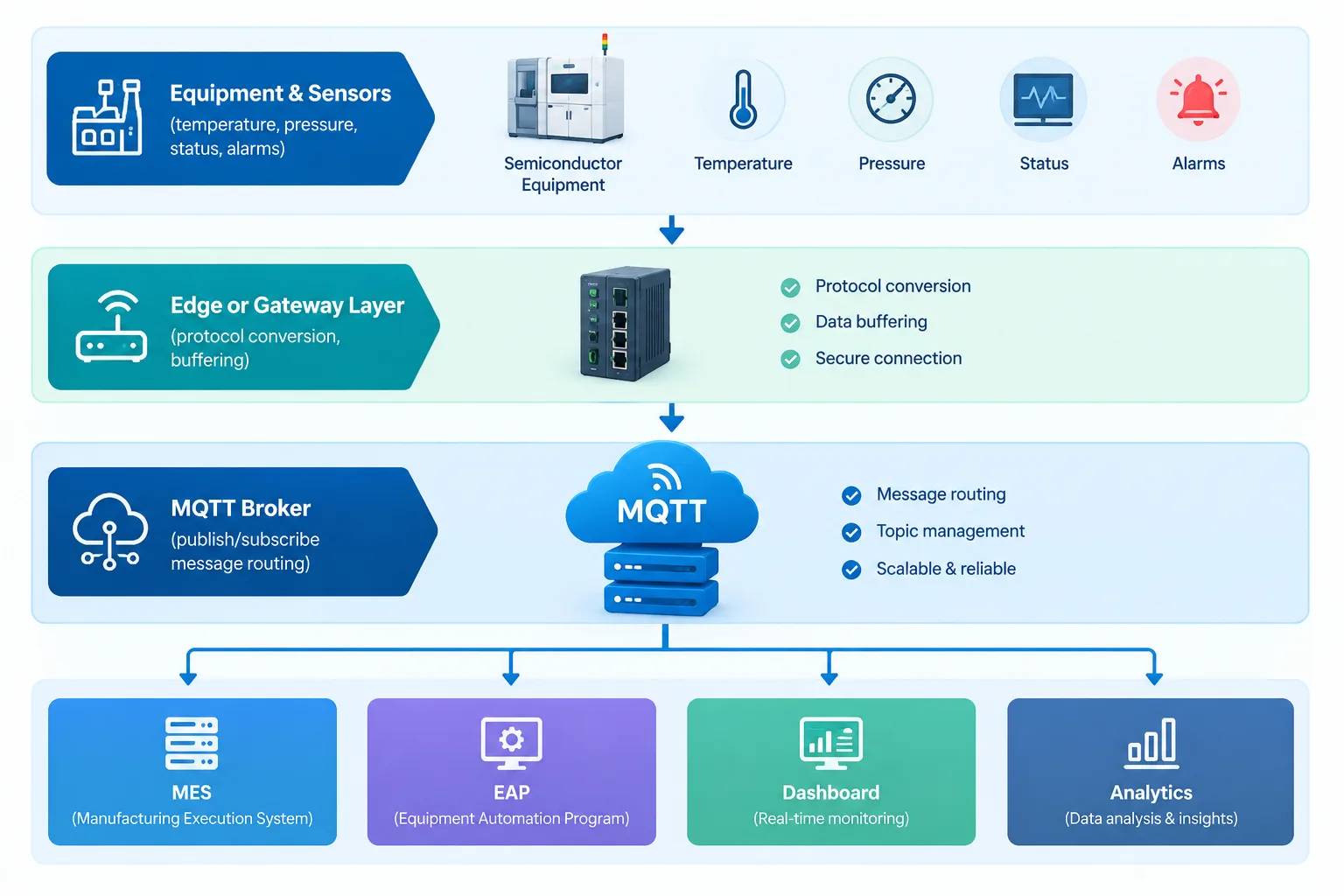
A smart factory can use MQTT to connect equipment with different factory systems. A typical architecture looks like this:
Equipment → Data/Communication Layer → MQTT Broker → MES / EAP / Monitoring / Analytics
For example, a machine may detect an unusual vibration level. A sensor captures the reading and sends it to the MQTT broker under the right topic.
Next, a monitoring application receives the data and alerts the team. At the same time, an analytics system can receive the same message and store it for trend analysis.
As a result, one equipment reading can support several factory teams. An operator can view the alert on a dashboard. An engineer can use the data to check equipment health. Meanwhile, a data team can use historical readings for predictive maintenance models.
This architecture also reduces the need for separate connections between equipment and every application. Instead, applications can connect to the MQTT broker and subscribe to the data they need.
Therefore, MQTT can provide a flexible communication layer for connected equipment and smart factory applications.
Commercial Applications of MQTT in Manufacturing
Beyond the technical architecture, MQTT supports several business-relevant use cases in manufacturing:
- Equipment monitoring — continuous visibility into equipment status helps teams respond to issues before they escalate into downtime
- Predictive maintenance — streaming sensor data supports maintenance workflows aimed at identifying wear or performance drift earlier
- Production visibility — consolidated data feeds give managers and engineers a clearer picture of throughput and equipment utilization
- Remote equipment monitoring — centralized data distribution allows authorized teams to monitor equipment from locations outside the factory floor
- Energy monitoring — factory energy data can be published and tracked alongside production metrics for better resource planning
- Factory dashboards — real-time equipment data feeding dashboards supports faster, more informed operational decisions
- Industrial analytics and IIoT data integration — structured, consistent data flow makes it easier to feed analytics platforms without building custom data pipelines for each source
How eInnoSys Helps Connect Semiconductor Equipment
Connecting equipment to modern factory systems is a persistent challenge in semiconductor manufacturing, particularly where legacy tools, varied communication interfaces, and multiple application requirements intersect. eInnoSys focuses on this connectivity challenge, with core capabilities in SECS/GEM equipment connectivity, EAP and host communication, and equipment data collection.
Solutions such as EIGEMBox and EIGEMEquipment are built to help equipment and factory systems communicate using standardized methods, supporting equipment monitoring and the broader goal of integrating tools into smart factory and Industry 4.0 environments. This extends to equipment data collection workflows that can support monitoring and, where applicable, FDC-related and predictive maintenance initiatives.
The broader objective is making equipment data usable — whether that data feeds an EAP system, a monitoring dashboard, or an analytics platform. For teams evaluating how to extend equipment connectivity for their factory architecture.
Key Considerations Before Implementing MQTT in a Factory
Before adopting MQTT as part of a factory communication strategy, several practical factors are worth evaluating:
- Existing equipment interfaces — whether current equipment supports direct MQTT publishing or requires a gateway/edge layer
- Data source compatibility — how sensor and equipment data will be normalized before publishing
- MQTT broker architecture — whether a single broker or a distributed/clustered setup better fits factory scale
- Security — encryption, access control, and network segmentation to protect equipment data in transit
- Authentication and authorization — controlling which systems can publish or subscribe to specific topics
- Network reliability — factory floor network conditions and how the broker handles reconnections
- Data volume — expected message frequency and payload size across the facility
- Scalability — how the architecture will accommodate additional equipment or applications over time
- Integration with MES/EAP/analytics systems — how MQTT data feeds into existing manufacturing systems
- Legacy equipment connectivity — how older tools without native MQTT support can be bridged into the architecture
Future of MQTT and Smart Manufacturing
As factories continue adding connected equipment, the volume and variety of data generated on the floor will likely keep increasing. Edge computing, combined with IIoT architectures, may help process data closer to its source before it reaches central systems. Analytics and AI/ML tools depend on consistent, well-structured data feeds, which makes protocols like MQTT relevant to how that data gets organized and distributed across Industry 4.0 architectures going forward.
Conclusion
MQTT protocol for smart factory automation offers a lightweight, scalable communication layer suited to the demands of connected manufacturing environments. Its publish/subscribe model makes it well suited for distributing equipment data — from sensor readings to production status — across multiple applications without complex point-to-point integrations. In semiconductor manufacturing, MQTT can work alongside standards like SECS/GEM. Each technology serves a different role in the overall factory communication system.
For manufacturers and equipment OEMs evaluating their equipment connectivity and Industry 4.0 roadmap, understanding where MQTT fits alongside existing communication standards is a useful starting point. Reach out to eInnoSys to discuss how your equipment connectivity and factory automation requirements align with your broader smart manufacturing goals.


