
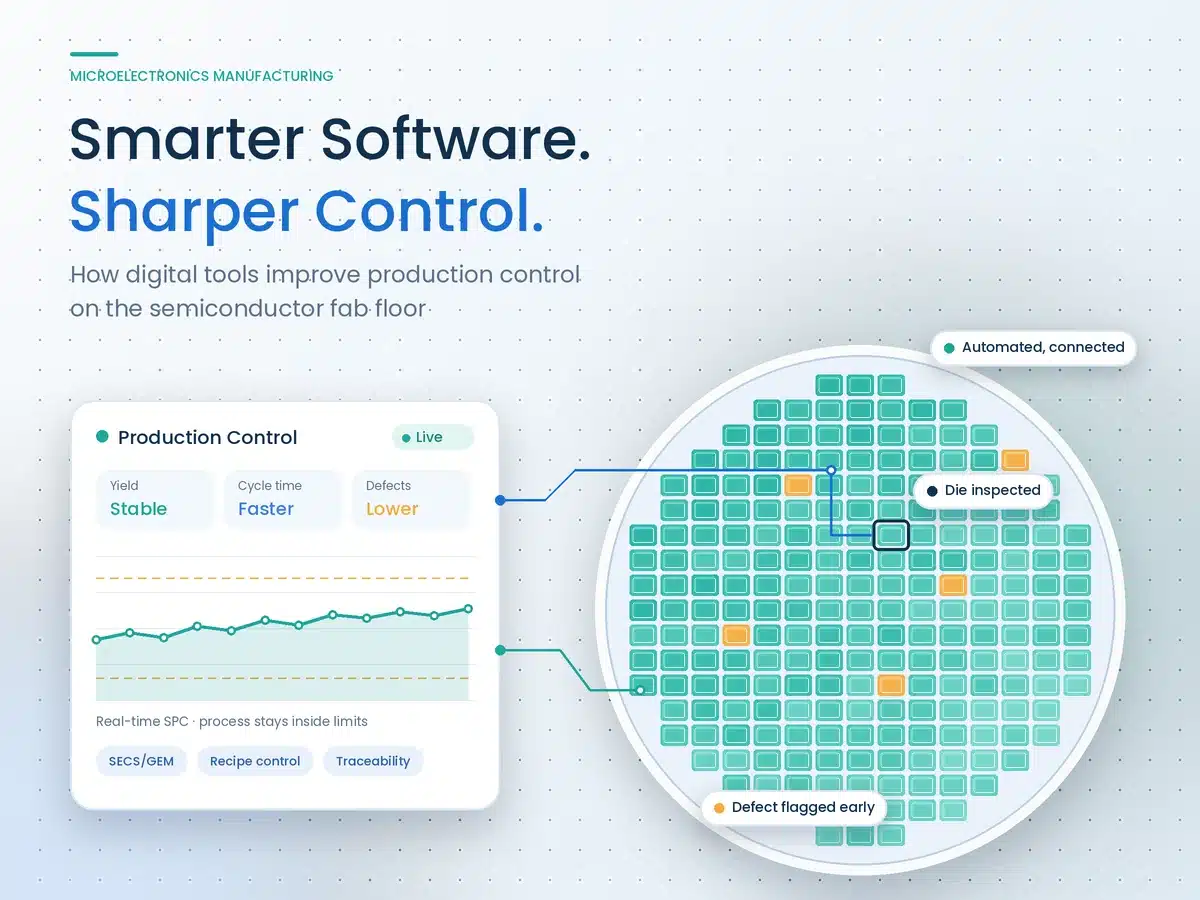
Microelectronics production leaves very little room for error. Cycle times are tight, yields matter, and every process step must be recorded. Modern fabs run hundreds of tools from different vendors, each producing its own data.
Microelectronics manufacturing software connects those tools and turns raw machine data into usable information. This helps teams monitor production in real time and respond faster. This guide explains what this software does, which problems it solves, and how it supports stronger production control.
What Is Microelectronics Manufacturing Software?
Microelectronics manufacturing software connects equipment, collects process data, and shares it with factory systems. It acts as the communication layer between production tools and the systems that manage them, such as a Manufacturing Execution System (MES).
In practice, this software typically does four things:
- Connects equipment to host and MES systems
- Collects and organizes machine and process data
- Monitors equipment status and production progress
- Supports process control and traceability
Without this layer, engineers rely on manual logs and isolated tools. With it, production becomes visible and controllable from a central point.
Key Production Challenges in Microelectronics Manufacturing
Many facilities share the same obstacles. Software addresses each of them directly.
- Equipment connectivity gaps. Tools from different vendors often use different protocols. Older machines may have no standard interface at all.
- Fragmented data. Process data sits in separate systems and formats. Engineers lose time collecting and reconciling it.
- Manual processes. Operators often key in lot data and recipe details by hand. This slows production and increases the risk of errors.
- Unplanned downtime. When equipment status is not visible, teams find problems late. Small issues grow into long stoppages.
- Weak traceability. Quality investigations need a clear record of which tool, recipe, and parameters touched each lot. Incomplete records make root-cause analysis slow and uncertain.
How Software Improves Production Control
Digital tools improve production control in five connected ways.
- Real-Time Monitoring;-
Software shows the live state of each tool: running, idle, in alarm, or down. Production managers see issues as they happen instead of at the end of a shift. This supports faster operational decisions. - Equipment Integration:-
Integration links each tool to the factory network through a common interface. Once connected, equipment can receive commands and report events automatically. - Automated Data Collection:-
The software gathers process parameters, alarms, and events directly from the machine. This removes manual transcription and keeps records consistent and timestamped. - Alerts and Notifications:-
Rules can trigger alerts when a parameter drifts or a tool faults. Teams respond before defects spread across a batch. - Production Tracking:-
Lot movement and process history are tracked across equipment. This gives managers an accurate view of work in progress and bottlenecks.
The Role of Semiconductor Manufacturing Software
Semiconductor manufacturing software links fab equipment with higher-level manufacturing systems. A fab may run lithography, etch, deposition, inspection, and packaging tools together. Each needs to exchange data with the MES in a predictable way.
This software translates between the equipment layer and the factory layer. It lets the host system send instructions and receive results without custom coding for every tool. The result is broader operational visibility across the whole facility, not just one machine at a time.
Semiconductor Manufacturing Automation
Semiconductor manufacturing automation applies software to tasks that people once did by hand. In a connected environment, automation covers:
| Area | How Software Helps |
|---|---|
| Equipment Communication | Tools and hosts exchange messages automatically. |
| Data Exchange | Process data flows to the MES without manual steps. |
| Workflow Execution | Recipes, lot starts, and status changes follow defined rules. |
| Production Tasks | Routine checks and reporting run automatically. |
Automation does not remove engineers from the process. It frees them from repetitive work so they can focus on yield, process improvement, and problem solving.
Key Software Capabilities to Look For
When evaluating microelectronics manufacturing software, check for these core capabilities.
- SECS/GEM support. SECS/GEM is the standard communication protocol between semiconductor equipment and host systems. It defines how tools report status, alarms, and data, and how hosts send commands. Standardized communication reduces integration effort across vendors.
- Equipment integration. The software should connect new and existing tools to the factory network with minimal change to the machine.
- Host communication. Reliable host-side connectivity lets the MES control and monitor equipment centrally.
- Protocol conversion. Not every tool speaks SECS/GEM. Protocol conversion lets equipment using other interfaces join the same network.
- Data collection. Flexible collection of events, alarms, and process parameters supports analysis and traceability.
- Scalability. The solution should grow from a few tools to a full facility without being rebuilt.
Benefits of Manufacturing Software in Microelectronics
Teams that digitize equipment connectivity typically see practical gains:
- Higher visibility: one view of equipment and production status
- Less manual work: fewer hand-entered records and fewer operator errors
- Faster response: problems are detected and addressed sooner
- Better traceability: complete lot, tool, and recipe history
- Improved equipment utilization: less idle time and fewer surprise stoppages
- Scalable growth: new tools join the network with a repeatable approach
eInnoSys Solutions for Microelectronics Production
eInnoSys offers a set of products built around equipment connectivity and factory automation. Each addresses a different part of the integration challenge.
- EIGEMEquipment provides SECS/GEM equipment communication and automation. It helps equipment makers and fabs add standard host connectivity to their tools.
- EIGEMHost handles host-side communication and equipment management. It lets factory systems control and monitor connected tools.
- EIGEMLink is a universal protocol conversion and connectivity solution. It bridges equipment that uses different communication protocols.
- EIGEMBox offers plug-and-play SECS/GEM integration for legacy equipment. Older tools can join a modern automated line without major modification.
These products support the wider microelectronics industry solutions eInnoSys provides for manufacturing automation and equipment integration. You can learn more about the company on the eInnoSys website.
Conclusion
Microelectronics production depends on connected equipment, accurate data, and fast decisions. Manufacturing software provides the foundation for all three. It links tools to host systems, automates data collection, and gives teams the visibility they need to control production with confidence.
eInnoSys supports this goal with EIGEMEquipment, EIGEMHost, EIGEMLink, and EIGEMBox, covering new tools and legacy machines alike. Explore eInnoSys microelectronics manufacturing software and equipment integration solutions to improve production control, connectivity, and automation.


