
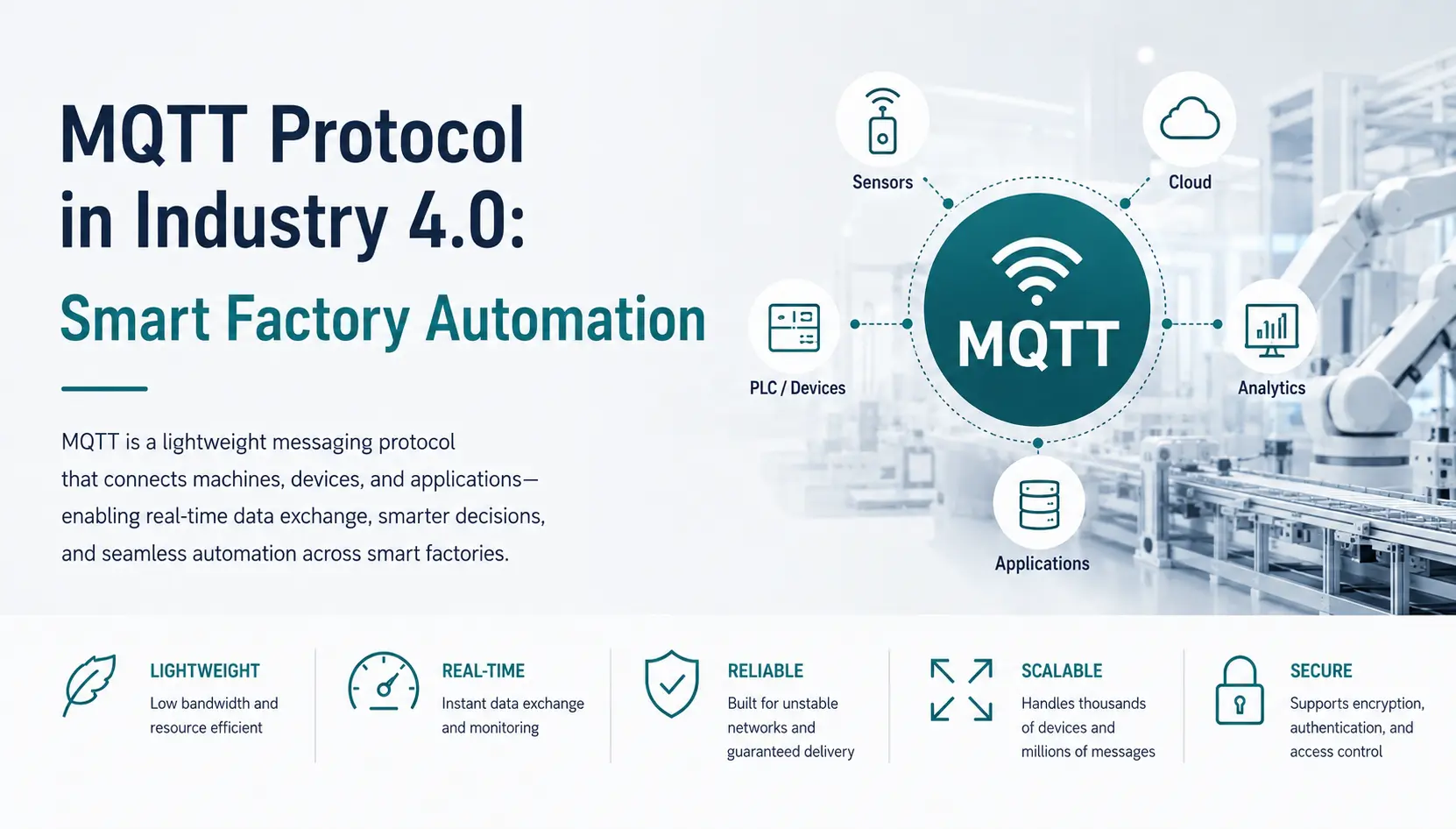
Manufacturing plants generate enormous volumes of data every second — from PLC signals and sensor readings to production counters and machine states. The challenge isn’t collecting this data; it’s moving it reliably, in real time, from the shop floor to the systems that need it. This is where MQTT protocol in Industry 4.0 has become a foundational technology for smart factory automation.
MQTT was built for exactly this kind of environment: constrained networks, intermittent connectivity, and the need for lightweight, real-time messaging. As factories modernize with IoT sensors, edge gateways, and cloud analytics, MQTT has emerged as one of the most widely adopted protocols for connecting industrial equipment to modern software systems.
This guide breaks down what MQTT is, how it works inside a smart factory, and why it plays such a central role in Industry 4.0 initiatives.
What Is MQTT Protocol?
MQTT (Message Queuing Telemetry Transport) is a lightweight publish/subscribe messaging protocol designed for low-bandwidth, high-latency, or unreliable networks. Instead of devices communicating directly with each other, MQTT uses a central MQTT broker that receives messages from publishers (like sensors or PLCs) and distributes them to subscribers (like MES, SCADA, or cloud analytics platforms).
Because it was originally designed for constrained industrial and telemetry environments, MQTT is compact, efficient, and doesn’t demand heavy processing power — making it a natural fit for factory floors where devices range from modern IIoT sensors to older, resource-limited equipment.
How MQTT Works in a Smart Factory
In a typical smart factory deployment, data flows through a simple but powerful chain:
Machine/Sensor → Gateway → MQTT Broker → MES/SCADA/Cloud/Analytics
- A machine, sensor, or PLC generates data (temperature, vibration, cycle count, machine status, etc.).
- An industrial gateway collects this data and converts it into MQTT messages.
- The gateway publishes these messages to an MQTT broker under specific topics (e.g., plant1/line3/machine7/temperature).
- Subscribed systems — MES, SCADA, historians, dashboards, or cloud platforms — receive the relevant data instantly.
This publish/subscribe model decouples data producers from data consumers, meaning new systems can subscribe to existing data streams without requiring changes to the machines themselves.
Role of MQTT in Industry 4.0
Industry 4.0 is built on connected, data-driven manufacturing — machines, systems, and people sharing information in real time to improve efficiency and decision-making. MQTT plays a central role in making that connectivity possible.
It acts as the messaging backbone that links legacy equipment and modern IIoT devices to higher-level systems like MES, ERP, and cloud analytics. By standardizing how data moves across the factory network, MQTT helps manufacturers build the connected infrastructure that Industry 4.0 strategies depend on, without needing to replace existing equipment.
Benefits of MQTT for Smart Manufacturing
MQTT offers several advantages that make it well suited to industrial environments:
- Lightweight footprint: Minimal bandwidth and processing overhead, ideal for large sensor networks.
- Real-time data exchange: Messages are delivered with low latency, supporting near-instant visibility into shop-floor conditions.
- Scalability: A single broker can handle thousands of connected devices and topics, supporting growth from a single line to an entire plant network.
- Reliable delivery: Quality of Service (QoS) levels ensure messages reach their destination even over unstable networks.
- IIoT connectivity: MQTT is a widely supported standard across IoT platforms, cloud providers, and industrial gateways, simplifying integration.
MQTT Use Cases in Factory Automation
Manufacturers are applying MQTT across a range of practical use cases, including:
- Machine monitoring: Streaming real-time status, cycle times, and performance metrics from equipment to dashboards.
- Predictive maintenance: Publishing vibration, temperature, and wear data so analytics platforms can flag issues before failures occur.
- Production monitoring: Tracking output, downtime, and throughput across lines for OEE and productivity insights.
- Energy monitoring: Collecting power consumption data from machines and utilities to identify inefficiencies and reduce costs.
MQTT and Industrial IoT
MQTT is one of the most common protocols underpinning Industrial IoT (IIoT) deployments. Its ability to efficiently move small, frequent messages from thousands of distributed sensors makes it a practical choice for connecting field devices to cloud and edge analytics platforms.
As factories add more connected sensors, cameras, and smart devices, MQTT provides a consistent, scalable way to funnel that data into a unified stream — supporting everything from simple dashboards to advanced machine learning models built on shop-floor data.
MQTT vs OPC UA, Modbus and SECS/GEM
MQTT is often compared to other industrial communication protocols, but each serves a different purpose:
- MQTT vs OPC UA: OPC UA is designed for structured, semantic data exchange between industrial systems, often at the machine or controller level. MQTT, by contrast, focuses on lightweight message transport across the network. Many architectures use both — OPC UA for structured machine data, MQTT for transporting that data efficiently across the plant and cloud.
- MQTT vs Modbus: Modbus is a request/response protocol commonly used for direct communication with PLCs and legacy devices. MQTT is typically used further up the stack, aggregating and distributing data collected via Modbus.
- MQTT vs SECS/GEM: SECS/GEM is a semiconductor industry standard for equipment communication. MQTT can complement SECS/GEM by transporting the collected equipment data to MES, analytics, or cloud systems.
Rather than replacing these protocols, MQTT typically works alongside them — acting as the connective layer that moves data collected via OPC UA, Modbus, or SECS/GEM to the broader enterprise and cloud environment.
MQTT Integration With PLC, MES and SCADA
A major strength of MQTT is how it bridges the gap between operational technology (OT) and information technology (IT). Industrial gateways can read data directly from PLCs and convert it into MQTT-based data streams, which are then published to a broker.
From there, MES and SCADA systems — or any other subscriber — can consume this data without direct, point-to-point connections to every machine. This reduces integration complexity, especially in facilities with a mix of legacy PLCs and modern IIoT devices, and allows new systems to be added with minimal disruption to existing operations.
MQTT Security and Challenges
Because MQTT connects critical industrial systems, security is a key consideration in any deployment. Best practices include:
- TLS encryption to protect data in transit between devices, gateways, and the broker.
- Authentication and access control to ensure only authorized devices and users can publish or subscribe to specific topics.
- Network segmentation to isolate OT networks from broader IT infrastructure.
- Broker hardening including regular updates, monitoring, and topic-level permission management.
Challenges can also include managing broker scalability at high device counts and ensuring consistent QoS configuration across a mixed fleet of legacy and modern equipment. A well-planned integration layer helps address these challenges without compromising reliability.
How EIGEMLink Supports Industrial Protocol Integration
Bringing MQTT into a factory environment often means connecting it with existing protocols like OPC UA, Modbus, and SECS/GEM — without disrupting current operations. EIGEMLink serves as an industrial communication and integration layer that helps manufacturers bridge legacy equipment protocols with modern MQTT-based data streams.
Rather than replacing existing infrastructure, EIGEMLink is designed to work alongside it, converting and routing data securely so factory floors, MES/SCADA systems, and cloud analytics platforms can all stay connected. Learn more about EIGEMLink’s industrial protocol integration capabilities.
Conclusion
MQTT protocol has become a core building block of Industry 4.0, giving manufacturers a lightweight, scalable, and reliable way to move data from the factory floor to the systems that drive decisions. From machine monitoring and predictive maintenance to energy tracking, MQTT enables the real-time visibility that smart manufacturing depends on.
Rather than replacing established industrial protocols like OPC UA, Modbus, or SECS/GEM, MQTT complements them — acting as the connective tissue between operational technology and enterprise systems. For manufacturers looking to modernize their connectivity without overhauling existing equipment, solutions like EIGEMLink offer a practical path forward


