
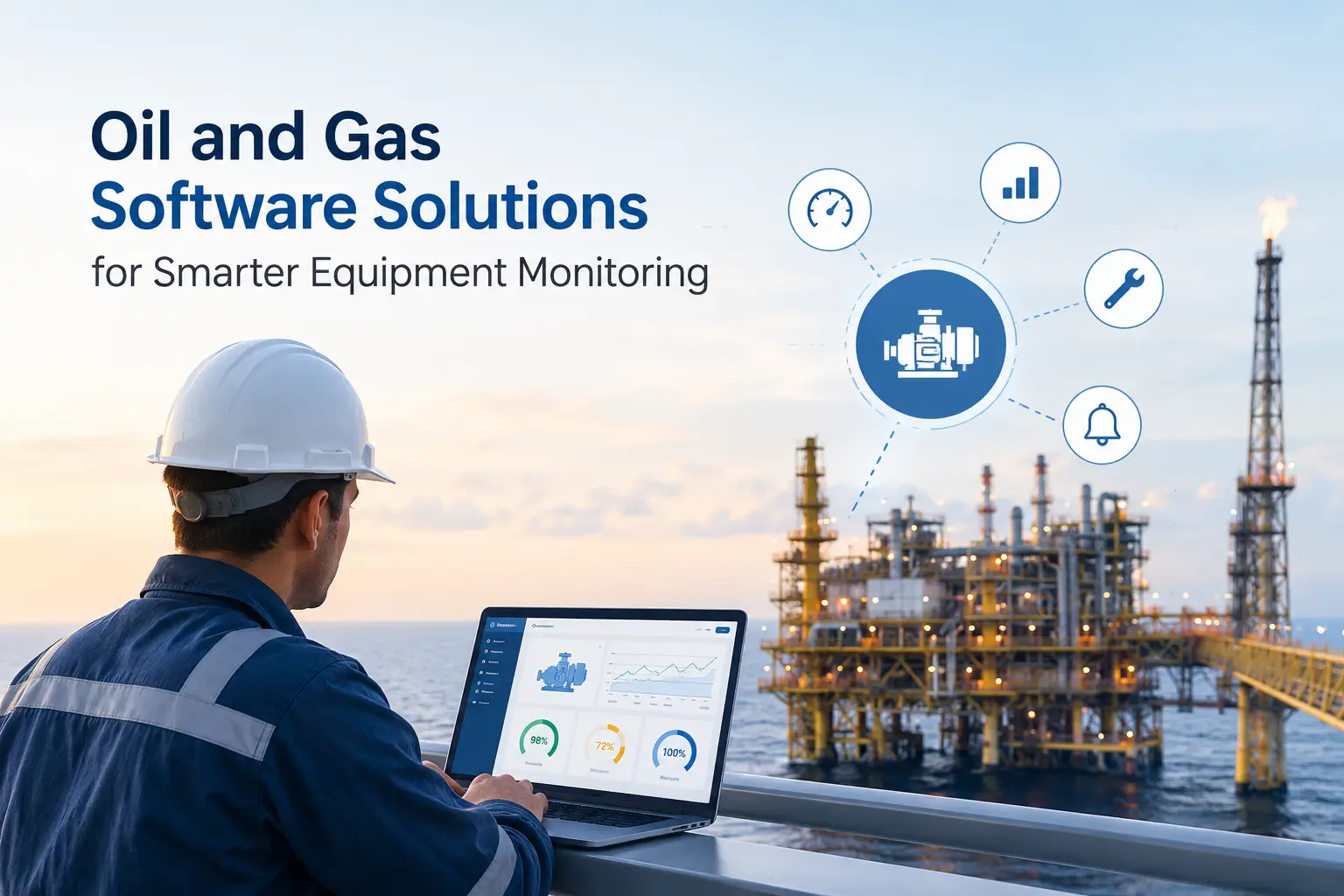
Oil and gas facilities run on equipment that simply cannot afford to fail without warning. A single unplanned shutdown on a pump, compressor, or turbine can halt production, drive up repair costs, and create serious safety risks. For decades, plants relied on scheduled inspections and reactive repairs to keep operations running. Today, that approach is being replaced by something far more capable: oil and gas software solutions that combine real-time sensor data, analytics, and automated alerts to monitor equipment health continuously.
This shift isn’t just a technology upgrade — it’s a change in how maintenance and operations teams make decisions. Instead of waiting for a machine to break down or servicing it on a fixed calendar, plant managers now have visibility into how equipment is actually performing, minute by minute. This blog explains what oil and gas software solutions are, why equipment monitoring matters, and how predictive, AI-driven platforms are reshaping reliability across the industry.
What Are Oil and Gas Software Solutions?
Oil and gas software solutions are digital platforms built to collect, process, and interpret data from plant equipment and processes. They connect sensors installed on critical assets to centralized dashboards, where engineers can track performance indicators like vibration, temperature, pressure, and energy consumption in real time.
At their core, these platforms do three things:
- Collect data from equipment using sensors and existing plant instrumentation
- Analyze that data using rules, statistical models, or machine learning to spot abnormal patterns
- Deliver insights and alerts so maintenance teams can act before a failure occurs
Rather than replacing engineers, this software gives them a clearer, continuous picture of asset health, allowing maintenance decisions to be based on evidence instead of guesswork.
Why Equipment Monitoring Matters in Oil & Gas
Oil and gas operations depend on complex, interconnected machinery, and any single point of failure can ripple through the entire process. A few realities make equipment monitoring especially critical in this industry:
- Unplanned downtime is expensive. A single unexpected outage can cost far more than the equipment repair itself once lost production is factored in.
- Equipment degrades gradually. Wear, corrosion, and fatigue build up over time — often invisible until a failure occurs.
- Maintenance costs add up. Over-servicing healthy equipment wastes labor and parts, while under-servicing risks catastrophic failure.
- Safety and continuity are non-negotiable. Equipment failures in oil and gas settings can pose serious safety hazards, not just financial ones.
Consistent, data-driven monitoring addresses all four issues by giving teams early warning signs long before a breakdown happens.
Key Equipment That Needs Monitoring
Not every asset requires the same level of oversight, but certain equipment categories are consistently high-priority for monitoring programs:
- Pumps
- Compressors
- Motors
- Turbines
- Valves
- Rotating equipment
- Other critical process equipment
These machines typically operate continuously under demanding conditions, which makes them more prone to wear — and more costly when they fail unexpectedly.
How Predictive Maintenance Improves Equipment Monitoring
Predictive maintenance is where oil and gas software solutions deliver the most value. Instead of servicing equipment on a fixed schedule, predictive maintenance for oil and gas relies on live condition data to determine when maintenance is actually needed. This typically involves:
- Vibration monitoring to detect misalignment, imbalance, or bearing wear
- Temperature monitoring to catch overheating before it damages components
- Energy and current monitoring to identify inefficiencies or abnormal load
- Condition-based alerts that flag deviations from normal operating ranges
- Failure prediction models that estimate when a component is likely to fail
- Historical trend analysis to understand long-term equipment behavior
Together, these capabilities allow teams to intervene at the right time — not too early, and not too late.
Key Features of Modern Equipment Monitoring Software
A strong oil and gas equipment monitoring platform generally includes:
- Real-time monitoring of asset performance
- AI/ML-based analytics to detect subtle abnormalities
- Automated alerts sent to the right teams instantly
- Equipment health indicators that summarize asset condition at a glance
- Trend visualization for spotting long-term performance shifts
- Remote monitoring so teams can track assets from anywhere
- Predictive insights that forecast potential failures
- Integration with existing industrial systems, such as SCADA or DCS platforms
Preventive vs. Predictive Maintenance
| Factor | Preventive Maintenance | Predictive Maintenance |
|---|---|---|
| Basis for Action | Fixed time intervals | Actual equipment condition |
| Risk of Over-Maintenance | Higher | Lower |
| Failure Detection | Scheduled inspections | Condition/data-based detection |
| Data Dependency | Low | High |
| Maintenance Timing | Calendar-based | Condition-based |
| Operational Insight | Limited | Continuous |
Both approaches have a role to play, but predictive maintenance for oil and gas offers a more precise, cost-effective way to manage critical assets as facilities scale up digital monitoring.
Benefits of Smarter Equipment Monitoring
Facilities that adopt modern equipment monitoring software typically see measurable improvements, including:
- Reduced unplanned downtime
- Earlier detection of developing faults
- Better maintenance planning and scheduling
- Improved equipment reliability
- Lower overall maintenance costs
- Higher asset utilization
- Greater visibility into plant-wide operations
How AI and IoT Support Oil & Gas Equipment Monitoring
The combination of AI and the Internet of Things (IoT) is what makes modern oil and gas automation software so effective. The general workflow looks like this:
Sensors → Data Collection → Analytics → Alerts → Maintenance Action
IoT sensors continuously capture data from equipment, while AI and machine learning models process that data to identify patterns that would be difficult — or impossible — for a human to catch manually. This combination allows teams to move from periodic inspections to continuous, always-on equipment health monitoring.
Implementation Considerations
Before adopting an oil and gas equipment monitoring platform, it’s worth evaluating a few practical factors:
- Existing equipment and sensors — what’s already in place versus what needs to be added
- Connectivity requirements — how data will move from the plant floor to the software
- Data quality — ensuring sensor data is accurate and consistent
- Integration with plant systems — compatibility with existing control and automation infrastructure
- Deployment model — choosing between on-premise and cloud-based solutions
- Cybersecurity — protecting operational data and connected systems
- Scalability — the ability to expand monitoring across additional assets or sites over time
Getting these fundamentals right early on makes it far easier to scale a monitoring program across an entire facility or multiple sites.
How eInnoSys Supports Oil & Gas Equipment Monitoring
eInnoSys offers a suite of tools purpose-built for oil and gas plants looking to modernize their approach to equipment health monitoring. XPump applies AI/ML-based analytics to monitor pump and motor health, helping teams catch early signs of wear before they escalate into failures. Beyond XPump, eInnoSys’s broader predictive maintenance solutions bring together equipment data analytics and industrial automation integration, giving plant and reliability teams a unified view of asset condition across their operations.
Conclusion
The oil and gas industry is steadily moving away from reactive, calendar-based maintenance toward intelligent, condition-based monitoring powered by real-time data and AI. This shift helps plants reduce downtime, extend equipment life, and make maintenance decisions based on actual asset condition rather than assumptions. As facilities continue their digital transformation, adopting the right oil and gas software solutions will be central to building a more reliable, efficient, and safer operation.
eInnoSys offers a practical way to explore this transition, with tools purpose-built for equipment health monitoring and predictive maintenance across oil and gas operations. Explore eInnoSys’s oil and gas software solutions to see how smarter equipment monitoring can support your facility’s reliability goals.


