
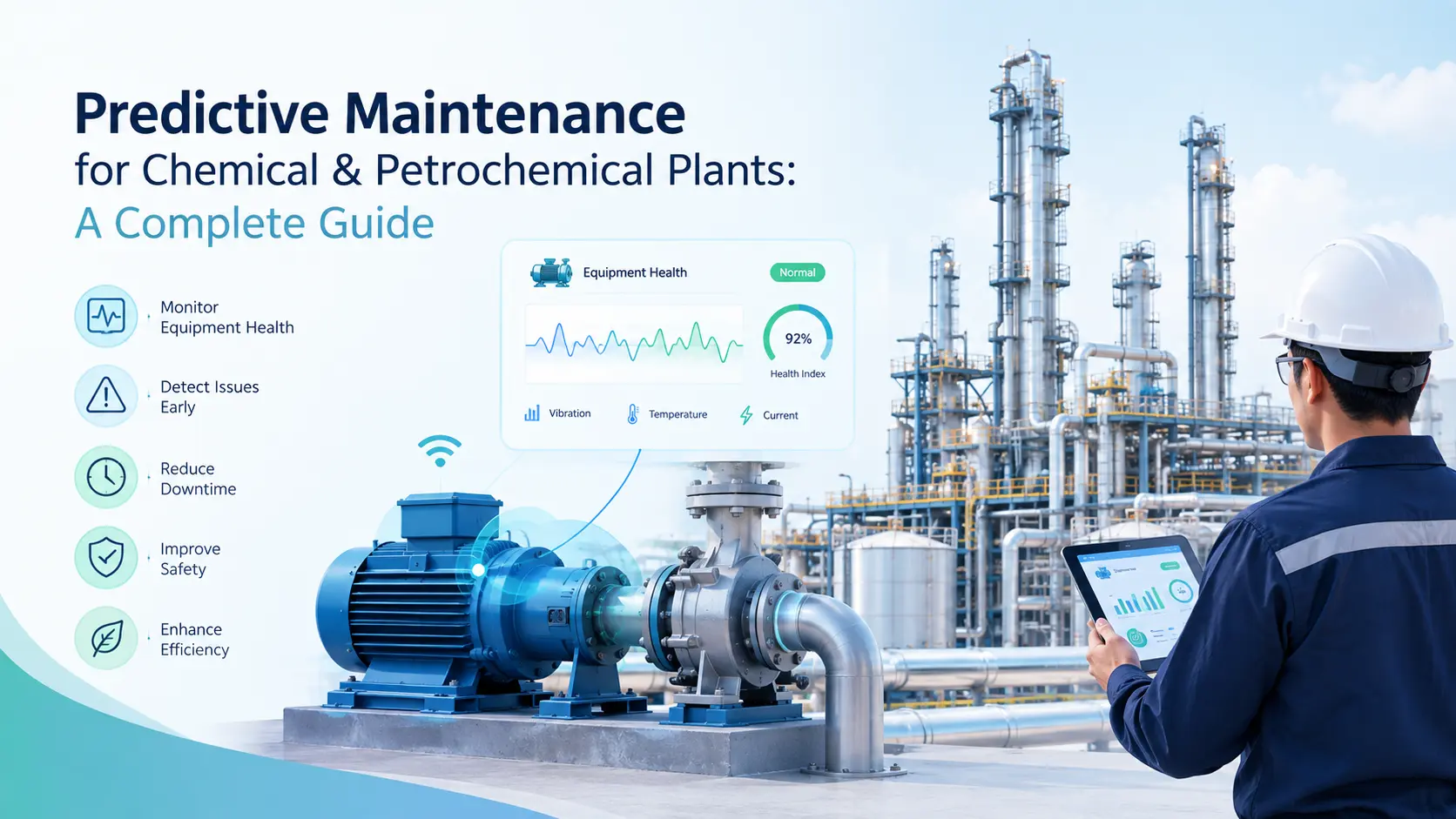
Unplanned downtime is one of the most expensive problems chemical and petrochemical plants face. A single compressor failure or pump seizure can halt an entire production line, trigger safety incidents, and cost hundreds of thousands of dollars in lost output. As plants push for higher reliability and tighter margins, predictive maintenance for chemical & petrochemical plants has moved from a “nice-to-have” to a core operational strategy.
This guide explains what predictive maintenance really means in a process-industry context, why it matters more here than almost anywhere else, and how plant leaders can build a practical roadmap to adopt it.
What Is Predictive Maintenance?
Predictive maintenance (PdM) uses real-time sensor data, machine learning, and condition monitoring to predict when equipment is likely to fail — before it actually does. Instead of servicing assets on a fixed calendar (preventive maintenance) or waiting for a breakdown (reactive maintenance), predictive maintenance relies on the actual health of the equipment to decide when intervention is needed.
For chemical and petrochemical operations, this typically means continuously tracking:
- Vibration signatures on pumps, compressors, and rotating equipment
- Temperature and thermal patterns across motors, bearings, and process lines
- Pressure fluctuations in pipelines and vessels
- Flow rate anomalies
- Oil and lubricant quality
- Acoustic and ultrasonic signals indicating leaks or cavitation
By analyzing these signals over time, predictive maintenance systems can flag developing faults — a bearing starting to wear, a seal beginning to degrade, a motor drawing abnormal current — weeks or months before failure.
Why Predictive Maintenance Matters in Chemical & Petrochemical Plants
Chemical and petrochemical facilities operate under conditions that make equipment failure far riskier than in most other industries.
- High-Consequence Failures
Pumps, compressors, and reactors in these plants often handle flammable, toxic, or corrosive materials. A failure isn’t just a production loss — it can mean a chemical release, fire, explosion, or environmental incident. Predictive maintenance directly supports EHS goals by catching degradation before it becomes a safety event. - Continuous, 24/7 Operations
Most chemical and petrochemical plants run continuously. There’s no natural downtime window to inspect equipment, which makes unplanned stoppages disproportionately expensive. Predictive maintenance allows teams to plan interventions during scheduled turnarounds instead of reacting mid-run. - Aging Asset Bases
Many petrochemical facilities operate equipment that is decades old. Condition monitoring gives reliability engineers visibility into how these aging assets are actually performing, rather than relying on generic maintenance intervals that may no longer be accurate. - Tight Margins and Global Competition
With volatile raw material costs and pressure on production efficiency, unplanned downtime has a direct, measurable impact on profitability. Reliability-focused plants consistently outperform reactive ones on cost per unit produced.
Key Equipment That Benefits Most from Predictive Maintenance
While predictive maintenance can be applied broadly, certain assets deliver the fastest ROI:
- Centrifugal and reciprocating pumps — among the most failure-prone assets in any chemical plant
- Compressors — critical to process continuity, expensive to replace, and failure-prone under high loads
- Motors and drives — early detection of bearing wear, misalignment, and electrical faults
- Heat exchangers — fouling and efficiency loss detection
- Cooling towers and fans — vibration and bearing monitoring
- Valves and actuators — detecting leakage or actuation delays before they affect process control
Solutions like XPump are purpose-built for exactly this use case — continuously monitoring pump health and surfacing early warning signs so maintenance teams can act before a failure disrupts production.
Core Technologies Behind Predictive Maintenance
- IoT Sensors and Condition Monitoring
Wireless vibration, temperature, and pressure sensors are installed directly on critical assets, streaming data continuously rather than relying on periodic manual rounds. - AI and Machine Learning
AI predictive maintenance models learn the normal operating signature of each asset and detect deviations that indicate developing faults — often catching patterns invisible to human inspection. - Digital Twins
Some advanced predictive maintenance platforms build digital models of equipment to simulate wear patterns and stress conditions, refining failure predictions over time. - Predictive Maintenance Software Platforms
Dashboards and alerting systems consolidate sensor data into actionable insights, prioritized by risk level, so maintenance teams know exactly which asset needs attention first.
Benefits of Predictive Maintenance for Chemical & Petrochemical Plants
| Benefit | Impact |
|---|---|
| Reduced Unplanned Downtime | Prevent unexpected shutdowns and improve production uptime. |
| Lower Maintenance Costs | Reduce unnecessary part replacements, emergency repairs, and labor costs. |
| Improved Safety | Detect potential equipment failures early and reduce the risk of hazardous incidents. |
| Extended Asset Life | Keep equipment operating within optimal parameters for longer. |
| Better Resource Planning | Schedule maintenance based on actual equipment condition rather than guesswork. |
| Regulatory & EHS Compliance | Minimize the risk of environmental, health, and safety violations through proactive monitoring. |
How to Build a Predictive Maintenance Strategy
- Identify Critical Assets First
Not every pump or motor needs continuous monitoring. Start with equipment where failure has the highest safety, environmental, or production impact. - Install the Right Sensors
Match sensor type (vibration, thermal, acoustic, pressure) to the failure modes most relevant to each asset class. - Establish Baselines
Predictive models need a “normal” operating signature for each asset before they can reliably flag anomalies. - Integrate with Maintenance Workflows
Condition monitoring data is only useful if it triggers action. Integrate alerts directly into your CMMS or maintenance scheduling system. - Train Teams on Data-Driven Decisions
Reliability engineers and maintenance managers need to trust and act on predictive insights, not just log them. - Scale Gradually
Start with a pilot on a handful of critical assets, prove ROI, then expand plant-wide.
For a broader view of how these strategies apply specifically to process industries, see eInnoSys’s Predictive Maintenance Solutions page, which outlines implementation approaches across different asset types.
Predictive Maintenance vs. Preventive Maintenance
| Factor | Preventive Maintenance | Predictive Maintenance |
|---|---|---|
| Basis for Action | Fixed time intervals | Actual equipment condition |
| Risk of Over-Maintenance | High | Low |
| Risk of Missed Failures | Moderate | Low |
| Cost Efficiency | Moderate | High |
| Data Dependency | Low | High |
Preventive maintenance isn’t obsolete — it still has a role for low-criticality assets. But for equipment where failure is costly or dangerous, predictive maintenance consistently delivers better outcomes.
Industry-Specific Considerations for Chemical & Petrochemical Plants
Chemical and petrochemical environments present unique monitoring challenges: hazardous area classifications (ATEX/IECEx zones), extreme temperatures, corrosive atmospheres, and equipment that can’t be taken offline for inspection. Predictive maintenance sensors and platforms deployed in these environments need to be explosion-proof or intrinsically safe, wireless where cabling is impractical, and capable of operating reliably in harsh conditions for years without maintenance themselves.
This is why generic industrial IoT platforms often fall short — chemical and petrochemical plants need solutions engineered specifically for process-industry conditions. eInnoSys’s Chemical & Petrochemical Industry Solutions page addresses these industry-specific requirements directly.
Conclusion
Predictive maintenance is no longer a competitive advantage reserved for a few advanced facilities — it’s becoming the baseline expectation for chemical and petrochemical plants that want to protect safety, control costs, and maximize uptime. By moving from reactive and calendar-based maintenance to condition-based, AI-driven strategies, plants can catch failures before they happen, extend asset life, and keep operations running safely and efficiently.
If your plant is ready to move toward a data-driven reliability strategy, eInnoSys offers predictive maintenance solutions purpose-built for the chemical and petrochemical industry — from pump-specific monitoring with XPump to full-scale condition monitoring platforms. Explore how eInnoSys can help your team reduce downtime and strengthen asset reliability at einnosys.com.


