
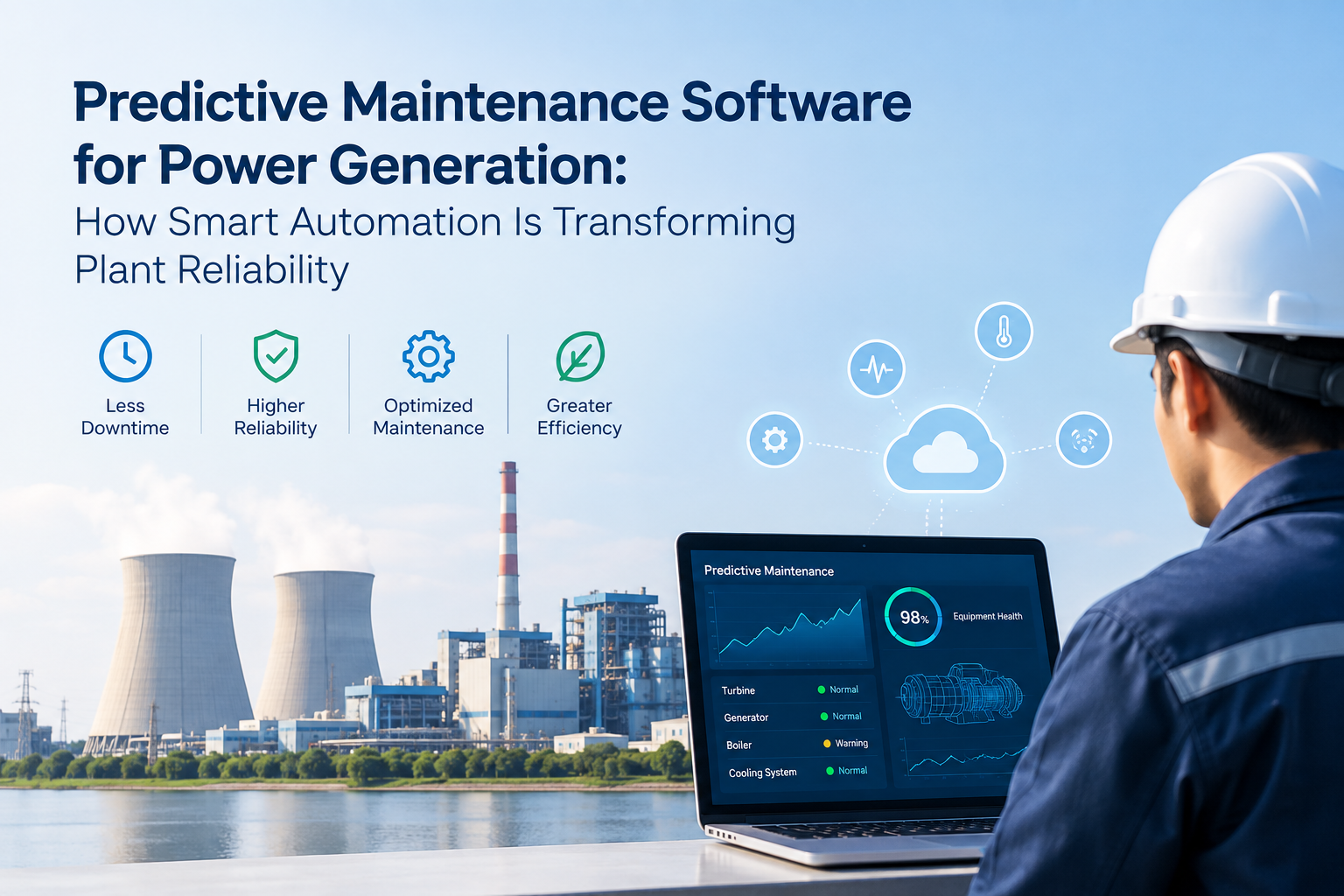
Power generation facilities operate on a simple but unforgiving rule: every hour of unplanned downtime costs money, disrupts the grid, and puts pressure on already-stretched maintenance teams. Turbines, boilers, generators, transformers, and pumps run around the clock under extreme thermal and mechanical stress, and even a single undetected fault can cascade into a costly outage. This is exactly why predictive maintenance software for power generation has moved from a “nice-to-have” to a core operational requirement for utilities, IPPs (independent power producers), and industrial energy teams across the USA and Europe.
Traditional maintenance strategies — reactive repairs after a breakdown, or calendar-based preventive maintenance — are no longer enough to keep pace with tightening efficiency targets, aging infrastructure, and rising regulatory expectations. Smart automation, powered by AI/ML algorithms, IoT sensors, and real-time condition monitoring, gives plant operators the ability to see problems before they happen, not after.
In this blog, we’ll break down how predictive maintenance software works in power generation environments, the technologies behind it, the measurable benefits it delivers, and how facilities can begin their transition toward a smarter, more reliable operational model.
What Is Predictive Maintenance Software for Power Generation?
Predictive maintenance (PdM) software is a digital solution that continuously analyzes equipment health data — vibration, temperature, pressure, current draw, acoustic signatures, and more — to forecast when a machine is likely to fail. Instead of servicing equipment on a fixed schedule or waiting for a breakdown, maintenance teams intervene only when the data indicates a real risk.
For power generation specifically, this means monitoring critical rotating and stationary assets such as:
- Steam and gas turbines
- Generators and alternators
- Boiler feed pumps and cooling water pumps
- Transformers and switchgear
- Compressors, fans, and motors
- Cooling towers and heat exchangers
By combining sensor data with machine learning models trained on historical failure patterns, predictive maintenance software can flag early signs of bearing wear, misalignment, cavitation, insulation degradation, and other precursors to failure — often weeks before a human inspector would notice anything unusual.
The Technology Stack Behind Smart Automation in Power Plants
- IoT Sensors and Edge Devices
IoT sensors installed on rotating machinery and electrical assets capture continuous streams of vibration, temperature, ultrasonic, and current data. Edge devices pre-process this data on-site, reducing latency and bandwidth load before sending relevant signals to the cloud or central monitoring platform. - AI and Machine Learning Models
This is where AI-powered predictive maintenance distinguishes itself from basic condition monitoring. Machine learning algorithms learn the normal operating signature of each asset and detect subtle deviations that indicate developing faults — long before thresholds or alarms would trigger under a traditional SCADA setup. - Real-Time Dashboards and Alerts
Modern power plant automation software presents actionable insights through centralized dashboards. Reliability engineers and maintenance managers get real-time visibility into asset health scores, remaining useful life (RUL) estimates, and prioritized work orders — all in one place. - Integration with CMMS/EAM Systems
To be genuinely useful, predictive maintenance platforms need to plug into existing Computerized Maintenance Management Systems (CMMS) or Enterprise Asset Management (EAM) tools, automatically generating work orders when anomalies are detected. This closes the loop between detection and action.
A strong example of this kind of integrated approach is XPump – AI/ML Predictive Maintenance, purpose-built to monitor pump health using AI/ML models that detect cavitation, bearing degradation, and seal failures before they escalate into costly breakdowns — a critical capability given how pump failures remain one of the leading causes of unplanned outages in power plants.
Why Power Plants Are Adopting Predictive Maintenance Software
- Reducing Unplanned Downtime
Unplanned outages in power generation are extraordinarily expensive, factoring in lost generation revenue, penalty clauses, emergency repair costs, and reputational impact with grid operators. Predictive analytics for power plants shifts maintenance from reactive to proactive, catching faults during scheduled windows rather than mid-operation failures. - Extending Asset Lifespan
Turbines, generators, and transformers represent massive capital investments. Continuous equipment health monitoring helps operators avoid the kind of repeated stress cycles and secondary damage that shorten asset life, maximizing return on these high-value assets. - Optimizing Maintenance Costs
Calendar-based preventive maintenance often results in either over-maintaining healthy equipment or under-maintaining at-risk equipment. Condition-based, data-driven maintenance ensures resources are spent only where and when they’re actually needed — reducing unnecessary part replacements and labor hours. - Improving Worker Safety
Many power generation assets operate in high-temperature, high-pressure, or high-voltage environments. Remote condition monitoring reduces the need for manual inspections in hazardous zones, improving overall workplace safety. - Supporting Regulatory and ESG Compliance
Utilities across the US and Europe face increasing pressure to demonstrate operational efficiency and emissions accountability. Reliable, well-maintained equipment runs more efficiently, directly supporting sustainability and compliance goals.
Key Features to Look for in Power Plant Monitoring Software
When evaluating industrial predictive maintenance software, plant managers and asset managers should look for:
- Multi-asset compatibility — support for turbines, pumps, motors, transformers, and auxiliary systems
- AI-driven anomaly detection — not just threshold alarms, but pattern-based early warning
- Scalable IoT sensor integration — wired and wireless sensor compatibility across brownfield and greenfield sites
- Remaining Useful Life (RUL) predictions — data-backed forecasts, not guesswork
- CMMS/EAM and SCADA integration — seamless connection to existing workflows
- Cloud and on-premise deployment options — flexibility based on plant IT/OT policies
- Customizable dashboards and reporting — tailored views for operators, reliability engineers, and management
Solutions like eInnoSys’s Predictive Maintenance Solutions are designed around these exact requirements, offering configurable AI models that adapt to different asset classes and plant configurations rather than forcing a one-size-fits-all approach.
Real-World Impact: What Smart Automation Delivers
Facilities that implement smart automation and predictive maintenance typically report:
- 20–30% reduction in unplanned downtime
- 10–20% lower overall maintenance costs
- Extended equipment lifespan through early fault correction
- Faster root-cause diagnosis using historical trend data
- Improved compliance reporting through automated health logs
These outcomes compound over time. As more operational data flows into the AI models, prediction accuracy improves, turning the maintenance program into a continuously self-improving system rather than a static tool.
Getting Started with Predictive Maintenance in Your Power Plant
Transitioning to a predictive maintenance model doesn’t require replacing your entire infrastructure overnight. A practical rollout typically follows these steps:
- Identify critical assets — start with equipment that has the highest downtime cost or failure frequency.
- Install IoT sensors on priority assets for vibration, temperature, and current monitoring.
- Deploy AI/ML-based analytics software to establish baseline health signatures.
- Integrate with existing CMMS/SCADA systems to automate alerts and work orders.
- Scale gradually across additional assets and plant sections as ROI is validated.
This phased approach allows plant managers to demonstrate value quickly, build internal buy-in, and expand smart automation coverage without operational disruption.
Conclusion
As power generation facilities across the USA and Europe face rising pressure to reduce downtime, control costs, and meet efficiency targets, predictive maintenance software is no longer optional — it’s foundational to modern plant operations. By combining IoT sensors, AI/ML analytics, and real-time monitoring, power plants can shift from reactive firefighting to proactive, data-driven reliability management.
eInnoSys specializes in delivering exactly this kind of smart automation and predictive maintenance capability for the power generation industry, with solutions like XPump built specifically to protect critical rotating assets. To explore how AI-powered predictive maintenance can improve reliability at your facility, visit eInnoSys’s Power Generation Industry page and see how their solutions align with your plant’s specific maintenance challenges.


