
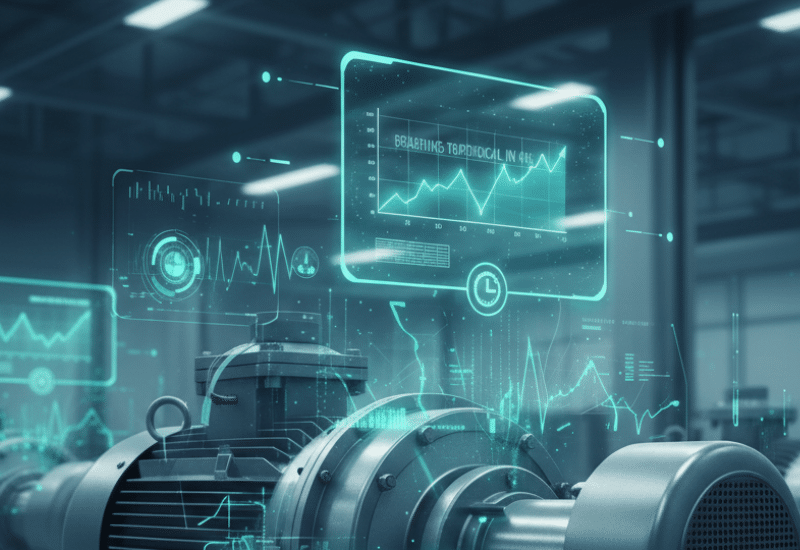
Quick Summary
- Revolutionizing Reliability: Predictive maintenance for pumps (PdM) shifts operations from reactive chaos to data-driven uptime.
- The $50B Problem: Unplanned equipment downtime costs industrial manufacturers an estimated $50 billion annually according to ARC Advisory Group.
- Smart Tech Fusion: PdM utilizes advanced IoT sensors and AI-driven condition monitoring to track asset health in real-time.
- Actionable Foresight: By analyzing continuous vibration, temperature, and pressure parameters, facilities predict faults weeks in advance.
- Financial Bottom Line: Shifting to condition-based repairs dramatically extends asset lifespan, optimizes component tracking, and drops overhead costs.
Unplanned equipment downtime is a colossal drain on industrial operations, a problem that plagues facilities managers and process engineers globally. It’s a costly game of catch-up, where every unexpected shutdown chips away at profitability and production schedules. At the center of this seismic shift sits predictive maintenance for pumps—a fundamental change in how industries manage their most critical assets to escape the expensive cycle of break-fix.
The future of industrial operations hinges on visibility and foresight, especially for assets as foundational as pumps. Pumps are the heart of nearly every industrial process, from oil and gas to wastewater and chemical processing. When they fail, the entire operation can grind to a halt. This is why adopting advanced smart pump monitoring techniques is no longer optional but a necessity for competitive advantage.
The Paradigm Shift: Why Time-Based Maintenance Isn’t Enough
For decades, many facilities relied on preventive maintenance, scheduling inspections and part replacements based on elapsed time or runtime hours. While this was an improvement over reactive maintenance (waiting for a breakdown), it’s fundamentally inefficient because it lacks insight into the actual condition of the equipment.
The Shortcomings of the Old Ways:
- Wasted Resources: Replacing perfectly good parts leads to unnecessary inventory costs and labor expenditure.
- Over-Maintenance Risk: Opening up a pump for inspection can sometimes introduce contaminants or assembly errors, paradoxically increasing the risk of failure.
- Hidden Failures: Premature failures caused by external factors (e.g., pipe misalignment, cavitation) are completely missed by a time-based schedule, as the maintenance doesn’t address the root cause of the problem.
The Core Technology of Pump Predictive Maintenance
The transition to data-driven maintenance is intrinsically linked to advancements in industrial maintenance technology, particularly the maturation of the Industrial Internet of Things (IIoT). Ruggedized sensor arrays form the pump’s nervous system, constantly reporting on vital signs.
What equipment is recommended for accurate pump vibration analysis?
Every rotating piece of equipment produces a distinct vibration signature. When components wear or misalign, that signature shifts. For accurate, actionable pump diagnostics, technicians use:
- Piezoelectric Accelerometers: Industrial standards for capturing high-frequency vibration signals on pump bearings and motor casings.
- Triaxial Vibration Sensors: Capture continuous dynamic data along three spatial axes (horizontal, vertical, axial) to expose complex fault frequencies.
- Wireless IoT Transducers: Scale easily across distributed assets, streaming high-resolution acceleration logs directly to analytical edge nodes.
- Portable Route Analyzers: Handheld diagnostic tools equipped with fast Fourier transform (FFT) processors used by engineers for specialized spectrum troubleshooting.
Beyond vibration spectrum monitoring, an integrated condition monitoring network utilizes multiple specialized hardware variables:
- Temperature Sensors: Detect thermal friction abnormalities in motor windings and bearing assemblies before catastrophic seizure.
- Acoustic Emission Sensors: Capture ultrasonic frequencies to identify structural chattering from internal fluid bypass or early-stage dry running.
- Pressure and Flow Sensors: Monitor differential pressure to immediately flag suction constraints, line blockages, or impeller fouling.
The Role of AI and Machine Learning in Pump Failure Prediction
Analyzing massive influxes of sensor data manually is impossible. AI for pump monitoring establishes an operational baseline, learning the healthy signatures of individual assets under varying loads. The AI engine continuously analyzes incoming sensor streams for subtle deviations—such as a micro-increment in bearing temperatures—predicting faults long before a human operator notices, allowing for controlled, scheduled repairs instead of emergency shutdowns.
Next-Gen Advancements in Pump Maintenance Technology
The engineering domain of fluid dynamics maintenance is undergoing rapid digital transformation, heavily expanding capability sets across both specialized gas infrastructure and universal process facilities.
What are the latest technologies used in gas station pump maintenance?
Retail and commercial gas station infrastructure leverages advanced environmental and mechanical telemetry. Key systems include Automatic Tank Gauging (ATG) systems that track fuel/water interfaces, Electronic Line Leak Detectors (ELLD) that enforce automated pressure-drop safety shutdowns, predictive flow meters that detect fuel filter clogging, and vacuum-assist sensors verifying strict vapor recovery system compliance.
What are the latest advancements in pump technology for technicians?
Field technicians are transitioning into digital supervisors due to embedded machinery enhancements:
- Edge-AI Processing Hardware: Sensors compute vibration fast Fourier transforms (FFTs) directly on the physical pump frame, bypassing latency.
- Augmented Reality (AR) HUDs: Technicians overlay system wiring schematics and teardown blueprints directly over a live pump casing via mobile lenses or AR glass matrices.
- Integrated Smart Seals: Mechanical seals embedded with micro-pressure sensors alert field teams before dangerous chemical leaks manifest.
Maximizing Industrial Pump Reliability
Can monitoring electrical pumps help prevent failures and reduce maintenance costs?
Yes, absolutely. Monitoring electrical variables via Motor Current Signature Analysis (MCSA) serves as a primary defense against industrial equipment degradation. It saves massive overhead through:
- Dual Mechanical/Electrical Visibility: Tracking magnetic flux and current anomalies exposes stator degradation, balance issues, and eccentricities weeks before catastrophic failure occurs.
- Instant Cavitation Mitigation: Catching high-frequency pressure and electrical current fluctuations instantly limits destructive impeller erosion.
- Quantifiable Cost Reductions: Transitioning from calendar intervals to real-time data trends reduces unscheduled system downtime by 25–35% and lowers pump overhaul costs by up to 30%.
Remote diagnostics empower Process Engineers to monitor distributed pumping systems from a centralized control room. When an alert triggers, the network pinpoints specific operational frequencies, ensuring technicians arrive on-site with exact tools and specific execution paths, accelerating the Mean Time to Repair (MTTR).
Best Predictive Maintenance Tools Feature Criteria:
- CMMS/EAM Integration: Automated creation of maintenance work tickets based on real-time anomaly risks.
- Intuitive Interfaces: Translating deep spectrum sensor analysis graphs into clean, color-coded status indices.
- Targeted Implementation: Phased rollouts prioritizing high-criticality assets guarantee immediate returns on asset operations.
Predictive vs. Preventive Maintenance ROI Dynamics
| Metric | Preventive Maintenance (PM) | Predictive Maintenance (PdM) |
|---|---|---|
| Maintenance Cost | Higher (Due to unnecessary scheduled overhauls) | Lower (Condition-based, just-in-time repairs) |
| Parts Inventory | Higher (Constant stocking for schedule expectations) | Lower (On-demand part sourcing via early trends) |
| System Downtime | Frequent scheduled stops + unexpected breakdowns | Optimized windows (Unplanned halts near zero) |
| Asset Lifespan | Standard limits (Often disrupted by installation errors) | Extended (Avoiding catastrophic mechanical stress) |
| Fault Diagnosis | Manual periodic inspections / visual tracking | Automated, continuous, cloud AI diagnostics |
The era of predictive maintenance for pumps has arrived, fundamentally reshaping expectations for asset management. By embracing industrial pump reliability technologies like IoT, advanced sensor data, and AI, companies can move beyond reactive chaos and rigid schedules. The typical ROI for a well-implemented PdM program ranges from **3:1 to 5:1** within the first few years (McKinsey, 2023), ensuring higher operational efficiency, extended asset life, and a significant boost to the bottom line.


