
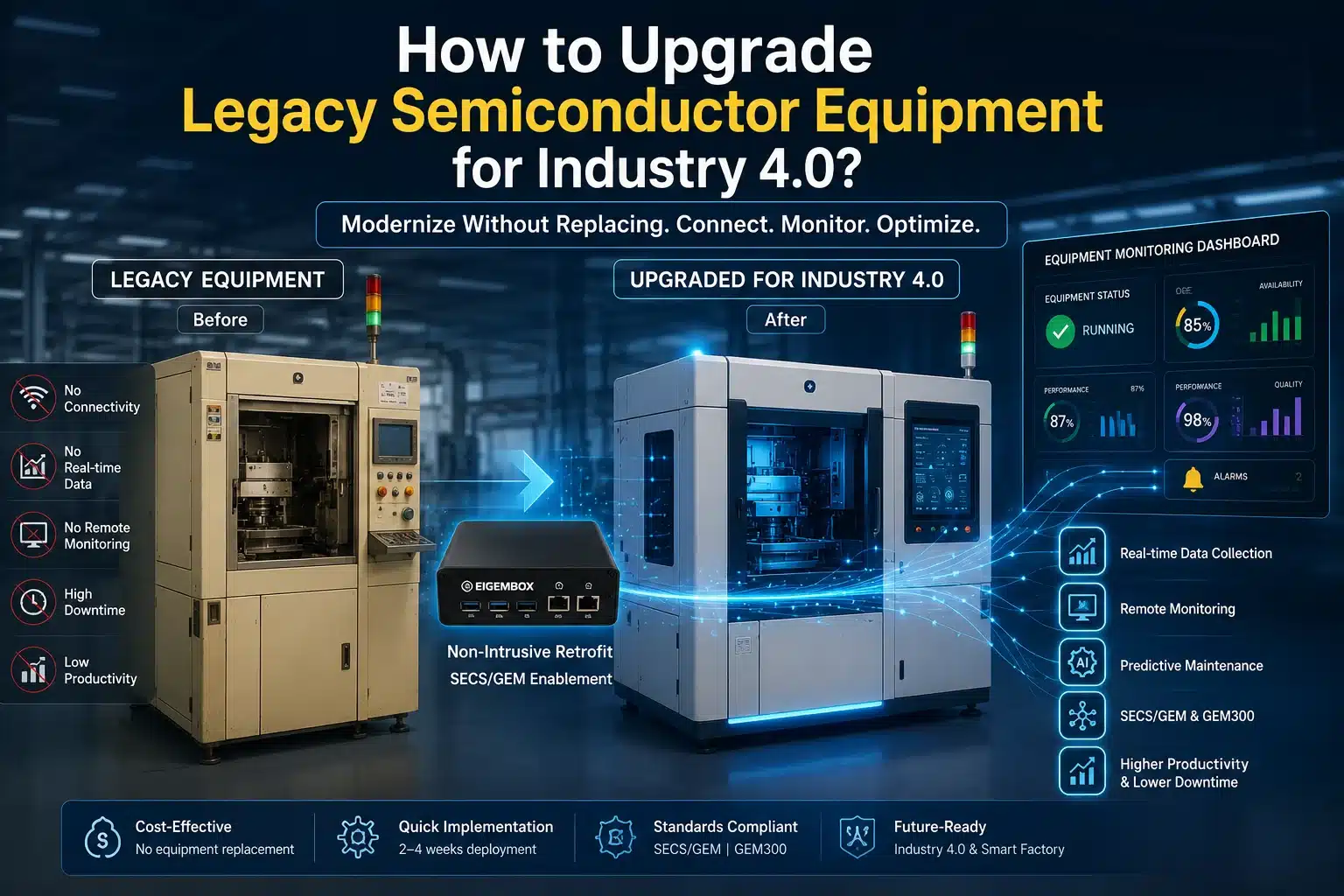
Walk onto the floor of almost any wafer fab or OSAT facility and you’ll find it: a lithography tool, wire bonder, lapping system, or test handler that’s been running reliably for 15-20 years — fully depreciated, mechanically sound, and completely invisible to your MES. It has no SECS/GEM interface, no way to report OEE, no way to feed data into your predictive maintenance or yield analytics systems. It just runs, silently, outside the reach of every Industry 4.0 initiative built around it.
This is one of the most common — and most misunderstood — problems in semiconductor manufacturing today. The instinct is to assume the only path to Industry 4.0 compliance is replacing that equipment. In reality, most legacy tools can be upgraded for Industry 4.0 without touching the controller, without OEM involvement, and without the six-figure cost of a new tool. This guide explains exactly how.
1. Why Legacy Equipment Is the Biggest Blocker to Industry 4.0
Industry 4.0 in semiconductor manufacturing depends on one thing above all else: data. Real-time equipment data feeding MES systems, automated material handling (AMHS), fault detection and classification (FDC), and AI-based predictive maintenance all assume that every tool on the floor can talk to the factory host.
Legacy 150mm and 200mm tools — and even some early 300mm systems — were built before this was standard. Many predate SECS/GEM adoption entirely, or only support partial, unreliable implementations. The result is a two-tier fab: modern tools generating rich data streams, and legacy tools operated almost manually, tracked on paper logs or spreadsheets, invisible to real-time dashboards.
For OSAT facilities in particular, where equipment fleets often mix decades of vintage across multiple process types, this gap isn’t a minor inconvenience — it’s the single biggest obstacle standing between the current operation and a genuine Industry 4.0 factory.
2. What “Upgrading” Legacy Equipment Actually Means
When people say “upgrade legacy equipment for Industry 4.0,” they usually mean enabling four capabilities that modern tools have natively:
- Standardized host communication — SECS/GEM (and for 300mm, GEM300/E87) so the tool can talk to MES/EAP systems in a language they already understand.
- Real-time data collection — Automated capture of process parameters, alarms, events, and recipes instead of manual logging.
- Material handling automation — E84/E87 protocol support so the tool can interface with AMHS, OHT, AGV, or RGV systems.
- Downstream analytics readiness — Once data is flowing in a standard format, it becomes usable for FDC, OEE dashboards, and AI-based predictive maintenance.
Critically, none of these four capabilities require replacing the tool’s core controller or process software. They’re a communication and data layer added around the equipment — which is exactly what makes non-intrusive retrofit solutions possible.
3. The Traditional (Expensive, Risky) Upgrade Paths
Before non-intrusive retrofit solutions existed, fabs had three options, and none of them were good:
Replace the equipment. Cost-prohibitive for a fully depreciated tool that still performs its process function reliably, and disruptive to qualified process recipes.
Upgrade SECS/GEM via the OEM. Often costs up to $100,000 per tool, requires significant equipment downtime, and — for tools whose original manufacturer has merged, been acquired, or gone out of business — may not even be possible.
Use third-party I/O-based retrofit kits. These typically require deep knowledge of the equipment’s internals, physically intrusive wiring changes, and carry real risk of disrupting a qualified, validated process.
For a fully depreciated legacy tool that is still mechanically and functionally reliable, all three of these paths are frequently unviable — financially, operationally, or both. This is precisely the gap that non-intrusive, plug-and-play retrofit technology was built to close.
4. The Non-Intrusive Retrofit Approach: How It Works
The modern alternative is a non-intrusive gateway device — a compact hardware unit that sits alongside the equipment and connects through ports the tool already has: its display output (VGA, DVI, or HDMI) and, optionally, its keyboard/mouse ports (USB or PS/2).
Here’s the key idea: the gateway doesn’t modify the equipment’s controller, firmware, or process software at all. Instead, it observes the tool’s existing display output and interface, translates that into standard SECS/GEM (or Modbus/OPC) messages, and exposes that data and control layer to the factory host. From the tool’s perspective, nothing has changed. From the factory host’s perspective, the tool now behaves like a fully GEM-compliant piece of modern equipment.
This “watch the screen, translate the protocol” approach is why retrofit projects that would traditionally take months of custom engineering can now be completed in a matter of hours of physical installation, plus a day or two of configuration — without process requalification, without OEM permission, and without downtime risk to the qualified recipe.
5. SECS/GEM and GEM300 Integration Explained
SECS/GEM (SEMI Equipment Communication Standard / Generic Equipment Model) is the industry-standard protocol suite that governs how semiconductor equipment communicates with factory host systems — covering everything from alarm reporting and event handling to recipe management and remote command execution. It’s built on SECS-I (RS-232, older/slower) and SECS-II/HSMS (Ethernet-based, faster), with GEM defining the standard behavioral model on top.
For 300mm fabs, GEM300 extends this further with a set of additional SEMI standards specifically for automated wafer handling and control:
- SEMI E87 — Carrier management (how the tool tracks and reports wafer carrier movement)
- SEMI E90 — Substrate tracking
- SEMI E94 — Control job management
- SEMI E116 — Equipment performance tracking
A tool that supports full GEM300 compliance can participate in automated material handling — communicating with Overhead Hoist Transport (OHT), AGVs, and RGVs for lot delivery without manual intervention — a baseline requirement for any modern automated fab.
The practical upshot: enabling SECS/GEM and GEM300 on a legacy tool isn’t just a “nice to have” data feed — it’s what allows that tool to fully participate in automated production flow rather than remaining a manual island in an otherwise automated fab.
6. Beyond Connectivity: MES Integration, FDC, and Predictive Maintenance
Getting a legacy tool talking SECS/GEM is the foundation, but the real Industry 4.0 payoff comes from what that connectivity unlocks downstream:
- MES/EAP integration — Recipe validation, automated data collection, and elimination of manual data entry errors.
- Fault Detection and Classification (FDC) — Real-time monitoring of critical process parameters (RF power, pressure, temperature) with automated early anomaly detection, instead of relying on operators noticing a problem after the fact.
- OEE visibility — Real-time equipment performance tracking replaces manual, after-the-shift reporting.
- AI-based predictive maintenance — Once equipment data is flowing continuously and reliably, it becomes usable input for machine learning models that predict failures before they happen — extending the life of legacy tools even further and reducing unplanned downtime on assets that are, by definition, harder and slower to replace.
This is the real strategic value of legacy equipment modernization: it’s not just about compliance with a data standard, it’s what makes an entire category of your existing fleet finally usable for the analytics and automation initiatives the rest of the fab already benefits from.
7. Step-by-Step: How to Plan a Legacy Equipment Upgrade
Inventory your non-connected fleet. Identify every tool without native or reliable SECS/GEM connectivity, and prioritize by production criticality and OEM support status (especially tools from manufacturers that have merged or exited the market).
Define the data and automation requirements. Do you need basic data collection, full GEM300/E87 material handling automation, or FDC-level parameter monitoring?
Evaluate retrofit vs. replacement for each asset. For fully depreciated, mechanically reliable tools, retrofit is almost always the lower-cost, lower-risk path.
Select a non-intrusive integration solution. Confirm SEMI standards compliance (E4, E5, E30, E37, and E87/E90/E94/E116 if GEM300 is required).
Pilot on one or two tools. Validate installation time, configuration effort, and data quality before scaling fleet-wide.
Integrate with MES/EAP and downstream analytics. Connect the newly GEM-compliant data stream into existing FDC, OEE, and predictive maintenance systems.
Scale across the fleet. Roll out to the remaining legacy tools using the validated configuration and process from the pilot.
8. Common Objections and Risks Addressed
“Will this void our OEM warranty or require OEM approval?”
Non-intrusive retrofit solutions connect via existing display and keyboard/mouse ports and don’t modify the equipment’s controller, firmware, or core software — so they typically require no OEM license, upgrade kit, or permission. This is particularly valuable for tools whose original manufacturer has merged, been acquired, or no longer exists.
“Will this disrupt our qualified process or require requalification?”
Because the retrofit approach doesn’t alter the machine’s controller or process software, the underlying process remains untouched — it’s a communication layer added alongside the equipment, not a modification to it.
“How long will installation and integration take?”
Physical installation is typically measured in hours per tool, depending on complexity. Initial configuration through a web-based interface typically takes anywhere from several hours to 1-2 days. Full SECS/GEM integration projects, done this way, commonly complete in 2-4 weeks — compared to several months for a from-scratch or OEM-led implementation.
“Can it handle 300mm GEM300 requirements, not just older 200mm tools?”
Yes — solutions built for this purpose can support full GEM300 communication standards, including SEMI E87, E90, E94, and E116, for 300mm wafer handling environments, in addition to legacy 150mm/200mm tools.
9. How eInnoSys Solves This: EIGEMBox and Related Solutions
eInnoSys offers a full suite of solutions purpose-built for exactly this challenge, developed specifically for semiconductor fabs and OEMs modernizing legacy equipment.
EIGEMBox is a patented, plug-and-play solution that adds SECS/GEM, Modbus, or OPC capability to legacy semiconductor equipment — without any hardware or software installation on the tool itself. Installation is as simple as connecting the equipment’s existing display cable (VGA, DVI, or HDMI) and, optionally, its keyboard/mouse ports (USB or PS/2), enabling full host communication and remote control. It has been successfully deployed to enhance SECS/GEM communication with full parameter exchange and reduced latency, enable AMHS (E84/E87) integration in 200mm fabs, and extract non-standard data beyond traditional SECS/GEM limitations for advanced monitoring and automation.
EIGEMEquipment SDK is a complementary SEMI standards-compliant (E30, E4, E5, E37) SDK for equipment OEMs building SECS/GEM compliance directly into new tool designs — with roughly 80% of core functionality available out of the box and no deep protocol expertise required.
Real deployments illustrate the range: EIGEMBox has enabled SECS/GEM compliance on legacy tools including the Shinkawa UTC-200 wire bonder, the Peter Wolters AC 2000-P2 lapping/polishing system, and the Canon FPA 5000 ES3 lithography system — as well as Honeywell’s broader legacy fleet, where the retrofit unlocked FDC and predictive maintenance capability that analog instrumentation had made impossible.
Because EIGEMBox requires no OEM license, upgrade kit, or support contract, it’s especially well suited to fabs and OSAT facilities managing a mixed fleet where some original equipment manufacturers are no longer in business or no longer supporting older tool generations.
Talk to eInnoSys about your legacy equipment fleet →
10. Choosing the Right Legacy Modernization Partner
When evaluating a legacy equipment upgrade partner, look for:
- True non-intrusive integration — no modification to the equipment’s controller or core software.
- Full SEMI standards compliance — SECS-I, SECS-II/HSMS, GEM (E30), and GEM300 standards (E87/E90/E94/E116) if 300mm automation is required.
- No OEM dependency — critical for tools from manufacturers that have merged, been acquired, or exited the market.
- Proven deployment history — ask for case studies on equipment types similar to yours (lithography, bonding, lapping/polishing, test handling).
- Speed to production — realistic timelines (weeks, not months) with a clear pilot-to-scale path.
- Downstream integration capability — the ability to feed data into your existing MES/EAP, FDC, OEE, and predictive maintenance systems, not just a standalone dashboard.
- Compliance and validation support — implementation, testing, and certification support to ensure the integration meets your fab’s automation team requirements.
ROI: What Legacy Equipment Upgrades Actually Save
The financial case for retrofitting over replacing is usually straightforward once you lay out the comparison:
| Upgrade Approach | Typical Cost | Typical Timeline | Process Risk |
|---|---|---|---|
| Replace with New Equipment | Very high (new tool purchase + installation + qualification) | Several months | High – New equipment qualification, production disruption, and operator training required |
| OEM SECS/GEM Upgrade | Up to ~$100,000 per tool | Several months, including equipment downtime | Moderate – Recipe requalification and software/controller modifications may be required |
| Non-Intrusive Retrofit (e.g., EIGEMBox) | A fraction of the OEM upgrade cost | 2–4 weeks | Minimal – No changes to the equipment controller or application software, reducing implementation risk |
Beyond the direct cost comparison, the upgrade unlocks value that’s harder to put a single number on but often matters more: extended usable life of fully depreciated assets, elimination of manual data logging errors, real-time OEE visibility, and — once data is flowing — access to FDC and AI-based predictive maintenance capabilities that were previously simply not possible on that tool.
For fabs and OSAT facilities carrying a large legacy fleet, this math typically makes retrofit the default first option, with replacement reserved for tools that are genuinely reaching mechanical end-of-life.


