
Every tool that ships into a modern fab eventually faces the same acceptance question: can the host talk to it, and does it behave the way the factory expects? SECS/GEM is how that conversation happens. It is also where a surprising amount of project time disappears, usually because the equipment side of the interface was scoped late or scoped loosely.
Part of the confusion starts with vocabulary. Equipment OEMs evaluating options run into a SECS/GEM driver, SECS/GEM software, a SECS/GEM SDK, and a SECS/GEM interface — sometimes describing the same product, sometimes describing very different levels of functionality. Vendors do not use these words consistently, and no SEMI standard defines them as product categories.
What Is a SECS/GEM Driver?
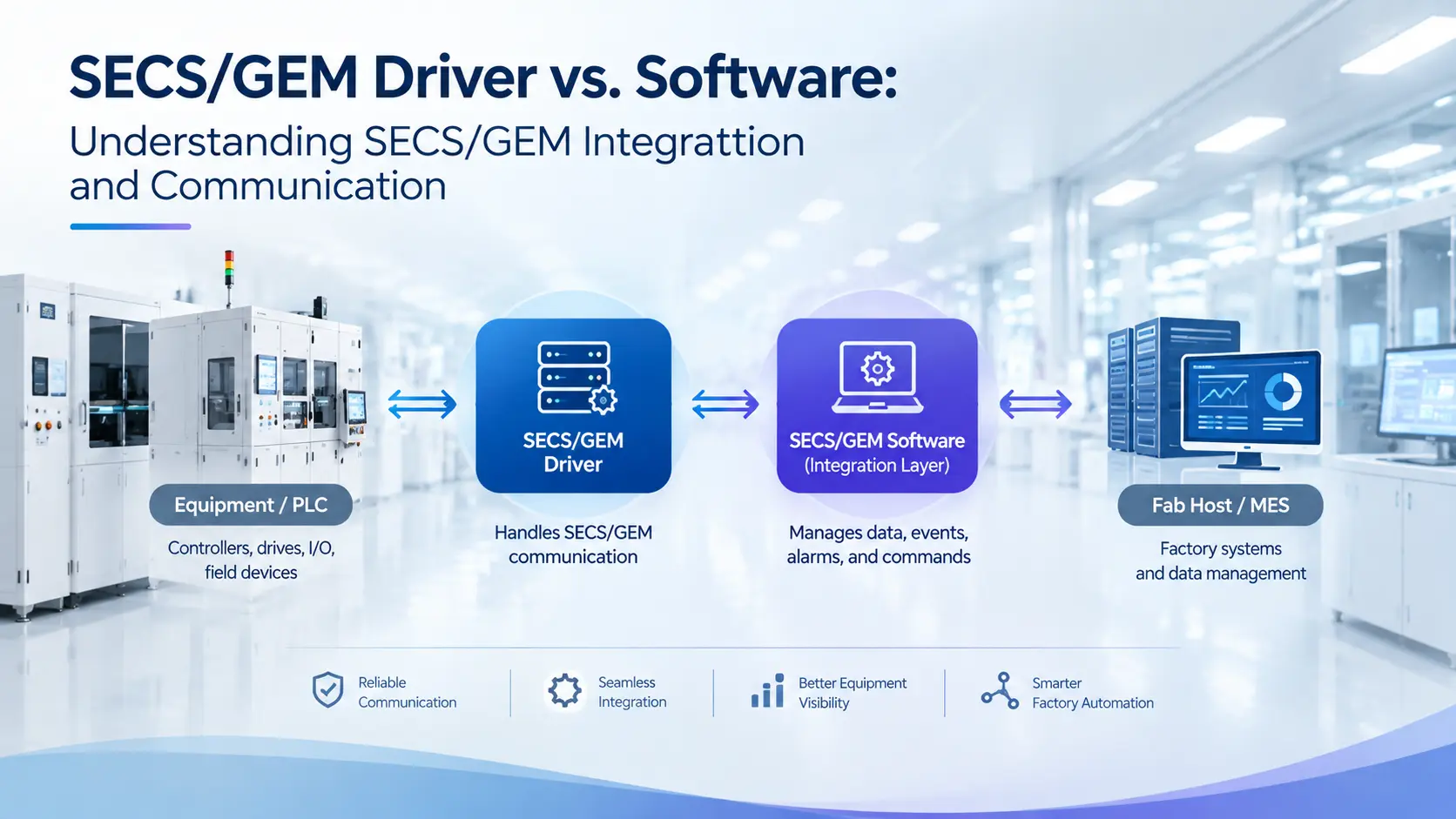
In most usage, a SECS/GEM driver is the communication component — the part that moves messages between the equipment and the fab host and keeps that link healthy.
Typically it handles:
- Transport and connection management. HSMS over TCP/IP (SEMI E37) or SECS-I over serial (SEMI E4), including connection establishment, select/deselect, linktest, and the timeout behavior (T3, T5, T6, T7, T8) that fabs test against.
- SECS-II message handling. Encoding and decoding streams and functions per SEMI E5, including list structures and data item types such as ASCII, binary, unsigned integers, and floats.
- Transaction logic. Matching primary and secondary messages, honoring the W-bit, managing system bytes, and reporting communication failures rather than silently dropping them.
- Communication and control state. Maintaining the GEM (SEMI E30) communication state and, where implemented, the online/offline and local/remote control states.
- An interface to the equipment application. An API, callback set, or message queue the equipment software uses to send and receive.
A driver is deliberately narrow. It gives the equipment a reliable pipe and a correct message format; it generally does not decide what to report, when to report it, or how the equipment model should be structured. How much of GEM a given driver implements varies significantly by vendor, so this is worth confirming rather than assuming.
What Is SECS/GEM Software?
SECS/GEM software usually refers to a broader implementation that sits above the messaging layer and delivers a working, configurable equipment interface.
Depending on the product, that can include:
- SECS-II and GEM communication (often using an internal driver component)
- An equipment model: status variables, data variables, equipment constants, collection events, alarms, and report definitions
- Dynamic report configuration and event linking (S2F33, S2F35, S2F37)
- Alarm enable/disable and alarm reporting behavior
- Remote command handling (S2F41) and supported command definitions
- Trace and status data collection
- Equipment state and processing state representation
- Logging, message tracing, and diagnostics for commissioning and field support
- Configuration tools so variables and events can be adjusted without recompiling
- APIs or integration interfaces to the equipment control application, PLC, or database
No single package contains all of this, and not every fab requires all of it. The useful distinction is scope: driver-level products focus on messaging; software-level products focus on the complete equipment interface, including the data model and the tooling around it.
SECS/GEM Driver vs. Software: Key Differences
| Aspect | SECS/GEM Driver | SECS/GEM Software |
|---|---|---|
| Primary Role | Handles SECS/GEM communication | Provides broader equipment integration functionality |
| Main Function | Sends, receives, and processes SECS/GEM messages | Manages communication, data, events, alarms, and commands |
| Scope | Communication-focused | End-to-end integration-focused |
| Configuration | Typically basic communication settings | May include equipment models, variables, events, alarms, and commands |
| Data Handling | Handles message and data exchange | Supports data collection, monitoring, logging, and integration |
| Customization | Often requires development or configuration | May provide configurable and ready-to-use features |
| Typical Use | Adding SECS/GEM communication to an existing application | Building or managing a complete SECS/GEM integration environment |
| Best Suited For | OEMs needing a communication component | OEMs requiring a broader SECS/GEM solution |
How a SECS/GEM Driver Fits Into the Equipment Architecture
A common arrangement looks like this:
Equipment control system / PLC → SECS/GEM driver or integration layer → SECS/GEM (HSMS or SECS-I) → fab host / MES
The control system owns the process: recipes, motion, sensors, interlocks, sequencing. The integration layer subscribes to or polls the values the host needs, maps them to GEM identifiers, detects the conditions that trigger collection events and alarms, and converts host requests into actions the control system understands.
Real architectures vary. Some equipment exposes data through an OPC UA server or a PLC tag database; some through a shared memory interface, a local API, or a database. The physical topology matters too — the interface may run on the equipment PC or on a separate industrial computer alongside it. The right design depends on the controller, the existing software architecture, and what the fab requires.
What Does SECS/GEM Software Typically Handle?
- Equipment Variables
Status variables (SVs) expose values such as control state, processing state, recipe name, or port status. Data variables (DVs) carry values meaningful at the moment of an event — a completed substrate ID, a measured result, a cycle time. Equipment constants (ECs) hold configurable settings the host may read or change. - Collection Events
Events mark something the host cares about: process start and end, material arrival, recipe change, state transition. Each event can be linked to reports containing the relevant variables, and hosts typically configure those links dynamically and receive them via S6F11. - Alarms
Alarms report abnormal conditions with an identifier, text, and set/clear notification. The engineering work is defining which conditions genuinely warrant a host alarm, distinguishing them from warnings, and keeping alarm behavior consistent with the equipment’s own HMI. - Remote Commands
Hosts may issue supported commands such as start, stop, or pause, with defined parameters and acknowledgment codes. What matters is that the equipment only accepts commands that are safe and valid in its current state, and returns meaningful rejection codes otherwise. - Equipment States
GEM defines communication and control state models; processing states are equipment-specific, and many fabs also expect SEMI E10 based reporting for utilization tracking. These models need to reflect what the machine is actually doing. - Data Collection
Beyond event reports, software may support trace collection at fixed intervals, limits monitoring, and spooling so messages generated while the link is down can be delivered when it recovers.
When Does an Equipment OEM Need a SECS/GEM Driver?
A driver-level component usually fits when:
- The equipment already has a mature control application, and only host communication is missing.
- The OEM wants to keep full ownership of the equipment model and application logic.
- The development team is building its own GEM behavior and needs a reliable messaging foundation.
- The required interface is modest — a defined set of events, variables, and alarms.
- The equipment software must remain a single integrated application for support reasons.
This path gives maximum control. It also means the OEM owns the GEM behavior, the state models, and the compliance testing.
When Is a Complete SECS/GEM Software Solution More Appropriate?
A broader solution tends to fit when:
- The equipment must satisfy varied host requirements across multiple customers or regions.
- The data model is large, or expected to change after installation.
- Events, alarms, remote commands, and diagnostics are all in scope.
- Configuration needs to be adjustable by field engineers rather than developers.
- GEM300 capabilities such as carrier management or substrate tracking are required for 300 mm fabs.
- The OEM’s software team is small, or already committed elsewhere.
Neither approach is inherently better. The decision follows the equipment architecture, the host requirements, and how much of the interface the OEM wants to build and maintain.
SECS/GEM Driver, SDK, and Software: How Are They Related?
- Driver — the communication-focused component handling SECS-II/GEM messaging and connectivity.
- SDK — a development toolkit with libraries, APIs, and documentation so developers can build SECS/GEM functionality into their own equipment application.
- Software — a broader, more ready-to-use implementation combining communication with configuration, an equipment model, monitoring, and integration functions.
These are working descriptions, not industry definitions. Some vendors call an SDK a driver; some call a complete product a driver. Evaluate the capability list, not the label.
Common SECS/GEM Integration Challenges
Most difficulty in a SECS/GEM project is not protocol coding. It shows up as:
- Defining the variable list and agreeing what each value means
- Mapping equipment conditions to collection events and alarms without over- or under-reporting
- Implementing remote commands safely against the equipment state model
- Reconciling differing host requirements between fabs and regions
- Building processing state models that match real machine behavior
- Message validation and error handling, including malformed or unexpected messages
- Communication recovery, timeouts, and spooling behavior
- Testing against host simulators before on-site integration
- Meeting SEMI E5, E30, E37, and GEM300 requirements where applicable
- Adding the interface without destabilizing existing equipment control software
Planning the data model early, and testing with a host simulator before shipment, removes most of the surprises.
How eInnoSys Supports SECS/GEM Equipment Integration
eInnoSys works with equipment OEMs on both sides of this decision.
EIGEMEquipment provides SECS/GEM SDK and implementation services for teams building the interface into their own equipment application — useful when the OEM wants to keep the equipment model and control logic in-house but needs a proven SECS/GEM foundation and engineering support.
EIGEMBox supports plug-n-play SECS/GEM integration for equipment that needs host connectivity without redesigning its existing control architecture — typically where an established tool must meet a fab’s communication requirement with minimal change to the machine software.
Our teams also work on GEM300 equipment integration and broader SECS/GEM and GEM300 for semiconductor equipment, including defining the equipment model, mapping events and alarms, and validating the interface with SECS/GEM host simulation before it reaches the fab floor.


